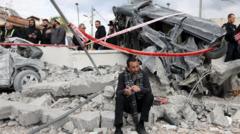
The sirens across Tel Aviv no longer trigger panic so much as a weary, synchronized industrial response. On February 28, 2026, as the first waves of Operation Roaring Lion—a massive joint U.S.-Israeli offensive—struck Tehran, the Israeli public did not retreat in shock. They moved with the practiced efficiency of a society that has spent the last 30 months in a state of rolling mobilization. This is the second direct war with Iran in less than a year, following the 12-day escalation in June 2025, and the psychological shift is total. The "war between wars" era is dead. In its place is a grim, popular acceptance of perpetual, high-intensity conflict as the only viable architecture for survival.
Public support for the current strikes, which successfully targeted Supreme Leader Ali Khamenei and dozens of top IRGC commanders, remains startlingly high. A snap poll following the opening sorties showed that despite the immediate retaliatory barrage of Iranian ballistic missiles hitting central Israel, nearly 75% of the population backs the offensive. This is not the jingoism of a fresh conflict. It is the calculated, almost transactional resolve of a populace that has decided that "finishing the job" is cheaper than another decade of proxy attrition.
The Exhaustion Threshold
The Israeli economy is currently bleeding roughly $3 billion a week. Since the 2023 Hamas invasion and the subsequent 2024 campaign against Hezbollah, the national treasury has been hollowed out. The 2025 June war added tens of billions to the deficit, yet the Finance Ministry’s warnings about the "unprecedented" cost of Roaring Lion have largely fallen on deaf ears.
The average Israeli citizen has developed a paradoxical relationship with economic ruin. While small businesses in the north and south have been shuttered for years, and the tech sector—once the untouchable engine of the nation—struggles with a persistent brain drain of reservists, the collective consensus has drifted toward a "security at any cost" model. The logic is brutal: why worry about a 2027 recession if the threat of a nuclear-armed Iran makes 2027 a theoretical concept?
The Death of the Peace Narrative
Investigating the corridors of the Knesset reveals a political landscape where the "peace camp" has been effectively erased, not by force, but by a total loss of credibility. Opposition leaders like Yair Lapid and Yair Golan have not just supported the Netanyahu-Trump offensive; they have criticized it only for not happening sooner.
This is a radical departure from the Israel of the 1990s or even the early 2010s. The belief that Iranian regional hegemony could be managed through "strategic patience" or back-channel Omani diplomacy died when the IAEA confirmed in late February that Tehran had successfully hidden highly enriched uranium in an underground facility that survived the 2025 strikes. For the Israeli voter, the failure of the 2025 "victory" to prevent the 2026 war was the final nail in the coffin of containment.
The Technological Crutch
At the heart of this resilience is the defense industry. Israel has become the world’s most advanced laboratory for AI-driven interceptors and autonomous strike systems. During the 12-day war in June 2025, the world watched as "smart" defense layers maintained a civilian casualty rate that, while tragic, was statistically miraculous given the tonnage of explosives fired from Iran.
However, this reliance on tech has created a dangerous feedback loop. The more effective the Iron Dome and its laser-based successors become, the more the public feels insulated from the consequences of escalation. It fosters an environment where war feels like a software update—disruptive, expensive, but ultimately manageable. This "high-tech shield" allows the government to bypass traditional diplomacy, as the domestic political cost of military action remains artificially low.
The Regional Fracture
While Israel and the U.S. focus on regime change from the air, the ground reality in the Middle East is fragmenting. The "Axis of Resistance" is weakened, with Hezbollah’s leadership decimated and Hamas reduced to an insurgency, yet the vacuum is not being filled by moderate forces. Instead, we are seeing the rise of "active deterrence" doctrines across the board.
Jordan, Egypt, and the Gulf states are caught in a geoeconomic vice. The closure of the Strait of Hormuz has already triggered a $3.2 trillion loss in global equity value. While Israeli citizens sit in bunkers watching the "successes" of their Air Force on Telegram, the surrounding region is looking at a future defined by supply chain collapse and inflationary war finance.
The question no longer being asked in Tel Aviv is "when will it end?" but rather "can we stay ahead of the next escalation?" The 2026 war has proven that "historic victories" are temporary. Security is no longer a destination; it is a permanent, exhausting process of military maintenance.
Israelis are standing firm, but they are doing so in the shadow of a mounting psychological emergency. With 45% of the population reporting significant concern for personal safety and a generation of children who play "siren" as a playground game, the social fabric is being rewritten. The nation is winning the battles, but it is becoming a Spartan society by default. The sword is no longer just a tool for defense; it has become the only home the country knows how to inhabit.