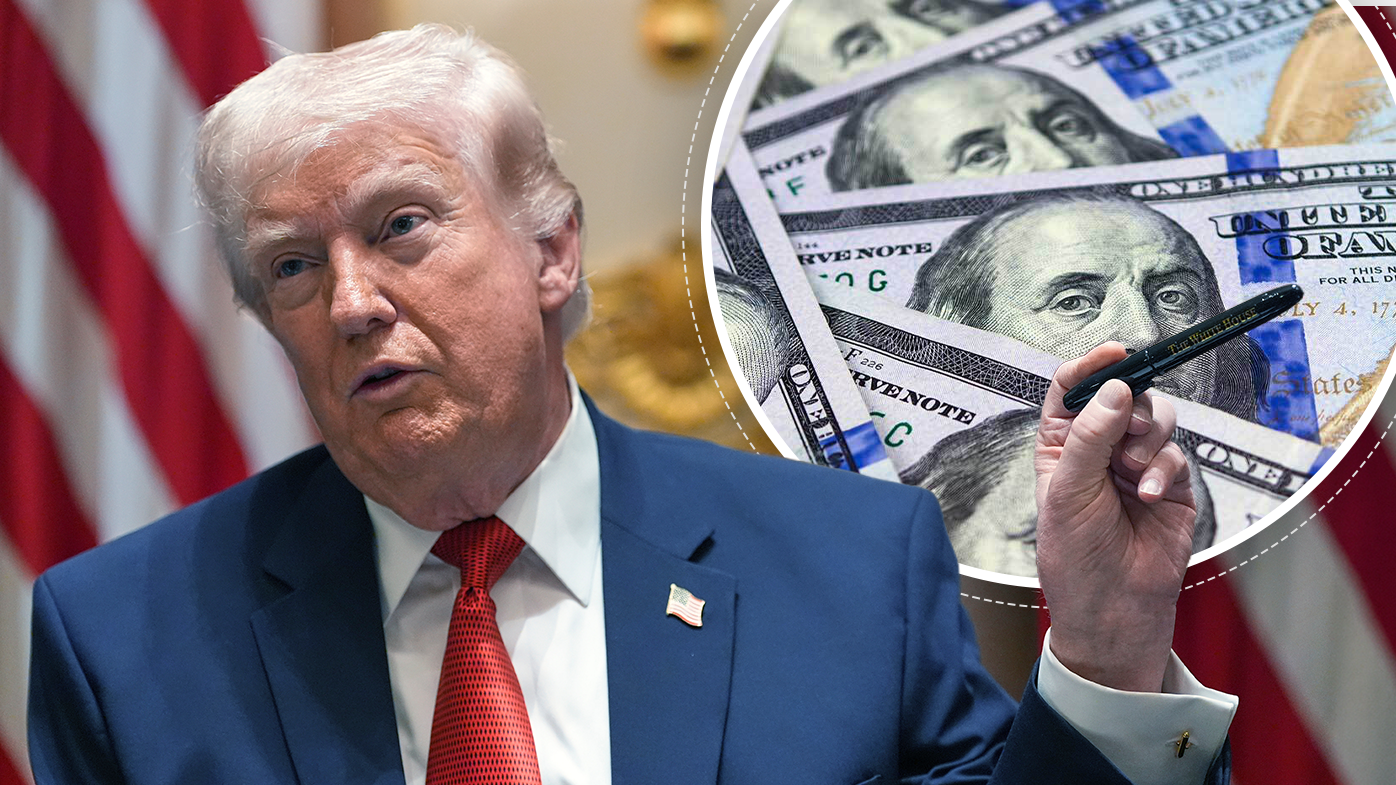
For the first time since the Civil War era, the physical representation of American soft power is undergoing a transformation that is less about economics and more about the cult of personality. The Department of the Treasury is preparing to circulate Federal Reserve notes bearing the signature of Donald Trump. While the move has been framed as a procedural evolution or a standard exercise of executive oversight, the historical weight of this shift cannot be overstated. Since 1861, when Salmon P. Chase first appeared on the one-dollar bill, the signatures on our currency have served as a silent guarantee of institutional stability. They represented the office, not the individual. That era of faceless bureaucracy is officially over.
The mechanics of this change are straightforward but the implications are tangled. Traditionally, the Secretary of the Treasury and the Treasurer of the United States sign the plates used for printing. However, through a specific series of executive directives, the 47th President has ensured his own script will adorn the bottom right corner of the bills. This isn't just a change in ink. It is a fundamental rebranding of the world’s reserve currency.
The Ghost of Salmon P Chase
To understand why this matters, we have to look at the precedent set during the American Civil War. Before 1861, the United States didn't really have a uniform federal paper currency. Individual banks issued their own notes, creating a chaotic "broken bank" era where a ten-dollar bill from a Georgia bank might be worthless in New York. The Legal Tender Act of 1862 changed everything. It created the "Greenback."
Salmon P. Chase, then Treasury Secretary, understood that for a new, unbacked paper currency to work, people had to trust the institution behind it. He put his own face on the $1 bill—not out of vanity, he claimed, but to make the federal presence felt in every household. Since then, the signatures on our money have acted as a "living" connection to the Treasury. By inserting a presidential signature directly onto the note, the current administration is bypassing the traditional separation between the fiscal managers of the nation and the political head of state.
Money as a Marketing Tool
Critics argue this is the ultimate manifestation of "sovereign branding." In the private sector, putting your name on a building or a plane is a sign of ownership. In the public sector, putting your name on the currency is an assertion of personal authority over the national ledger.
The Treasury Department has remained tight-lipped about the specific logistical costs of the change. Replacing printing plates is an expensive, precision-heavy process. Each plate is etched with microscopic detail to prevent counterfeiting. When a signature changes, the Bureau of Engraving and Printing (BEP) must create new master dies. This isn't a simple "find and replace" on a digital file. It involves master engravers, high-security facilities in Washington D.C. and Fort Worth, and a rigorous testing phase to ensure the new ink density doesn't interfere with the magnetic scanning used by vending machines and banks.
The Technical Hurdle of the Script
There is also the matter of the signature itself. Bureaucratic signatures are often illegible scrawls—think of Jack Lew’s famous "O" loops that President Obama jokingly asked him to fix before his name went on the money. The Trump signature is different. It is highly stylized, angular, and vertical.
From a security standpoint, a highly consistent and complex signature is actually harder to forge than a simple one. The BEP uses "intaglio" printing, where the ink is pulled from recessed grooves under massive pressure. This creates a tactile ridge. When you run your fingernail over a genuine bill, you feel the "vibration" of the ink. The sharp peaks and valleys of the new signature will provide a unique tactile profile that counterfeiters will find difficult to replicate with standard inkjet or laser printers.
Breaking the Institutional Wall
For decades, the Treasury and the Federal Reserve have operated with a degree of perceived independence. The Fed controls the money supply; the Treasury handles the bills. By placing the President’s signature on the currency, that wall of separation becomes visually blurred. It sends a message to international markets: the US dollar is no longer a product of an anonymous committee, but a reflection of the executive branch.
This carries a specific type of risk. The dollar’s status as a global reserve currency depends on the belief that it is insulated from the whims of any single politician. If global investors begin to view the currency as a political instrument, the "exorbitant privilege" of the dollar could face its first real test.
The Global Reaction
Central banks in Beijing, Brussels, and Tokyo are watching this more closely than the American public. To a domestic supporter, the signature is a badge of a new era. To a foreign currency trader, it is a signal of "fiscal personalization."
Historically, when leaders in volatile economies put their portraits or names on currency, it often preceded periods of hyperinflation or radical policy shifts. While the US is nowhere near a Weimar Republic scenario, the optics matter. The dollar relies on the "full faith and credit" of the United States. Usually, that faith is placed in the Constitution and the laws of the land. Now, that faith is being explicitly tied to an individual.
The Replacement Cycle
It is important to understand that your current wallet isn't going to become obsolete overnight. The BEP does not recall old money when a new design is issued. Instead, they use a "natural attrition" model.
- Longevity of a $1 bill: Approximately 6.6 years.
- Longevity of a $20 bill: Approximately 7.8 years.
- Longevity of a $100 bill: Over 15 years.
As old, tattered bills are returned to the Federal Reserve by commercial banks, they are shredded. The new "Presidential" notes will then be fed into the system to replace them. This means we are entering a transition period where two versions of American reality will circulate simultaneously in the same cash registers.
Why This Isn't Just "Another Story"
Most news outlets are treating this as a quirky trivia fact. It is not. It is a shift in the semiotics of American power. Since the founding of the Republic, we have moved away from the "King’s Image" on our coins. George Washington famously refused to have his face on the first coins because he felt it was too monarchical. He preferred the personification of Liberty.
It took nearly a hundred years for presidents to start appearing on coins, and even then, it was usually posthumous. Putting a sitting president’s signature on the currency—even if technically allowed under broad interpretations of Treasury authority—breaks a long-standing taboo against the "deification" of the current occupant of the White House.
The Cost of Perception
Beyond the philosophical, there is the raw business of the dollar. The US Treasury must sell debt to fund the government. When people buy Treasury bonds, they are betting on the long-term stability of the American system. If the currency becomes a billboard for a specific administration, the "neutrality" of the dollar is compromised.
If you are a business owner or an investor, you need to look past the political theater and see the structural change. We are moving toward a "High-Visibility Executive" model of government. Every lever of the state, down to the $5 bill you use to buy a coffee, is being leveraged as a medium for a specific message.
The signature is the final seal on this new contract between the citizen and the state. It is no longer enough for the money to be "legal tender for all debts, public and private." Now, it must also carry a brand.
Would you like me to investigate the specific legislative loopholes that allowed this signature change to bypass standard Congressional oversight?