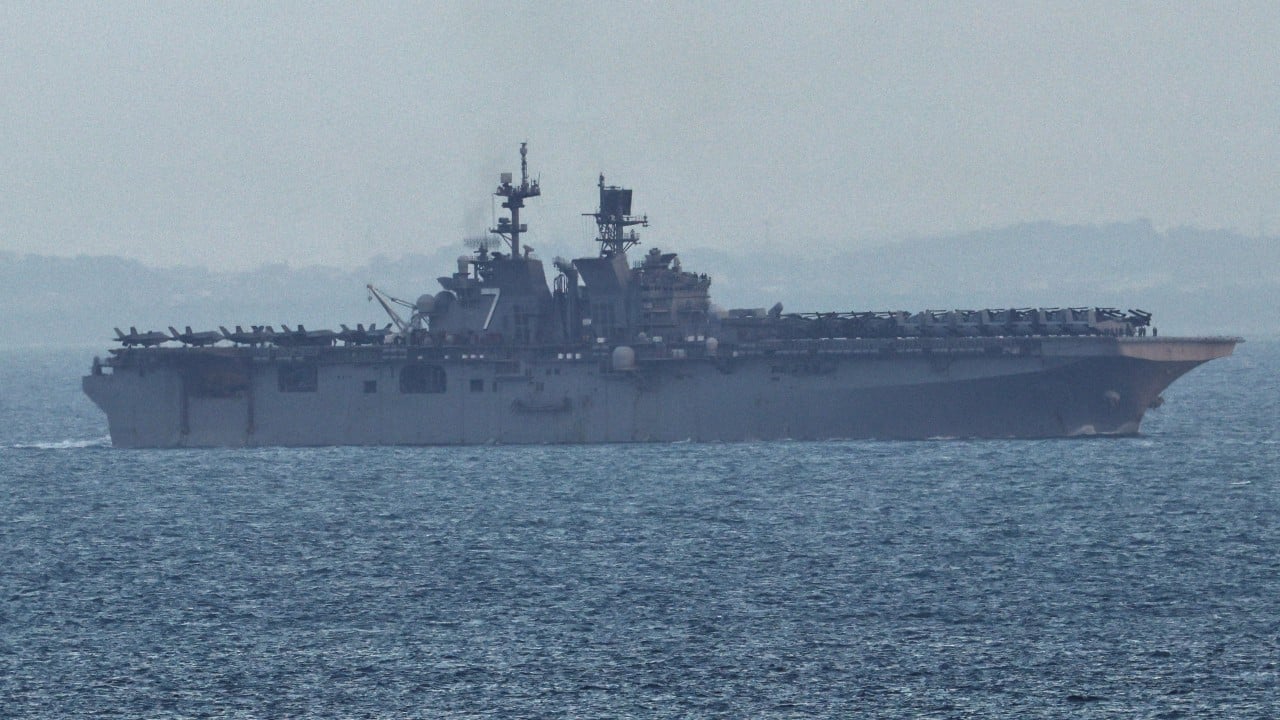
The arrival of the USS Tripoli in the Middle East isn't just another routine ship rotation. It’s a massive neon sign pointing toward a ground operation that Washington has spent weeks downplaying. While Secretary of State Marco Rubio tells the G7 that the U.S. can hit its goals from the air, the Pentagon is busy parking 3,500 Marines and a "big deck" amphibious assault ship right on Iran’s doorstep.
You don't send an America-class ship like the Tripoli—specifically designed to ditch heavy landing craft in favor of an overwhelming swarm of F-35B stealth jets and MV-22 Ospreys—just to sit in the Gulf and look pretty. It's a mobile, floating airbase optimized for "lightning carrier" operations and rapid-response raids. If you've been following the news, you know the rhetoric is shifting. We're moving from "surgical strikes" to "maximum optionality," which is military-speak for "we’re putting boots on the ground if Tehran doesn't blink."
The Tripoli and the 31st MEU Are Different
Most people think all Navy ships are basically the same. They aren't. The USS Tripoli (LHA 7) is part of a new breed. Unlike older amphibious ships, it doesn't have a well deck for landing craft. Instead, it has a massive hangar and expanded fuel capacity for aircraft.
By bringing the 31st Marine Expeditionary Unit (MEU) from Japan to the Middle East, the U.S. is positioning a force that is arguably the most "combat-ready" unit in the entire Marine Corps. These guys were literally just doing drills near Taiwan when they got the call. They aren't coming from a desk job; they’re coming from the front lines of the Pacific.
- 3,500 Personnel: A mix of elite Marines and specialized Navy sailors.
- Air Power: F-35B Lightning II stealth fighters and CH-53K King Stallion heavy-lift helicopters.
- Speed: These units are designed to seize a "lodgment"—a fancy word for a beachhead or an airfield—within hours.
Why a Ground Operation Is Suddenly on the Table
For the first month of Operation Epic Fury, the strategy was simple: bomb them back to the table. We’ve hit over 11,000 targets. We’ve taken out IRGC Navy Commander Rear Admiral Alireza Tangsiri. But Iran isn't stopping. Just look at the March 27 attack on Prince Sultan Air Base in Saudi Arabia. Ten U.S. troops were wounded, two of them seriously.
When your "air-only" campaign isn't stopping the missiles from hitting your own bases, you change the math. The Pentagon is reportedly looking at a "limited" ground campaign. This wouldn't be a 2003-style march on the capital. Think more along the lines of seizing Kharg Island—Iran's main oil hub—or Larak Island to physically pry open the Strait of Hormuz.
The logic is brutal but simple. If you control the oil export terminals and the islands choking the shipping lanes, you don't need to negotiate. You've already won the economic war.
What Most People Get Wrong About the Build-up
I've seen the "illegal war" headlines and the "regime change" theories. While those make for great clicks, the reality on the ground—or at sea—is more about logistics than ideology. The USS Gerald R. Ford had to limp back to Europe for repairs after a laundry room fire. That left a gap in our regional air cover.
The Tripoli fills that gap, but with a twist. It brings the infantry that a carrier doesn't have. This isn't just about replacing lost planes; it's about adding a capability that hasn't been in the theater since the war started on February 28.
The Risks of a Ground Move
Let’s be honest: any ground move is a gamble. Tehran’s "Welcome to Hell" headline in the Tehran Times isn't just bluster. Iran has spent decades preparing for an asymmetric war.
- Improvised Explosives: The same tech that plagued troops in Iraq, but refined.
- Swarm Drones: We've seen them hit Kuwait International Airport and the Port of Salalah. Imagine those targeting a Marine landing.
- The "Coffin" Factor: Even a successful raid on an oil terminal will result in casualties. In an election year—or any year under Trump—the tolerance for American body bags is zero.
Reality Check on the "Weeks Not Months" Timeline
Rubio says this will wrap up in weeks. I don't buy it. You don't order the USS Boxer and the 11th MEU to rush out of San Diego—cutting their leave short—if you expect the war to end by Friday.
Right now, we have about 50,000 troops in the region. There are reports of another 10,000 on the way. You don't build a 60,000-person force for a "matter of weeks." You build it because you’re preparing for the worst-case scenario: a prolonged campaign to secure the world's energy supply.
If you’re watching the markets or the news, keep your eyes on the amphibious groups. Carriers are the hammer, but the Tripoli and its Marines are the scalpel. If they move toward the coast, the "talk" of a ground operation is over—the operation has begun.
Check the flight decks. If you see the Ospreys warming up and the Marines in full combat gear on the flight deck, it's time to pay attention. The next phase won't be fought from 30,000 feet. It'll be fought in the trenches and on the docks of the Persian Gulf.