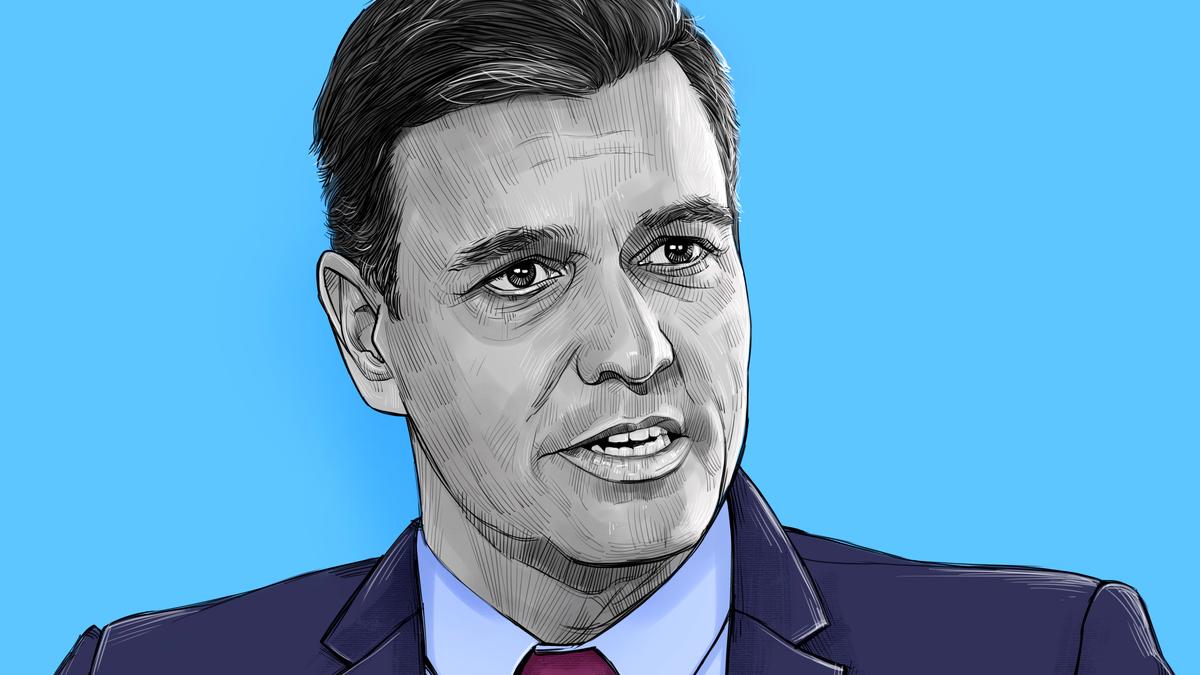
Spain’s foreign policy under Pedro Sanchez has deviated from the traditional Mediterranean consensus, positioning Madrid as a friction point within the European Union’s unified security architecture. While characterized by some as a "pacifist" stance, the data suggests a more calculated maneuver: the pursuit of middle-power autonomy through the exploitation of institutional gridlock in Brussels. This strategy is not merely an ethical choice but a response to specific domestic political dependencies and a bet on a multi-polar shift in global influence.
The Three Pillars of Spanish Diplomatic Divergence
The "anti-war" label frequently applied to Sanchez oversimplifies a complex three-part strategic framework. Each pillar serves a distinct function in maintaining the current Spanish administration's domestic coalition while attempting to elevate its profile on the world stage.
- Normative Revisionism: Madrid has increasingly challenged the "pro-Atlanticist" default of the EU. By framing conflicts—specifically those in Eastern Europe and the Middle East—through the lens of international law rather than military alliance obligations, Sanchez creates a legalistic shield for non-intervention or delayed cooperation.
- Asymmetric Multilateralism: Spain is leveraging its historical ties to the Global South (specifically Latin America and North Africa) to act as a bridge. This is a play for "soft power" equity that can be traded for economic concessions within the EU.
- Domestic Coalition Stabilization: The current Spanish government relies on a fragile parliamentary alliance with left-wing and regionalist parties. A hardline military stance would trigger a budget crisis or a vote of no confidence. Therefore, the "anti-war" posture is an essential mechanism for internal survival.
The Cost Function of Moral Grandstanding
Every diplomatic pivot carries a measurable cost in terms of "Alliance Credit." In the context of NATO and the EU, Spain’s refusal to align with the hawkish core (Poland, the Baltic States, and Germany’s Zeitenwende) creates a specific set of liabilities.
The primary bottleneck is Influence Dilution. When a member state consistently breaks rank on high-stakes security votes, its ability to negotiate on non-security matters—such as fiscal rules or energy subsidies—is diminished. We see this in the friction between Madrid and the "Frugal Four" nations. The second limitation is Intelligence Isolation. Security alliances operate on a currency of trust; states perceived as "wildcards" often find themselves excluded from the highest tiers of information sharing, particularly regarding sensitive regional threats.
Resource Allocation and the Defense Spending Paradox
While Sanchez maintains an anti-war rhetorical front, the fiscal reality is more nuanced. Spain has committed to increasing defense spending to 2% of GDP by 2029. This creates a logical contradiction between the "pacifist" brand and the "loyal ally" requirement.
- The Investment Gap: Spain’s current defense expenditure remains among the lowest in NATO relative to GDP.
- The Industry Hedge: Much of the proposed spending is directed toward domestic defense contractors (Navantia, Indra). This suggests that the "anti-war" stance is partially a smoke-screen for a protectionist industrial policy. The government is not necessarily against military hardware; it is against military hardware that it does not build or control.
The friction arises when this domestic industrial focus meets the urgent operational needs of the European Defense Technological and Industrial Base (EDTIB). By prioritizing local jobs over immediate allied readiness, Spain risks becoming a logistical bottleneck in the event of a pan-European mobilization.
Strategic Divergence in the Mediterranean and North Africa
The most significant risk to the Sanchez Doctrine is the volatility of the Maghreb. Spain's pivot on Western Sahara to appease Morocco—a move that contradicted decades of Spanish policy—demonstrates that the "anti-war" label is selective.
This move was a calculated exchange: Madrid traded a long-standing normative position (support for Sahrawi self-determination) for immediate stability in migration management and counter-terrorism cooperation. This reveals a cold-blooded realism lurking beneath the idealistic surface. The "anti-war" Prime Minister is perfectly willing to engage in high-stakes geopolitical horse-trading when the variables involve direct border security.
The Mechanistic Failure of the "Middle Power" Bet
The fundamental hypothesis of the Sanchez administration is that Spain can become the leader of a "Third Way" within Europe—a bloc that balances between US interests and a more autonomous, perhaps more China-friendly, European path.
However, this bet faces three structural obstacles:
- The Gravity of the Franco-German Axis: No amount of Mediterranean alignment can offset the combined economic weight of Paris and Berlin. When the core moves, the periphery eventually follows or suffers capital flight.
- Energy Dependency: Spain’s push for "Green Hydrogen" and its role as an LNG hub require massive EU subsidies. These funds are politically linked to security solidarity.
- The Mediterranean Split: Italy’s shift toward a more traditional, hard-power Atlanticist stance under Meloni has left Spain isolated in its regional "pacifist" niche.
Analytical Projection of the 2027 Pivot
As we move toward the next EU budget cycle, the sustainability of the Sanchez Doctrine will reach a breaking point. The transition from "Rhetorical Divergence" to "Operational Alignment" is inevitable for three reasons.
First, the exhaustion of the "Strategic Autonomy" narrative. Without a unified European army, which Spain is not actively funding, "autonomy" is just a euphemism for "unprotected." Second, the rising cost of debt. Spain’s high debt-to-GDP ratio makes it vulnerable to European Central Bank (ECB) policy shifts. If Germany conditions its support for fiscal leniency on security cooperation, Madrid will have no choice but to fold. Third, the internal erosion of the governing coalition. As the junior partners lose popularity, Sanchez will likely shift toward the center-right on security to capture moderate voters, effectively ending the "anti-war" experiment.
The strategic recommendation for observers and stakeholders is to discount the rhetoric of "peace" and monitor the following three indicators:
- Contract Awards to Indra and Navantia: This will signal the true scale of Spain’s rearmament, regardless of the public narrative.
- Voting Patterns in the European Council on Sanctions: Any softening here indicates a continued bet on multi-polarity.
- The Gas Pipeline Infrastructure (MidCat/BarMar): If Spain accelerates these links to France, it is a sign they are trading energy security for a seat back at the "Hawkish" table.
The era of the "anti-war" Prime Minister is a temporary phenomenon, a product of a specific domestic parliamentary geometry rather than a permanent shift in Spanish strategic culture. Expect a quiet, bureaucratic return to the Atlanticist mean as the fiscal costs of isolation begin to outweigh the domestic political benefits of dissent.
Would you like me to analyze the specific economic impact of Spain's recent trade agreements with Morocco under this framework?