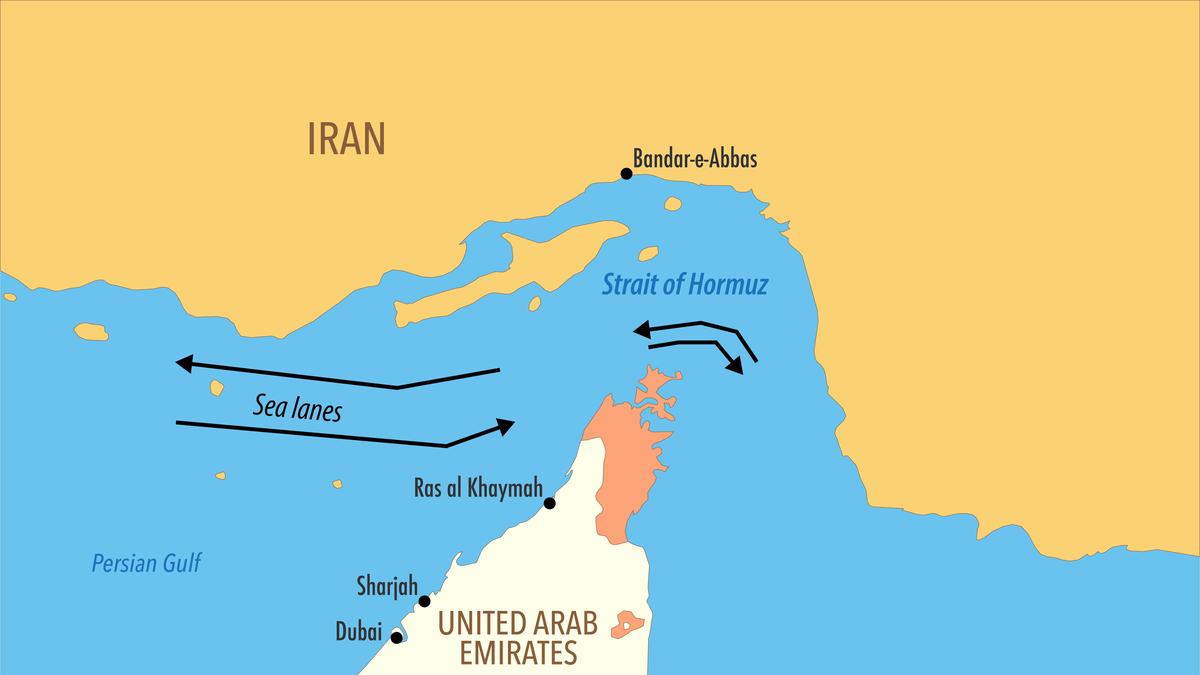
The security of the Strait of Hormuz is not a binary state of open or closed, but a graduated scale of sovereign permission and kinetic risk. Tehran’s recent decision to grant specific passage rights to India, alongside four other nations, represents a calculated de-risking of its primary economic leverage. This is not a gesture of diplomatic goodwill; it is a structural adjustment to the regional maritime trade equilibrium. By exempting specific flag states from the threat of seizure or disruption, Iran creates a tiered maritime environment that forces global shipping to choose between the high-cost "unprotected" pool and the lower-risk "exempted" pool.
The Strait of Hormuz remains the world’s most significant chokepoint, with daily oil flow averaging over 20 million barrels per day. Any disruption here does not just impact spot prices; it threatens the physical solvency of refining operations globally. For India, which relies on the Middle East for over 60% of its crude requirements, this exemption is a critical insulation layer against the volatility of the Persian Gulf.
The Triad of Iranian Strategic Objectives
Iran’s decision to formalize safe passage for a select group of nations functions through three distinct strategic layers:
- Economic Circumvention via Selective Enforcement: By allowing Indian-flagged vessels or vessels carrying Indian cargo to pass unhindered, Tehran ensures that its own energy exports—often rebranded or transferred via third-party ship-to-ship (STS) maneuvers—maintain a viable path to one of the world’s largest energy consumers. This creates a "gray zone" of trade that remains liquid even during periods of heightened sanctions enforcement.
- Geopolitical Wedge Mechanics: Granting exemptions to India, while maintaining a stance of "controlled volatility" toward Western-aligned shipping, creates a divergence in the security interests of the Quad (India, US, Japan, Australia). If India’s energy security is decoupled from that of the United States or the United Kingdom, New Delhi has less incentive to participate in US-led maritime security constructs like Operation Prosperity Guardian or the International Maritime Security Construct (IMSC).
- The Insurance Risk Premium Arbitrage: Maritime insurance is the silent arbiter of global trade. When a region is designated a "High Risk Area" (HRA) by the Joint War Committee (JWC), P&I clubs and underwriters spike premiums. By providing a credible guarantee of non-interference, Iran effectively lowers the "shadow cost" of shipping to the exempted nations, making their trade routes more competitive than those of their neighbors.
The Logistics of the International North-South Transport Corridor (INSTC)
The India-Iran relationship is anchored by the Chabahar Port, which serves as the maritime gateway for the INSTC. This multi-modal network connects India to Central Asia and Russia, bypassing Pakistan. The strategic exemption in the Strait of Hormuz is the prerequisite for the INSTC to function at scale.
- Connectivity Integrity: The viability of the Shahid Beheshti terminal at Chabahar depends on the perception of the Gulf of Oman and the Strait of Hormuz as stable corridors. If shipping lines fear seizure, the capital expenditure required to scale the INSTC becomes unrecoverable.
- Sovereign Guarantee as Infrastructure: In this context, the Iranian "passage grant" should be viewed as a piece of invisible infrastructure. It reduces the lead time for cargo by eliminating the need for circuitous routing or expensive naval escorts.
Quantifying the Maritime Risk Calculus
To understand why this exemption is a masterstroke of regional positioning, one must look at the cost function of a standard Very Large Crude Carrier (VLCC).
The daily hire rate for a VLCC fluctuates based on demand, but the "War Risk" surcharge is the variable that fluctuates based on geopolitical signaling. In 2019, following attacks on tankers in the Gulf of Oman, these surcharges spiked to over $200,000 per voyage. For India, an exemption theoretically eliminates this surcharge for state-owned tankers and vessels operating under its flag. This creates a direct budgetary saving for the Indian Ministry of Petroleum and Natural Gas, which is then passed down to the domestic economy as lower input costs.
However, the mechanism of "safe passage" is inherently fragile. It relies on the ability of the Iranian Revolutionary Guard Corps Navy (IRGCN) to distinguish between exempted and non-exempted vessels in real-time. This creates a technical requirement for:
- AIS (Automatic Identification System) Transparency: Exempted vessels must maintain high signal integrity to avoid "misidentification."
- Pre-Clearance Protocols: A de-facto manifest-sharing system where cargo origins and destinations are verified before the vessel enters the narrowest point of the Strait (21 miles wide).
The Friction of Dual Sovereignty
The primary limitation of this arrangement is the conflict between Iranian domestic law and international maritime law under the United Nations Convention on the Law of the Sea (UNCLOS). While UNCLOS provides for "transit passage" through international straits, Iran has historically argued for "innocent passage," which allows a coastal state to suspend transit if it deems the vessel prejudicial to its peace or security.
By "granting" passage, Iran is asserting a right to deny it to others—a position that the United States and most European powers reject. India’s acceptance of this exemption puts it in a complex legal position: it benefits from the specific Iranian interpretation while officially supporting the freedom of navigation as defined by UNCLOS. This creates a strategic dependency where India’s energy security is contingent on maintaining a specific diplomatic temperature with Tehran, regardless of broader international sanctions.
The Fragility of Selective Exemptions
No maritime exemption is absolute. The effectiveness of the Iran-India passage agreement faces three primary failure points:
- The Shadow Fleet Overlap: Much of the oil moving through the Strait involves the "shadow fleet"—vessels with opaque ownership and aging hulls. If an Indian-bound vessel is caught in a wider enforcement action by Western navies, Iran may retaliate by seizing any vessel in the Strait, regardless of its "exempted" status, to regain leverage.
- Kinetic Miscalculation: The IRGCN operates with a high degree of decentralized command. A low-level commander may not distinguish between an Indian-flagged vessel and a vessel owned by a Western entity but manned by Indian seafarers (who represent a massive portion of the global maritime workforce).
- Sanctions Escalation: If the US Treasury Department moves to sanction the specific entities facilitating this "safe passage" (such as port authorities or state-owned shipping lines), the economic benefit of the exemption is neutralized by the inability to transact in US Dollars.
Strategic Realignment of the Middle East Energy Flow
The inclusion of India in this "safe passage" group signals a broader shift in the energy map. We are witnessing the solidification of an "Eastern Energy Bloc" where the primary producers (Iran, Russia, Saudi Arabia) and the primary consumers (India, China) create bilateral security arrangements that bypass traditional global norms.
The Strait of Hormuz is no longer a public good protected by a global hegemon; it is being privatized into a series of bilateral corridors. For India, the move is a pragmatic necessity. For Iran, it is a tool of economic survival and a way to ensure that its most powerful neighbors have a vested interest in the stability of the Iranian regime.
The strategic play for New Delhi now involves formalizing these maritime guarantees into a multi-lateral maritime code with Tehran, while simultaneously expanding its own naval presence in the North Arabian Sea to provide an independent layer of "hard" protection. The exemption is a bridge, not a destination. India must use this window of lower risk to accelerate the diversification of its energy sources and the hardening of its own strategic petroleum reserves, as the current Iranian guarantee is a political asset that can be revoked with the same speed it was granted.