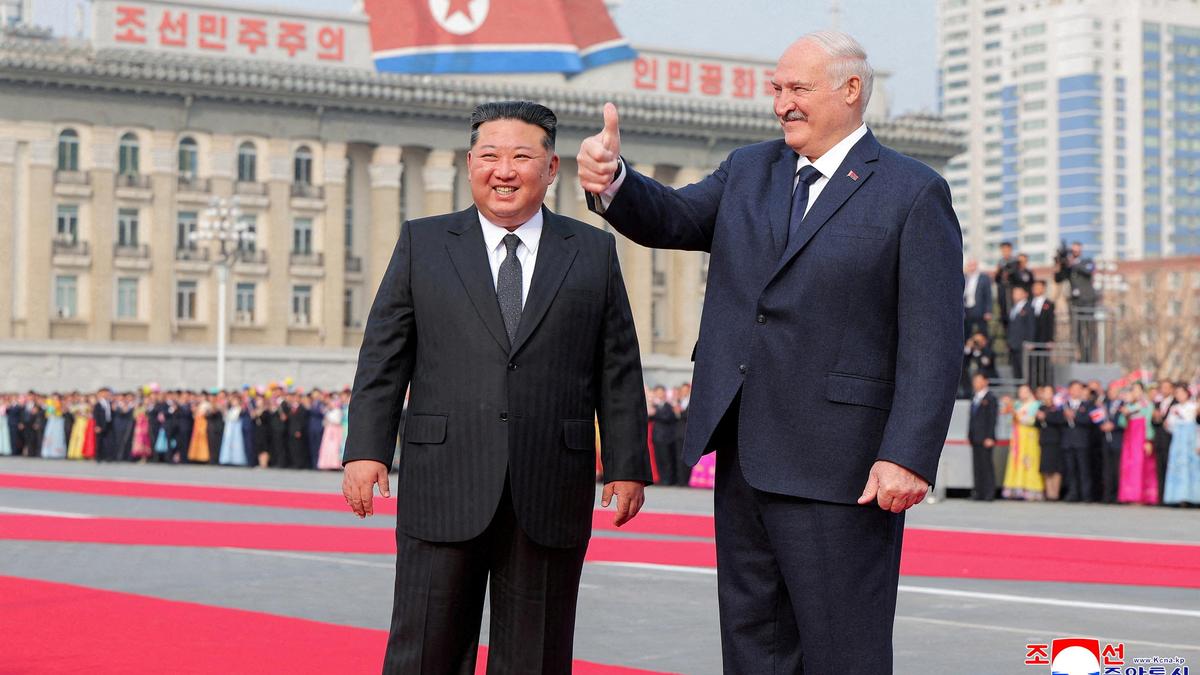
The tarmac at Sunan International Airport is a slab of concrete that feels like the end of the world. It is too wide, too silent, and polished to a mirror sheen that reflects the gray, heavy sky of Pyongyang. When Alexander Lukashenko stepped off his plane, the air didn't just carry the scent of jet fuel. It carried the weight of two men who have run out of neighbors to call friends.
The Belarusian leader, often dubbed the "last dictator in Europe," didn't come for the weather. He came for a treaty. On paper, it is a "friendship and cooperation agreement." In reality, it is a survival pact signed in a room where the clocks seem to have stopped in 1952.
To understand why this matters, you have to look past the choreographed goose-stepping and the forced smiles of the welcoming committees. You have to look at the map. Belarus sits on the jagged edge of Eastern Europe, a buffer turned pariah. North Korea is an island of defiance in the Pacific. They are separated by six thousand miles of Russian taiga and Mongolian steppe, yet they have never been closer.
The Architecture of Isolation
Imagine a room with every door locked from the outside. That is the current geopolitical reality for Minsk and Pyongyang. When you are barred from the global banking systems, when your athletes can’t fly their flags, and when your exports are treated like contraband, you start looking for anyone else holding a key.
Lukashenko’s visit wasn't a casual diplomatic stop. It was a calculated performance of mutual necessity. North Korea needs food, fuel, and perhaps a back-channel for its labor force. Belarus needs a partner that doesn't care about sanctions, a friend who won't ask questions about human rights, and a laboratory for how to exist while the rest of the world tries to look away.
The treaty signed during this visit covers everything from agriculture to "security cooperation." That last phrase is the one that keeps analysts in Washington and Seoul awake. It’s a vague term that acts as a container for anything from shared cyber-warfare tactics to the exchange of missile technology. In a world where Russia is increasingly reliant on North Korean shells to fuel its front lines in Ukraine, Belarus acts as the third leg of a very shaky, very dangerous stool.
A Tale of Two Cities
Walk through Minsk and you see a city trying to maintain the facade of a modern European capital. There are clean streets, functional cafes, and a quiet, simmering tension. Walk through Pyongyang and you see a monument to a single family’s will, a place where the architecture is designed to make the individual feel like an ant.
Yet, during this visit, these two worlds bled into one another.
The "friendship" being touted isn't between the people. A baker in Brest has nothing in common with a coal miner in Chongjin. They don't speak the same language, they don't eat the same food, and they will likely never meet. The friendship is a transaction between two administrative machines. It is a handshake between two men who realize that if one falls, the other’s shadow grows significantly shorter.
Consider the hypothetical life of a Belarusian tractor. Under this new treaty, that machine might find its way to a North Korean collective farm. In exchange, North Korean workers—famed for their discipline and the fact that their wages are largely garnished by their own government—might find themselves on Belarusian construction sites. It is a barter system of human misery and heavy machinery.
The Invisible Stakes
Why should someone in London, New York, or Tokyo care about a piece of paper signed in a marble hall in Pyongyang?
Because the world is fracturing into two distinct operating systems. On one side, you have the messy, loud, and often hypocritical world of global trade and international law. On the other, you have the "Sanctioned Circuit." This is a growing network of nations that have decided to build their own economy, their own internet, and their own rules.
This treaty is a brick in that wall.
When Belarus and North Korea align, they create a corridor that bypasses every Western lever of influence. If you can’t stop the flow of money because the money is actually just crates of artillery shells or sacks of grain, your "leverage" evaporates. The stakes are the slow erosion of a global order that, for all its flaws, prevented these kinds of rogue synergies for decades.
The Ghost at the Table
There was a third party in that room, though his name wasn't on the treaty. Vladimir Putin’s presence was felt in every syllable of the joint statements. Belarus is essentially a Russian province in all but name, and North Korea has become the Kremlin's primary armory.
Lukashenko isn't just representing Belarus; he is acting as a scout. He is testing the waters for how far this anti-Western bloc can go. The treaty is a signal to the Kremlin that the "minor" players are ready to take center stage. It is a message that the isolation intended to cripple these regimes has instead forced them into a tight, defensive huddle.
The imagery of the visit was jarringly retro. The heavy red curtains. The oversized pens. The way the cameras lingered on the firm grip of the handshake. It felt like a dispatch from a Cold War that never actually ended, just went into a long hibernation.
The Cost of a Friend
True friendship requires vulnerability. This treaty requires the opposite. It is built on a foundation of mutual suspicion and shared enemies.
There is a hollow ring to the rhetoric of "eternal brotherhood" when it comes from leaders who have spent their careers perfecting the art of the purge. The Belarusian people, who have shown a persistent, if suppressed, desire for integration with Europe, now find their future tied to a nuclear-armed hermit kingdom.
It is a strange, desperate alchemy.
As the motorcade wound its way back to the airport, past the towering statues of Kim Il-Sung and Kim Jong-Il, the treaty was tucked away. It will be used as a shield against the next round of sanctions. It will be used as a bargaining chip in the next round of negotiations with Moscow.
The airport in Pyongyang is still gray, still heavy, and still very far from anything resembling a normal life for the millions living in its shadow. But as Lukashenko’s plane took off, he wasn't just leaving a city. He was cementing a new reality where the most important handshake in the world is the one between two men who have nothing left to lose but their power.
The coldness of that handshake is what we should be watching. It is the chill of a world where the borders are closing, and the only people left to talk to are the ones who are just as trapped as you are.
The plane climbed into the clouds, leaving a city that exists in a different century, heading for a country that is slowly following it there.