The People’s Liberation Army (PLA) continues to integrate Active Protection Systems (APS) into its aging Type 59 main battle tank (MBT) fleet, a decision that contradicts standard Western procurement logic which typically favors platform replacement over the life extension of mid-20th-century hulls. This modernization effort is not a pursuit of parity with first-line Western armor like the M1A2 Abrams. Instead, it is a calculated optimization of "attritable" assets designed to saturate defensive environments where high-end platforms like the Type 99A are too logistically expensive or numerically scarce to deploy. By installing hard-kill APS on 1950s-era chassis, the PLA is effectively decoupling a tank’s defensive utility from its armor thickness, transforming a liability into a viable tool for urban suppression and amphibious lodgment support.
The Asymmetric Calculus of APS Integration
The fundamental constraint of the Type 59 is its homogeneous steel armor, which offers negligible protection against modern tandem-charge Anti-Tank Guided Missiles (ATGMs) or Kinetic Energy (KE) penetrators. Traditional passive armor upgrades, such as adding explosive reactive armor (ERA) or composite blocks, reach a point of diminishing returns due to the weight-to-horsepower ratio of the Type 59’s 520-hp engine. Overloading the chassis compromises mobility and increases transmission failure rates.
Active Protection Systems shift the defensive burden from the physical structure of the tank to the electromagnetic and kinetic spectrum. A hard-kill APS operates via a four-stage kill chain:
- Detection: Millimeter-wave radar or infrared sensors identify an incoming projectile.
- Tracking: The system calculates the velocity, trajectory, and estimated time to impact.
- Interception: A countermeasure—usually a high-explosive fragmenting grenade or a directional blast—is launched to intercept the threat.
- Neutralization: The incoming missile is detonated or physically deflected before it reaches the tank’s hull.
This mechanism allows a Type 59 to survive hits from weapons that would otherwise cause a catastrophic "jack-in-the-box" turret failure. The strategic value lies in the cost-exchange ratio. A modern ATGM like the FGM-148 Javelin costs roughly $200,000 per shot. By forcing an opponent to expend high-cost munitions against a low-cost, upgraded Type 59, the PLA degrades the enemy's logistical depth while preserving its own high-end Type 96 and Type 99A units for decisive maneuvers.
The Three Pillars of Type 59 Utility in Taiwan Operations
Military analysts often dismiss the Type 59 as "tinfoil" in the context of a modern cross-strait conflict. However, this ignores the specific operational requirements of a multi-domain amphibious assault. The PLA’s logic rests on three distinct pillars:
I. Mass and Saturation
In an amphibious landing, the initial waves face the highest density of fire. The Type 59, of which China still maintains thousands in various states of storage or active reserve, provides "mass." Even if an APS-equipped Type 59 only survives one or two ATGM strikes, it has successfully occupied a defender’s position and forced them to reveal their location. In a high-intensity conflict, volume often overcomes precision. Using upgraded legacy tanks allows the PLA to present more targets than the defender has interceptors.
II. Urban Terrain Dominance
Modern urban warfare is characterized by short-range, multi-directional threats from rooftops and basements. Modern MBTs are often too wide or heavy for certain urban thoroughfares. The Type 59 is significantly narrower and lighter, allowing it to navigate constrained environments. When equipped with APS, it becomes an ideal infantry support vehicle, capable of suppressing reinforced positions without requiring the logistical tail of a 65-ton Type 99A.
III. The Logistic Burden of Specialized Platforms
High-end tanks require complex maintenance, specialized fuel supplies, and heavy-lift transport. The Type 59 is mechanically simple, and its parts are ubiquitous within the PLA logistics chain. In the chaotic aftermath of a beachhead establishment, the ability to rapidly repair and refuel a rugged, simple platform is an operational advantage that offsets the platform's individual lack of sophistication.
Technical Constraints of the Hard-Kill APS
While the APS provides a leap in survivability, it is not a panacea. The integration on a legacy platform introduces specific technical bottlenecks that the PLA must manage.
- Power Consumption: Active radar arrays and rapid-response countermeasure launchers require significant electrical power. The Type 59’s original electrical system was never designed for high-frequency sensor loads, necessitating an auxiliary power unit (APU) or a complete overhaul of the internal power distribution.
- Sensor Blind Spots: The Type 59's turret geometry makes it difficult to achieve 360-degree radar coverage without creating significant "dead zones," particularly at high elevation angles common in urban settings.
- Collateral Risk: Hard-kill APS systems create a "danger zone" around the tank. When the countermeasure detonates, the resulting fragmentation is lethal to nearby friendly infantry. This necessitates a shift in small-unit tactics, forcing infantry to maintain a greater standoff distance from their supporting armor, which can leave the tank vulnerable to close-quarters sappers.
The Economics of Upgrading vs. Scrapping
The decision to upgrade involves a cold assessment of the "Opportunity Cost of Disposal." Scrapping a Type 59 yields only the value of the raw steel. Converting it into an APS-equipped, remote-controlled (RC), or specialized support vehicle provides a functional asset for a fraction of the cost of a new hull.
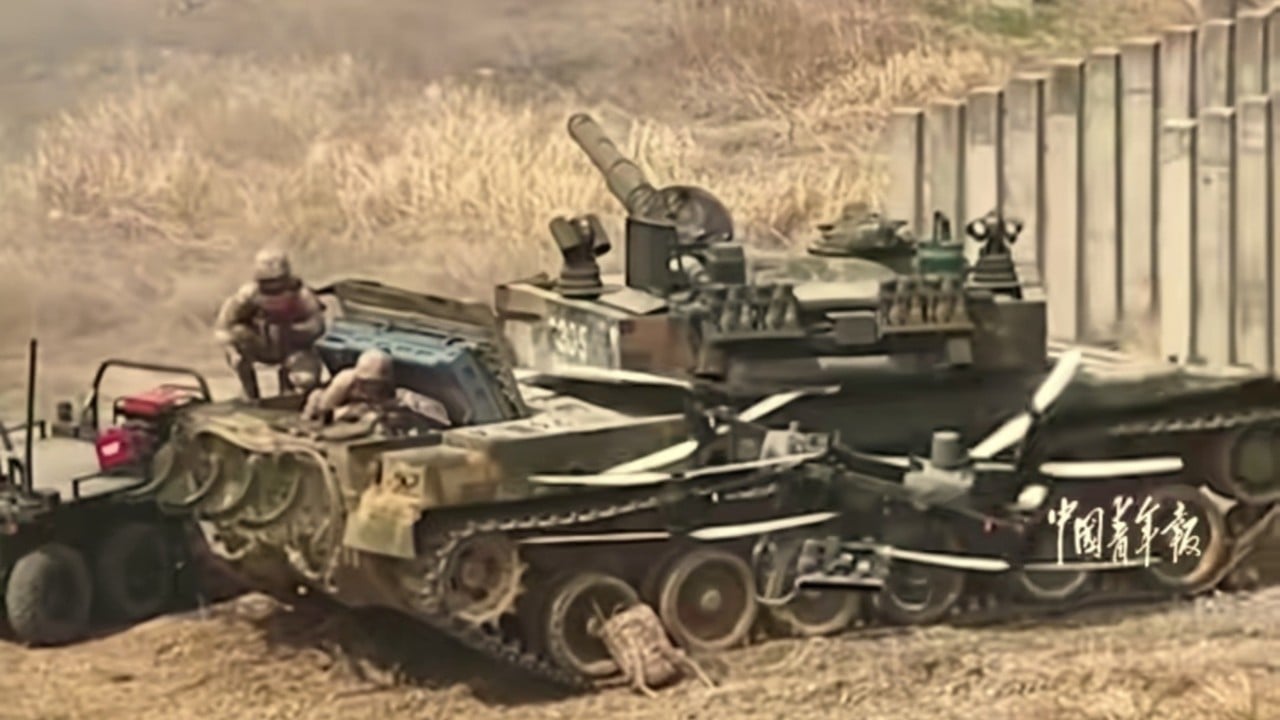
Recent sightings of Type 59s with "digital" camouflaging and integrated sensor suites suggest that these tanks are also being tested as unmanned ground vehicles (UGVs). An unmanned, APS-equipped Type 59 becomes the ultimate "breach" vehicle—an expendable, armored sensor node that can draw fire and clear obstacles without risking a four-man crew. This is the logical endpoint of the Type 59’s evolution: the transition from a manned fighting vehicle to a semi-autonomous, attritable effector.
Counter-Measures and the Evolution of the Threat
Opposing forces will inevitably adapt to the presence of APS on legacy hulls. The most immediate response is the "saturation strike," where two missiles are fired in rapid succession at the same target. Most APS systems have a "recharge" or "reset" time between interceptions.
The second counter-measure involves the use of top-attack munitions that exceed the elevation limits of the APS sensors. By diving vertically onto the thin roof armor, these munitions bypass the radar's primary search arc. The PLA's response has been the addition of "slat armor" or "cope cages" on the roof, which, while visually primitive, provides a physical standoff distance to trigger the shaped-charge jet before it hits the primary armor.
Tactical Reconfiguration of Armored Brigades
The presence of these upgraded tanks indicates a reorganization of the PLA's armored and mechanized infantry brigades. We are seeing a "High-Low" mix strategy. The "High" end (Type 99A) is reserved for the "Fist" or the primary breakthrough force against hardened enemy armor. The "Low" end (Upgraded Type 59) is assigned to the "Follow-on" or "Occupation" force, responsible for clearing bypassed pockets of resistance and securing urban centers.
This division of labor prevents the attrition of China’s most valuable assets in low-reward, high-risk scenarios. It also complicates the defender’s targeting priorities. If a defensive line sees fifty tanks approaching, they cannot easily distinguish which are the "expendable" Type 59s and which are the "high-value" Type 96s without sophisticated electronic signatures, which are often jammed in a modern combat environment.
The Strategic Play
The PLA’s modernization of the Type 59 with APS is a move toward "Integrated Mass." They are not trying to win a 1-on-1 duel; they are trying to win a war of attrition. The strategic recommendation for the PLA is to continue the modularization of these kits so they can be stripped and moved to other platforms as the Type 59 hulls eventually reach their structural fatigue limits.
For regional competitors, the lesson is clear: the age of a platform is no longer a reliable indicator of its lethality or its survivability. The threat is now defined by the sensor-to-shooter loop and the active defense layer, rather than the thickness of the steel. The focus of anti-tank development must shift from "more penetration" to "sensor-blinding" and "saturation-timed" strikes to overcome the digital shield now being draped over mid-century iron. Expect to see the Type 59 remain on the battlefield not as a relic, but as a specialized, low-cost node in a much larger, more lethal network.