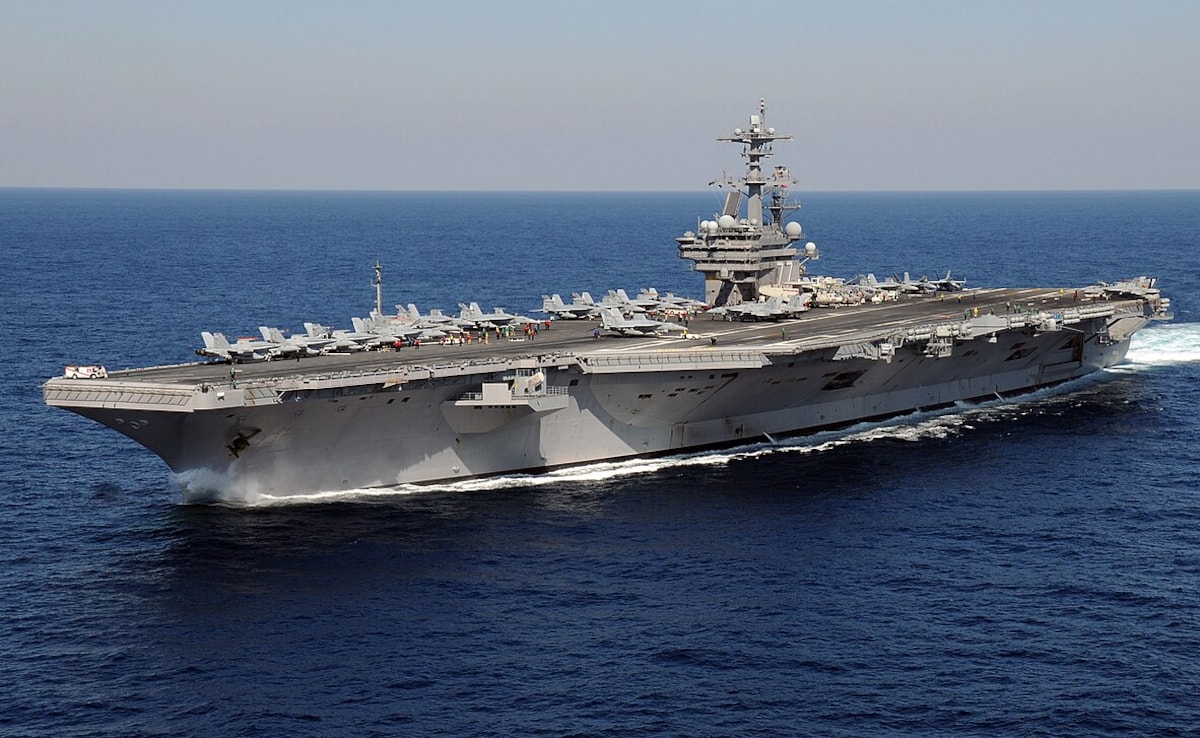
The movement of the USS George H.W. Bush (CVN 77) into the Eastern Mediterranean or Middle Eastern theater represents more than a logistical shift; it is a recalibration of the global escalation ladder. While political rhetoric focuses on punitive measures or "Stone Age" regression, the actual utility of a Nimitz-class supercarrier lies in its ability to manage three distinct operational variables: kinetic reach, electronic dominance, and the psychological compression of an adversary’s decision-making window. The deployment serves as a physical manifestation of a "Calculated Deterrence" framework, designed to saturate a specific geographic corridor with multi-domain capabilities that land-based assets cannot replicate with equal flexibility.
The Mechanics of Mobile Sovereignty
A Carrier Strike Group (CSG) functions as a floating, sovereign piece of territory that bypasses the diplomatic friction inherent in land-based basing rights. When the George H.W. Bush enters a theater, it introduces a self-sustaining ecosystem of power. This ecosystem is built upon four primary technical pillars:
- Aviation Saturation: The Nimitz-class carrier supports Carrier Air Wing 7, capable of launching up to 60-70 aircraft including F/A-18E/F Super Hornets, EA-18G Growlers, and E-2D Advanced Hawkeyes. This provides a persistent Combat Air Patrol (CAP) that can enforce no-fly zones or conduct deep-strike missions without requiring overflight permissions from neighboring states.
- The Aegis Shield: Accompanied by guided-missile cruisers and destroyers, the CSG establishes a ballistic missile defense (BMD) envelope. This shield protects not only the carrier but also regional allies, effectively neutralizing an adversary’s tactical missile inventory.
- Subsurface Denial: Attack submarines accompanying the carrier provide an invisible layer of intelligence collection and anti-ship capabilities, creating a 360-degree exclusion zone.
- Information Dominance: Through the E-2D Hawkeye and onboard signals intelligence (SIGINT) suites, the CSG acts as a regional command-and-control hub, vacuuming up electronic emissions and providing a real-time, digitized battlefield map to central command.
Deconstructing the Stone Age Threat Logic
The phrase "sending an adversary back to the Stone Age" is a colloquialism for a Total Infrastructure Degradation strategy. In military theory, this aligns with the "Five Rings" model developed by Colonel John Warden, which prioritizes the destruction of a nation’s strategic center of gravity.
The strategy targets the following layers in descending order of importance:
- Leadership: Command, control, and communication (C3) nodes.
- System Essentials: Electrical grids, petroleum, oil, and lubricant (POL) refineries, and water treatment.
- Infrastructure: Bridges, rail lines, and fiber-optic hubs.
- Population: Psychological operations and civil disruption.
- Fielded Forces: The actual military units in the field.
By deploying the George H.W. Bush, the United States signals the capability to bypass the fifth ring (fielded forces) and strike the first three rings directly and simultaneously. This creates a "strategic paralysis" where the adversary’s military may remain intact, but the state’s ability to function as an organized entity ceases to exist. The deployment isn't just about the potential for violence; it is about the credible threat of systemic erasure.
The Cost Function of Carrier Diplomacy
The operational cost of maintaining a CSG in a high-tension environment is immense, both financially and in terms of readiness cycles. A Nimitz-class carrier costs approximately $6.5 million per day to operate during active deployments. However, the cost to the adversary is measured in "asymmetric response requirements." For every hour the George H.W. Bush remains on station, the opposing force must maintain high-alert status for its coastal defenses, relocate its mobile missile launchers, and expend significant intelligence resources simply to track the carrier’s position.
This creates an economic and psychological drain on the adversary. If the opponent lacks the capability to sink or significantly damage a carrier—a feat requiring sophisticated anti-ship ballistic missiles (ASBMs) like the DF-21D or high-volume saturation attacks—the presence of the carrier forces them into a defensive posture that is unsustainable over a long duration.
Naval Power as a Brake on Regional Escalation
Contrary to the view that naval deployments provoke conflict, they often act as a stabilizing "brake" by raising the entry price of aggression. In the Middle Eastern context, the arrival of the George H.W. Bush limits the options of non-state actors and regional powers.
The presence of the CSG closes the "window of opportunity" for:
- Maritime Blockades: Ensuring the Free Flow of Commerce (FFOC) through strategic chokepoints like the Strait of Hormuz or the Bab el-Mandeb.
- Proxy Expansion: Rapid-response capabilities mean that if a proxy group launches a major offensive, the CSG can provide immediate close air support or precision strikes to blunt the momentum before land-based reinforcements arrive.
- Tactical Miscalculation: The sheer volume of sensor data collected by the carrier’s escort ships makes "surprise" attacks nearly impossible to execute successfully.
The Technological Edge: Beyond the Hull
The George H.W. Bush is the final ship of the Nimitz class, representing the peak of 20th-century naval engineering merged with 21st-century digital integration. Unlike its predecessors, it features upgraded radar systems and a redesigned island for reduced radar cross-section.
Its real power, however, is the integration of the Naval Integrated Fire Control-Counter Air (NIFC-CA) architecture. This technology allows a sensor on one platform (like an F-35 or an E-2D) to provide targeting data to a weapon launched from another platform (like a destroyer’s SM-6 missile). This "every sensor, any shooter" network turns the entire strike group into a single, distributed weapon system. When an administration threatens a return to the "Stone Age," it is this invisible network of data-linked lethality that provides the teeth to that claim.
Operational Risks and Strategic Limits
Deploying a carrier is not a risk-free maneuver. The primary constraint is the A2/AD (Anti-Access/Area Denial) bubble. Modern adversaries have invested heavily in "carrier killer" technologies, including:
- Hypersonic Glide Vehicles: Which move too fast for current interceptors to reliably track in the terminal phase.
- Swarm Tactics: Using hundreds of low-cost drones or small boats to overwhelm the Aegis system’s processing capacity.
- Subsurface Ambush: Diesel-electric submarines, which are exceptionally quiet when running on batteries, remain a persistent threat in the shallow, cluttered waters of the Persian Gulf or Mediterranean.
Furthermore, there is the "Readiness Trap." Keeping a carrier on station for extended periods delays critical maintenance (dry-docking) and exhausts the crew, leading to a "hollow force" in the subsequent years. Using the George H.W. Bush as a diplomatic chess piece today may limit the Navy’s ability to respond to a Pacific crisis tomorrow.
The Strategic Recommendation
To maximize the utility of the George H.W. Bush deployment, the operational focus must shift from "Presence" to "Persistence and Unpredictability." A static carrier is a target; a maneuvering carrier is a threat.
The following tactical shifts are necessary:
- Disaggregated Operations: The CSG should occasionally operate its escort ships at high dispersion. This forces the adversary to track multiple high-threat targets across a wider geographic area, diluting their surveillance assets.
- Electronic Signature Management: The carrier must toggle between "Emission Control" (EMCON) and "Full Spectrum Saturation." By suddenly going silent, the carrier creates a vacuum of information that forces the adversary to reveal their own positions by frantically searching for the ship.
- Cross-Domain Integration: Use the carrier as a "mother ship" for unmanned systems. Launching drone swarms from the deck to conduct ISR (Intelligence, Surveillance, and Reconnaissance) allows the manned aircraft to stay in reserve for high-intensity strikes, extending the operational life of the air wing.
The ultimate goal of this deployment is not to start a war, but to dominate the "Gray Zone"—the space between peace and open conflict. By positioning a supercarrier within striking distance of critical infrastructure, the United States essentially holds the "OFF" switch to an adversary’s modern civilization. The strategy is effective only as long as the adversary believes that the switch can and will be flipped. If the carrier stays too long without a clear mission, it becomes a fixture of the landscape rather than a symbol of imminent power. The play is to maintain the tension of the "Stone Age" threat without ever needing to deliver the first blow.