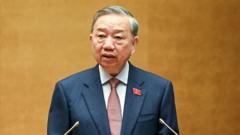
Vietnam just hit a massive political turning point, and it’s not exactly business as usual. On April 7, 2026, the National Assembly didn’t just hold a vote; they effectively handed the keys to the kingdom to one man. To Lam, already the General Secretary of the Communist Party, was unanimously elected as the State President. This isn't just another title for his resume. It's a fundamental shift in how one of Asia’s fastest-growing economies is governed.
For decades, Vietnam operated under a "four pillars" system. Power was split between the Party chief, the president, the prime minister, and the head of the National Assembly. It was a clunky, consensus-driven model designed to prevent any single person from becoming too powerful. Well, that model is basically in the rearview mirror now. By holding the two most powerful seats simultaneously, To Lam has consolidated authority in a way we haven't seen since the days of the late Nguyen Phu Trong—and arguably, he's gone even further.
The end of collective leadership as we know it
If you’re looking for a reason why this happened now, look at the "Blazing Furnace." This was the massive anti-corruption campaign started by Lam’s predecessor. As the former head of the Ministry of Public Security, To Lam was the one feeding the fire. He oversaw the investigations that took down high-ranking officials, including former presidents and deputy prime ministers.
By the time the dust settled, the competition was gone. Lam didn't just survive the purge; he used it to build a power base rooted in the security apparatus. Today, the Politburo is packed with people who started in the police or military. This isn't just a "security-first" government; it’s a streamlined machine designed for speed.
You might wonder why a country so focused on economic growth would ditch a system of checks and balances. The answer is simple: efficiency. Under the old way, big decisions—like massive infrastructure projects or major bureaucratic overhauls—could get bogged down in internal bickering for years. Lam is betting that by centralizing power, he can cut through the red tape and hit his ambitious target of 10% annual GDP growth.
Why the China comparison actually matters
Critics and analysts are already drawing parallels to China's Xi Jinping. It's a fair point. By unifying the roles of Party chief and State President, To Lam is adopting a "dual mandate" that looks very familiar to anyone watching Beijing. This setup allows him to represent Vietnam on the global stage with the full weight of the Party behind him.
But don't mistake this for a carbon copy of the Chinese model. Vietnam’s economy is deeply integrated with the West. Lam knows he can't afford to scare off foreign investors with pure authoritarianism. He's trying to balance a hardline security approach at home with a pro-business, tech-driven agenda for the world. He's talking about a "new era" of national rise, focusing on science, innovation, and digital transformation. It's a high-stakes gamble: can you have total political control and a freewheeling, innovative economy at the same time?
What this means for the average person
For the person on the street in Hanoi or Ho Chi Minh City, this political drama might feel distant, but the effects are real.
- Faster infrastructure: Expect big projects like high-speed rail and energy grids to move faster now that the top-down command is clearer.
- Bureaucratic slimming: Lam is already merging provinces and slashing government jobs to reduce overhead.
- Security presence: With a career policeman at the helm, the tolerance for dissent is at an all-time low. The "security state" isn't just a buzzword; it’s the new daily reality.
The peak power trap
There's a massive risk here that nobody likes to talk about in official circles. When you're the only one in charge, you're the only one to blame. Under the old collective leadership, if the economy tanked or a scandal broke, the blame was shared. Now, every power outage, every dip in the stock market, and every diplomatic friction sits squarely on To Lam’s shoulders.
He’s dismantled the buffers that protected past leaders. This "unanimous" support from the National Assembly looks strong on paper, but it also means there’s no safety net. If his aggressive growth targets don't hit, the friction within the Party—which hasn't disappeared, just gone underground—could resurface quickly.
What you should watch next
If you're an investor or just someone following regional geopolitics, keep your eyes on the new Prime Minister, Le Minh Hung. A former central bank governor, Hung is a technocrat. His job is to turn Lam’s political dominance into actual economic numbers. If these two can work in sync, Vietnam might actually hit those double-digit growth targets. If they clash, the "unified" leadership might show cracks sooner than expected.
Don't expect a return to the old ways anytime soon. The "four pillars" are now more like one giant column with a few supports. Whether this brings the stability Vietnam craves or leads to a "peak power trap" remains the biggest question in Southeast Asian politics today.
Stop waiting for the old consensus model to return. It’s gone. If you're doing business in Vietnam, you're now dealing with a centralized authority that values results over process. Adapt your strategy to a government that moves faster, expects more, and has very little patience for those who can't keep up with the "new era."