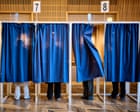
The coffee in Nuuk is always hotter than you expect, perhaps because the air outside is a constant reminder of how quickly warmth can vanish. In the early hours of a Danish election cycle, the steam rising from a ceramic mug in a Greenlandic kitchen feels less like a morning ritual and more like a tactical defense. On the mainland, in the cobblestone corridors of Copenhagen, voters are lining up at primary schools and community centers. They are there to decide on taxes, elder care, and the creeping cost of butter. But this time, a ghost is haunting the ballot box. It is a ghost from across the Atlantic, carrying a checkbook and a map.
The world woke up one morning to find that the American President wanted to buy Greenland. Not lease it. Not partner with it. Buy it.
To the average voter in Aarhus, the idea felt like a fever dream or a poorly timed satire. But as the polls opened, the laughter died down, replaced by a cold, sharp realization. The Arctic is no longer a peripheral concern of scientists and polar bears. It is the new front door of global power. When a superpower looks at your sovereign territory and sees a real estate opportunity, the "Lego-and-pastries" comfort of Danish domestic politics evaporates.
Consider a hypothetical voter named Mette. She is a librarian in Odense. Usually, she votes based on the longevity of the welfare state. She cares about whether her daughter’s school has enough teachers. But as she stands in the rain waiting to cast her vote, she is thinking about the Thule Air Base. She is thinking about the $1.7 trillion worth of mineral wealth locked under the ice—neodymium, praseodymium, the "rare earths" that make our smartphones vibrate and our electric cars hum.
Mette isn’t just voting for a Prime Minister. She is voting for a landlord who refuses to sell.
The tension isn't just about the absurdity of the offer; it is about the shift in the wind. For decades, Denmark and Greenland have shared a complex, often strained, but deeply familial "Rigsfællesskab"—the Realm of the Realm. Greenland has its own parliament and manages its own domestic affairs, but Copenhagen holds the keys to foreign policy and defense. When Washington knocked on the door, it didn't knock in Nuuk. It knocked in Copenhagen.
That knock echoed through the Danish Parliament, the Folketing. It turned a standard election into a referendum on dignity.
The numbers tell a story of immense, frozen potential. Greenland spans over 2 million square kilometers. More than 80% of it is buried under an ice sheet that is, in some places, 3 kilometers thick. If that ice melts—and it is melting—the world’s sea levels rise by 7 meters. This isn't just geography; it's a ticking clock. The Americans know that as the ice retreats, the shipping lanes open. The Northwest Passage, once a death trap for Victorian explorers, is becoming a highway.
Russia is already there. They have been refurbishing Cold War-era bases and deploying specialized Arctic troops. China has declared itself a "Near-Arctic State," a geographical stretch that would be hilarious if it weren't so financially backed by their "Polar Silk Road" initiative. In this context, the American offer to "buy" Greenland wasn't a joke. It was an opening gambit in a game where the board is made of melting glaciers.
But the human cost of being a "strategic asset" is heavy.
Walk through the streets of Nuuk and you will see the tension of a people caught between two worlds. There is the ancestral connection to the hunt, the sea, and the silence. Then there is the modern reality of being the most important piece of dirt on the planet. For a Greenlander, the "purchase" talk felt like a erasure of their humanity. You don't buy a people. You don't buy a culture.
In the voting booths of Denmark, this translated into a surge of national identity. The Danish Social Democrats, led by Mette Frederiksen, found themselves in a position where they had to be both the guardians of the welfare state and the defenders of the Arctic. Frederiksen called the suggestion of a sale "absurd." The American response was to cancel a state visit.
Diplomatic ripples became waves.
The "Trump factor" acted as a catalyst. It forced the Danish electorate to look at their defense spending. For years, European nations have been nudged, then shoved, toward meeting the 2% GDP spending target for NATO. Denmark, long a peaceful maritime nation, suddenly realized that if they didn't pay for their own locks, someone else would offer to buy the whole house.
The invisible stakes are the minerals. We are currently in a race to decarbonize the planet. To do that, we need magnets. Millions of them. These magnets require minerals that are currently controlled almost exclusively by China. Greenland sits on one of the largest untapped deposits of these materials in the world. Kvanefjeld, a site in southern Greenland, is a name that every geopolitical strategist knows by heart.
If Denmark allows mining, they risk the pristine environment they claim to protect. If they forbid it, they stifle Greenland’s path to economic independence from Copenhagen. If they sell it... well, that wasn't an option. Not for the voters.
The polls are more than a count of checkboxes. They are a temperature check on a kingdom that is realizing its backyard is the most valuable real estate in the 21st century. The voters aren't just choosing a leader; they are defining the borders of their pride.
The rain in Copenhagen continues. The wind from the North Atlantic carries the scent of salt and ancient ice. Inside the schools, the pencils scratch against the paper. It is a quiet sound, but it carries further than a billionaire's boast. It is the sound of a small nation deciding that some things are not for sale, even when the buyer is the most powerful man on earth.
As the sun sets over the fjords, the results start to trickle in. The numbers will show shifts in percentages and coalitions. They will talk about "Blue Blocks" and "Red Blocks." But the real story is written in the silence between the lines. It is the story of a librarian, a hunter, and a politician all looking at the same map and realizing that the ice is no longer a barrier. It is a bridge. And everyone is trying to cross it at once.
The ballot boxes are sealed. The coffee has gone cold. But the North is wide awake, watching the horizon for the next ship to appear, wondering if it brings a friend, a foe, or another man with a checkbook and a dream of owning the moon.