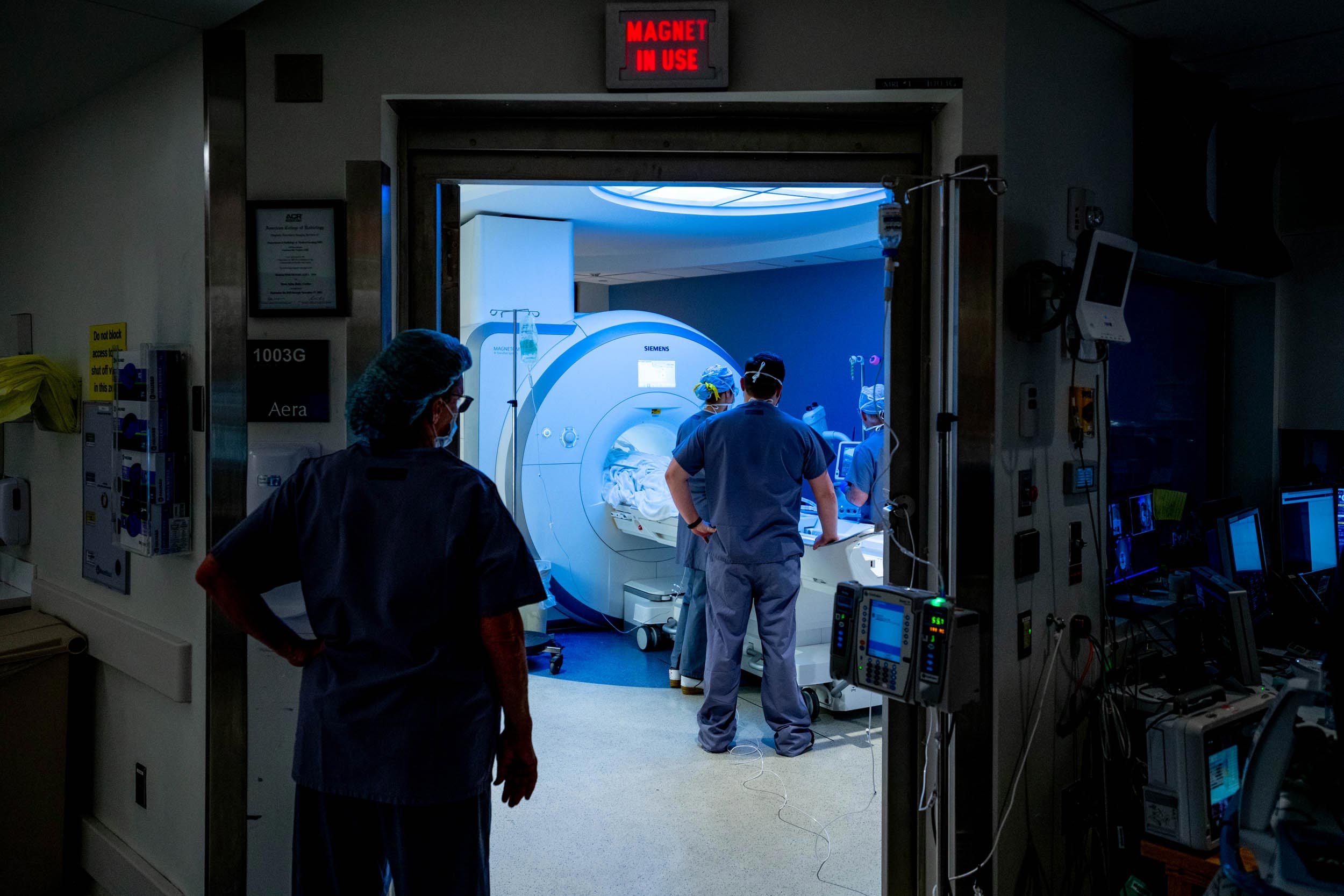
You’re lying on a sliding table, staring at a beige plastic ceiling just inches from your nose. Then, the jackhammering starts. It’s loud. It’s rhythmic. It feels like you're trapped inside a techno concert that nobody invited you to. For most people, the inside of an MRI is a place of high anxiety, cold air, and total mystery. Why does a medical camera need to sound like a construction site? And what is actually happening behind those plastic panels?
Honestly, it’s basically magic—if magic were powered by liquid helium and massive electrical currents.
The Magnetic Resonance Imaging (MRI) machine is a marvel of physics that doesn't use a single drop of radiation. Unlike an X-ray or a CT scan, which essentially "shines a light" through you to see shadows of your bones, the MRI talks to your body’s atoms. Specifically, it’s interested in your water. Since humans are basically walking bags of salt water, there is a lot for the machine to talk to.
The Giant Magnet That Never Turns Off
When you look at the inside of an MRI, you aren't just looking at a tube. You’re looking at a massive superconducting magnet. This isn't your refrigerator magnet. We are talking about a field strength of 1.5 to 3.0 Tesla in most clinical settings. To put that in perspective, the Earth’s magnetic field is about 0.00005 Tesla. The machine is roughly 30,000 to 60,000 times stronger than the planet we live on.
This magnet is always on. 24/7. Even when the lights are off and the technicians are home, that magnetic field is pulling. This is why hospitals are so incredibly strict about metal. If you walk in there with a paperclip, it becomes a lethal projectile. There have been documented cases, like the tragic 2001 accident at Westchester Medical Center, where an oxygen tank was pulled into the bore, underscoring just how powerful these forces are.
Inside the casing, miles of niobium-titanium wire are bathed in liquid helium. This keeps the temperature at about -269°C (-452°F). At this temperature, the wire has zero electrical resistance. You can run a massive current through it forever without it heating up or losing power. That’s the "superconducting" part.
What Happens to Your Atoms?
Usually, the hydrogen atoms in your body are spinning around in every which direction. They're chaotic. But the moment you slide into the inside of an MRI, that giant magnet forces them to line up. They align with the magnetic field like tiny compass needles.
Some point toward your head, some toward your feet.
Then comes the noise. That "thump-thump-thump" or "bzzzzzt" you hear is the radiofrequency (RF) pulse. The machine sends out a burst of radio waves—the same kind of waves your favorite FM station uses—tuned specifically to the frequency of hydrogen. This pulse knocks the atoms out of alignment.
When the pulse stops, the atoms "relax" back into their original position. As they do this, they give off a tiny, tiny bit of energy. The machine’s coils act like antennas, picking up these faint signals. Because different tissues (fat, muscle, tumor, bone marrow) have different water content, their atoms relax at different speeds. The computer calculates these differences and builds a 3D map of your insides.
The Mystery of the Loud Banging
Why the noise, though? It’s not the magnet moving. Nothing is actually spinning around you like it does in a CT scan. The noise comes from the gradient coils.
Inside the main magnet, there are three smaller magnets called gradients. These turn on and off rapidly to "fine-tune" the magnetic field so the computer knows exactly where in your body a signal is coming from. When electricity surges through these coils, they experience a physical force called the Lorentz force. They literally vibrate and bang against their mountings. It’s the sound of copper coils flexed by immense power.
The Experience: Space, Sound, and Sensation
If you’ve ever felt a weird "twitching" sensation during a scan, you aren't imagining things. The rapid switching of those gradient coils can actually stimulate your peripheral nerves. It feels like a tiny muscle spasm. It’s totally harmless, but it’s a weird reminder of how much energy is moving around you.
Some people also report a metallic taste in their mouth. This is especially common if you have dental fillings. The moving magnetic fields can create tiny electrical currents in your saliva or the metal in your teeth, which your brain interprets as a "penny-like" taste.
Does the Contrast Dye Matter?
Sometimes, the doctor wants a clearer look at blood vessels or inflammation. They'll inject a contrast agent, usually Gadolinium. Unlike the iodine used in CT scans, Gadolinium is a "paramagnetic" metal. It doesn't show up itself; rather, it changes the way nearby water atoms respond to the MRI's pulses. This makes certain areas "light up" on the screen.
It’s worth noting that while Gadolinium is generally safe, there has been ongoing debate in the medical community about "linear" vs. "macrocyclic" agents. Some studies, including research highlighted by the FDA in 2017, show that trace amounts of Gadolinium can remain in the brain and bones for years. While no clear health risks have been proven from these tiny deposits, many radiologists now prefer macrocyclic agents because they are chemically more stable and exit the body more efficiently.
Why the Bore is So Small
We’ve all wondered why the inside of an MRI has to be so claustrophobic. Can’t they just make the hole bigger?
Technically, they can. These are called "Open MRI" machines. The problem is image quality. To get those crisp, high-resolution pictures that can find a 2mm tear in a ligament, the magnetic field needs to be incredibly uniform. The closer the magnets are to your body, the stronger and more consistent that field is.
When you increase the size of the "bore" (the hole), the magnetic field gets "messier" at the edges. This is why "Closed" or "Short-Bore" units are still the gold standard for neurosurgery prep or complex orthopedic diagnosis. If you’re claustrophobic, many modern facilities now use "Wide-Bore" machines, which offer an extra few inches of headspace—it doesn't sound like much, but it makes a world of difference when you’re in there for 45 minutes.
Real-World Tips for Your Next Scan
If you’re heading in for a scan soon, there are things you can do to make it suck less. First, ask for the "prism glasses." Many centers have these little periscope-style glasses that let you look "out" toward the feet of the machine instead of at the ceiling three inches from your face. It instantly kills that feeling of being trapped in a box.
Second, be honest about any tattoos. Most modern tattoo inks are fine, but some older inks—or those from less regulated sources—contain iron oxide. The MRI can heat that metal up. It’s rare to get a burn, but people have reported a "tugging" or "burning" sensation on their skin. The tech can usually give you a cold compress to put over the tattoo just in case.
Third, don't skimp on the earplugs. Even if they give you headphones with music, wear the earplugs underneath if they fit. The decibel level inside the bore can reach 120 dB, which is roughly equivalent to standing next to a jet engine taking off. Protect your hearing.
Understanding the "Quench"
There is a big red button on the wall of every MRI suite labeled "Quench" or "Emergency Magnet Stop." Do not touch it unless someone is literally pinned to the machine by a forklift.
Pressing that button releases all the liquid helium as a gas. It’s a violent, expensive process that effectively kills the magnet in seconds. It costs tens of thousands of dollars to "re-ramp" the magnet and refill the helium. It’s the ultimate "break glass in case of emergency" measure.
Actionable Steps for Patients
- Request a Wide-Bore Machine: If you have a larger frame or struggle with tight spaces, call around to find a facility with a 70cm wide-bore unit.
- Check Your Clothing: Wear leggings or sweatpants with zero metal. Even "invisible" silver threads in high-end athletic wear (anti-odor tech) can heat up and cause burns in an MRI. Plain cotton is your best friend.
- Practice Stillness: The biggest reason for a "bad" MRI is motion blur. If you move even a fraction of an inch during a sequence, they have to restart that 5-minute block. Find a "zen" place and stay statuesque.
- Ask for a Blanket: The room is kept cold to protect the electronics. You'll be lying still for a long time; being shivering-cold makes it impossible not to twitch.
The inside of an MRI is an intimidating place, but it’s also one of the safest and most advanced ways we have to look at the human body. It’s just a very loud, very cold, very expensive conversation between a giant magnet and your atoms.