The heat in the Cox’s Bazar camps does not just sit; it vibrates. It carries the scent of woodsmoke, sun-baked plastic, and the metallic tang of open drains. But lately, a new weight has settled over the narrow, hilly alleys of the world’s largest refugee settlement. It is the sound of a dry, hacking cough—the kind that rattles a small chest and leaves a mother holding her breath, waiting for the next inhale that may not come.
Measles is an ancient predator. We often think of it as a relic of a dusty past, a childhood rite of passage overcome by the miracle of the needle. But in the crowded corners of Bangladesh, where over a million people live in shelters made of bamboo and tarpaulin, the virus has found a fresh hunting ground. It doesn’t care about borders, nor does it care about the politics of displacement. It only seeks a host.
Consider a woman named Amina. She is a fictional composite of the thousands of mothers currently standing in line under a brutal sun, but her fear is entirely real. She remembers the spots first. They started behind her three-year-old son’s ears—small, reddish-brown blooms that looked almost like a heat rash. By the third day, the fever had spiked so high his skin felt like it was radiating its own internal light. This is how the outbreak begins: not with a roar, but with a flush and a shiver.
The Math of a Contagion
To understand why the Bangladeshi government and international health agencies are currently scrambling to vaccinate nearly 500,000 children, you have to understand the terrifying efficiency of the Morbillivirus. Scientists use a measurement called $R_0$ (R-naught) to describe how contagious a disease is. While a seasonal flu might have an $R_0$ of about 1.3, measles is a mathematical monster. Its $R_0$ typically ranges from 12 to 18.
$R_0 \approx 15$
This means that in a community without immunity, one sick child will, on average, infect fifteen others. It is one of the most contagious diseases known to man. It lingers in the air for up to two hours after an infected person has left the room. In the dense grid of the camps, where ten people might share a single room, social distancing isn't just difficult—it is a physical impossibility.
When the numbers started climbing in early 2026, the alarm didn't just beep; it screamed. The Ministry of Health and Family Welfare, supported by partners like the WHO and UNICEF, recognized that they weren't just fighting a fever. They were fighting a biological wildfire.
The Invisible Stakes
We tend to underestimate measles because we focus on the rash. The rash is the least of it. The real danger lies in what the virus does to the body’s internal defenses. Measles causes what researchers call "immune amnesia." It wipes the "memory" of the immune system, deleting the antibodies the body has spent years building up against other illnesses.
A child who survives measles is suddenly vulnerable to every other bacteria and virus in their environment. It is as if the virus breaks into the house, steals the security system, and leaves the front door wide open for pneumonia, diarrhea, and malnutrition to walk right in.
In the camps, malnutrition is already a shadow that follows every family. When you combine a weakened immune system with a lack of protein, the mortality rate doesn't just rise; it leaps. This is the "why" behind the emergency campaign. It isn't just about stopping a rash. It’s about preventing a decade of secondary deaths that would follow in the virus’s wake.
The Logistics of Hope
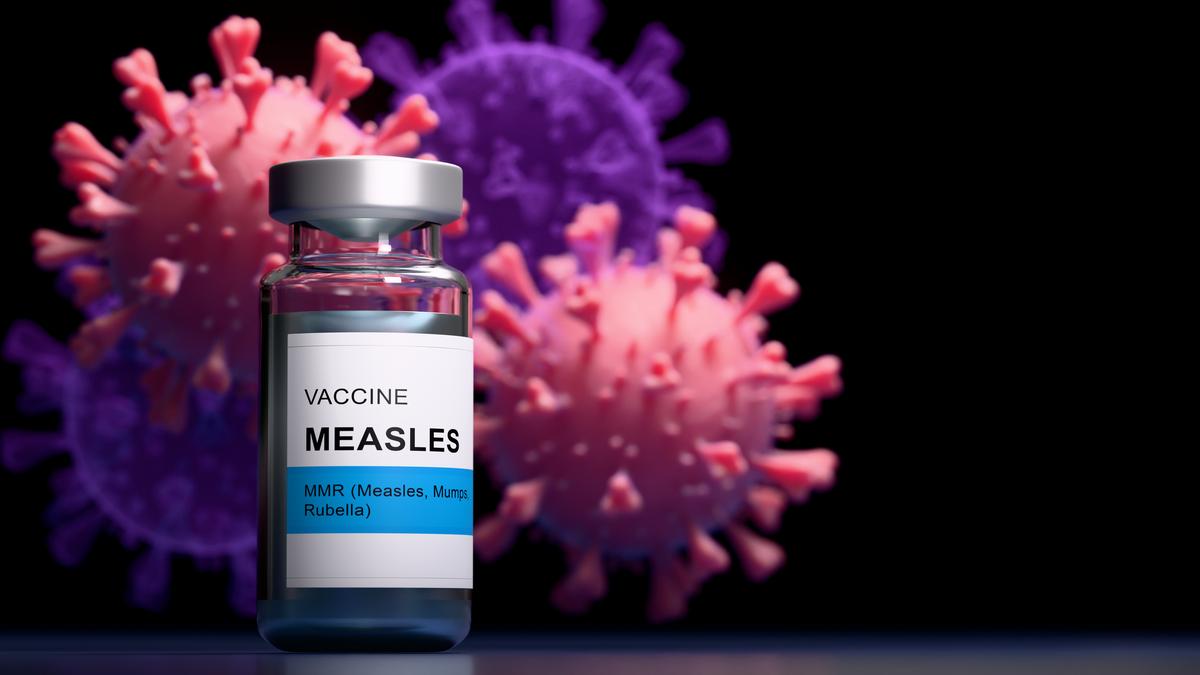
Moving half a million doses of vaccine through a landscape of mud and heat is a feat of engineering that rivals any corporate supply chain. It requires "the cold chain." This is a literal bridge of refrigeration that must never break. From the moment the vial leaves a high-tech facility, it must stay between 2°C and 8°C.
$2^\circ\text{C} \le T \le 8^\circ\text{C}$
If a solar-powered fridge fails in a remote sub-district, or if a cooler box sits too long in the sun during a trek up a steep hillside, the protein in the vaccine unravels. It becomes useless water.
The heroes of this story are the community health volunteers. They are the ones who walk miles in plastic sandals, carrying heavy blue boxes filled with ice packs. They are the ones who must answer the questions of skeptical parents. They don't use medical jargon. They talk about the "breath of the tiger" and the way a single prick in the arm can keep the family's future from evaporating.
The Resistance of the Mind
The greatest hurdle isn't the terrain or the temperature. It is trust. In any crisis, rumors travel faster than the virus itself. In the tea stalls of Cox’s Bazar and the marketplaces of Chittagong, whispers began to circulate. Some said the vaccine was a way to limit the population. Others feared it would make their children sicker.
This is where the narrative shifts from science to sociology. To win, the campaign leaders couldn't just deploy doctors; they had to enlist imams and community elders. They had to prove that the needle was an act of mercy, not a tool of control.
Amina, the mother waiting in line, heard the rumors. She hesitated for two days. But then she saw her neighbor’s daughter—a girl who used to chase chickens through the dust—lying silent and grey-faced in a clinic bed. The sight of that stillness was more persuasive than any government pamphlet. Fear of the needle is nothing compared to the fear of the silence that follows a child’s last cough.
The Cost of Hesitation
Bangladesh has been a global leader in immunization for decades. Their Expanded Programme on Immunization (EPI) is usually a model of efficiency. But the world is currently seeing a "backsliding" in routine vaccinations. During the global disruptions of the last few years, millions of children missed their scheduled doses.
We are now paying the interest on that missed debt.
The current outbreak is a symptom of a larger, global vulnerability. When the "wall" of herd immunity drops below 95%, the virus finds the holes. In the refugee camps, that wall was already precarious. The emergency campaign is a desperate masonry project, trying to plug the gaps before the entire structure collapses.
The statistics tell one story: 480,000 doses, 300 vaccination centers, a 10-day sprint. But statistics are just ghosts without skin.
The real story is the sting of the needle and the small, brave cry that follows. It is the purple ink mark on a child’s pinky finger—a badge of honor that says "protected." It is the collective exhale of a community that has seen enough tragedy to know when a miracle is being offered in a small glass vial.
Late in the afternoon, the sun begins to dip behind the hills of Myanmar, casting long, jagged shadows over the camps. The lines at the vaccination posts start to thin. Amina walks back toward her shelter, her son balanced on her hip. He is crying softly, rubbing his arm where the nurse just pressed the cotton ball.
She doesn't soothe him with words of science or public health. She just whispers into his hair, feeling the heat of his skin—a normal, healthy heat this time. She knows that tonight, the hacking coughs in the neighboring tents might still continue, but her son has been given a shield. In a world of tarpaulin and uncertainty, that shield is the only thing that matters.
The virus is still out there, floating in the humid air, searching for a way in. But today, in this one small corner of the earth, the door has been slammed shut.