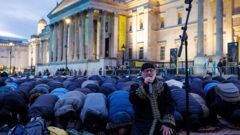
Kemi Badenoch has thrown her weight behind a fellow Conservative MP caught in a firestorm over a Muslim prayer event, a move that signals a fundamental shift in how the Tory leadership views the intersection of secular governance and religious practice. This is not merely a local spat over a community gathering. It represents a calculated gamble to redefine the boundaries of British pluralism at a time when the party is desperate to reclaim its identity. By backing an MP who challenged the optics and implications of a specific religious event, Badenoch is signaling that the era of quiet multiculturalism is over, replaced by a more muscular, assertive brand of integrationist politics.
The incident began when a Tory MP raised concerns about a Muslim prayer event, questioning whether such gatherings, when held in certain public or semi-public spaces, align with broader community cohesion goals. The backlash was immediate. Critics labeled the intervention as exclusionary or even Islamophobic. Yet, the leadership’s decision to double down rather than distance itself suggests a strategic pivot. They are betting that a significant portion of the electorate is weary of what they perceive as the "special treatment" of religious groups and is looking for a political home that prioritizes a singular, cohesive national identity over a "tapestry" of fragmented communities.
The End of Neutrality
For decades, the standard political response to religious friction was a desperate, often cloying neutrality. Ministers would release carefully worded statements about "mutual respect" and "shared values" while effectively doing nothing to address the underlying tensions. That template has been shredded. Badenoch’s intervention suggests that the Conservative Party no longer views itself as a neutral arbiter between competing interest groups. Instead, it is positioning itself as the guardian of a specific set of Western liberal values that it believes are being eroded by an over-extension of religious accommodation.
This isn't just about one prayer event. It is about the "why" behind the resistance. The MP in question argued that the visibility and nature of the event could be seen as territorial or exclusionary to non-Muslims in the area. Whether that assessment is factually accurate is almost secondary to the political reality it created. By validating this concern, the party is acknowledging a sentiment that has long simmered in post-industrial towns and suburban belts: the feeling that the public square is being partitioned.
The Integration Gap
We often talk about integration as if it is a settled metric. We look at employment rates or language proficiency and tick a box. But the real friction occurs in the "third spaces"—the parks, community halls, and streets where different groups must coexist without a formal script. When a religious event takes over one of these spaces, it forces a confrontation between the right to worship and the right to a secular public sphere.
The MP’s critics argue that prayer is a fundamental right and that the location shouldn't matter if the intent is peaceful. However, the counter-argument, now bolstered by the party's top brass, is that rights do not exist in a vacuum. They exist within a social contract. If a community feels that its shared spaces are being mono-culturalized, even temporarily, the social contract begins to fray. Badenoch is effectively saying that the discomfort of the majority is a valid political data point, not something to be reflexively dismissed as prejudice.
Secularism as a Shield
There is a profound irony in a conservative party—traditionally the home of the Church of England—becoming the loudest advocate for a rigid, French-style secularism in public life. But this is the "how" of their current strategy. By framing their objections in the language of secularism and "British values," they insulate themselves from charges of religious bigotry. They aren't "anti-Islam," the logic goes; they are "pro-neutrality."
This shift allows them to court a diverse range of voters, including secularists, Hindus, Sikhs, and even some moderate Muslims who are concerned about the rise of more fundamentalist or visible expressions of the faith. It is an attempt to build a coalition based on "integrationism." The risk, of course, is that this approach alienates the very communities it seeks to integrate, creating a siege mentality that drives people further into their respective corners.
The Architecture of a Row
To understand how we got here, one must look at the specific mechanics of the prayer event row. It wasn't a spontaneous eruption. It was the result of a long-standing tension between local councils, religious organizations, and residents. In many cases, these organizations are filling a vacuum left by the retreat of the state. When the local youth club closes, the mosque or the church steps in. This gives them a level of social capital and physical presence that can feel overwhelming to those outside the faith.
The MP’s intervention was a lightning rod because it touched on the "how" of religious expansion. It questioned the administrative processes that allow such events to take place and the lack of transparency in how public spaces are allocated. By backing the MP, Badenoch is signaling that these administrative decisions are now fair game for political scrutiny. The "technical" has become "political."
The Risk of the Hard Line
There is a thin line between defending secularism and stoking division. The veteran analyst knows that every time a politician leans into a "culture war" issue, they lose a degree of control over the narrative. While this stance may play well with the base and certain swing voters, it also provides ammunition to those who argue that the Conservative Party is becoming a "sectarian" force in its own right—a party for "the rest" against a specific minority.
Furthermore, this strategy assumes that "British values" are a fixed, easily definable set of rules. In reality, they are constantly evolving. What was considered a reasonable religious accommodation twenty years ago might be seen as an imposition today, and vice versa. By anchoring their identity to a specific, hardline interpretation of these values, the Tories risk being left behind by a younger, more fluid generation that views multi-faith coexistence not as a problem to be managed, but as a lived reality.
The Global Context
Britain is not an island in this regard. From the "hijab bans" in France to the debates over "sharia councils" in Germany, Europe is grappling with the limits of pluralism. The UK has long prided itself on a "live and let live" approach that avoided the legalistic rigidity of our neighbors. That era is closing. The Badenoch intervention is a signal that the UK is moving toward a more Continental model of integration, where the state (and its representatives) takes a much more active role in policing the boundaries of religious expression.
This move is also a response to the perceived failure of the "prevent" and "cohesion" strategies of the last two decades. Billions of pounds have been spent on programs designed to bring communities together, yet the sense of separation in many towns remains as sharp as ever. The Tory leadership is betting that voters are tired of "soft" interventions and want "hard" clarity.
The Electoral Calculus
At its core, this is a play for the "Red Wall" and the "Blue Wall" simultaneously. In the post-industrial north, the message of "one law for all" and "no special treatment" resonates with a working class that feels ignored. In the affluent south, the defense of secular liberal values appeals to a professional class that is increasingly wary of any form of religious fundamentalism. It is a rare moment of alignment for a fractured party.
However, the strategy relies on the MP in question being a "clean" messenger. If the intervention is found to be based on faulty data or if it descends into genuine vitriol, the leadership’s support will become a liability. They have hitched their wagon to a specific incident to prove a general point. If the incident falls apart under scrutiny, so does the point.
The Silence of the Opposition
One of the most telling aspects of this row is the relative caution of the Labour Party. In years past, they would have been unified in their condemnation of the Tory MP. Today, they are walking a tightrope. They know that many of their own voters share the concerns expressed by the Conservatives, even if they dislike the rhetoric. By forcing the issue, Badenoch has put Labour on the defensive, making them choose between their traditional base and their progressive activists.
This is the "why" of the timing. The Conservatives are using faith and integration as a wedge to split the opposition. They are forcing a conversation that many in the political establishment would rather avoid, and they are doing so with a bluntness that is designed to disrupt the status quo.
The Future of the Public Square
The row over the prayer event will eventually fade from the headlines, but the precedent has been set. The "neutrality" of the MP is no longer a given. Every community event, every religious gathering, and every use of public space is now a potential site of political contestation. We are entering a period where the "common ground" is no longer assumed; it must be negotiated, often painfully, in the full glare of the national media.
The real question is whether this more aggressive approach actually leads to better integration or simply more resentment. If the goal is a more cohesive society, then highlighting differences and challenging religious practices in public may be counterproductive. But if the goal is political survival and the consolidation of a specific electoral bloc, then Badenoch’s move is a masterclass in opportunistic positioning.
The battle for the British soul is being fought not in cathedrals or mosques, but in the corridors of Westminster and the parks of suburban England. It is a struggle to define what it means to be a "citizen" versus a "believer," and which identity takes precedence when the two collide. The Conservatives have made their choice. They have chosen the citizen, even if it means alienating the believer.
The prayer event was just the spark. The fire has been building for a long time. It is a fire fed by economic anxiety, rapid demographic change, and a profound sense of loss. By backing the MP, the leadership is attempting to channel that fire into a political movement. Whether they can control the flames remains to be seen.
The next time a religious group applies for a permit or a community holds a festival, the ghost of this row will be in the room. Every decision made by a local council will be weighed against the new "integrationist" standard. This is the new reality of British politics: nothing is purely local, and nothing is truly private. Everything is a data point in a larger war of values.
Ask yourself what happens to the quiet, unremarked instances of cooperation that happen every day. In the rush to define the boundaries and police the "third spaces," we risk destroying the very organic integration that occurs when politicians stay out of the way. The "hard-hitting" approach demands winners and losers. In the delicate ecosystem of a multi-faith society, that is a dangerous game to play.
Would you like me to analyze the specific legislative changes the Conservative Party is proposing to formalize this "integrationist" stance?