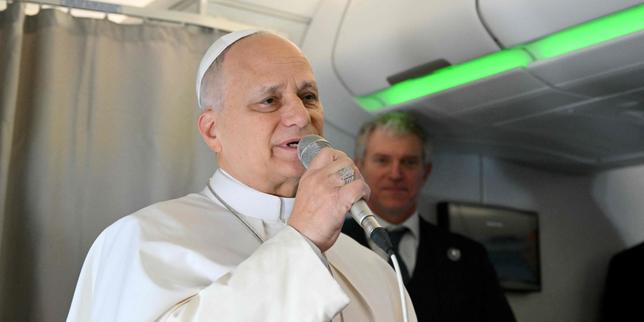
The collision between the Holy See and the White House has moved beyond mere theological disagreement into a full-scale geopolitical confrontation. When Pope Leo XIV declared he does not fear the Trump administration, he wasn't just defending the Gospel; he was drawing a line in the sand regarding the moral governance of the twenty-first century. This isn't a squabble over rhetoric. It is a fundamental clash between two diametrically opposed visions of global order—one rooted in national sovereignty and transactional politics, the other in a borderless moral authority that views modern secular power as inherently transient.
The tension has reached a boiling point because both leaders recognize that the stakes involve more than just immigration or environmental policy. They are fighting for the soul of Western institutional trust.
The Gospel as a Geopolitical Weapon
To understand the friction, one must look past the headlines of "fearlessness." The Vatican has historically functioned as the world’s oldest intelligence agency and diplomatic corps. When Leo XIV invokes the Gospel in response to American political pressure, he is utilizing the only "soft power" tool capable of bypassing traditional state borders. He is signaling to the global Catholic population—roughly 1.3 billion people—that their primary loyalty lies with a moral framework that the current American administration finds inconvenient.
The Trump administration views this as interference. From the perspective of Washington, the Pope’s critiques of "America First" policies aren't just religious observations; they are perceived as tactical attempts to undermine domestic policy. The White House operates on a logic of tangible results and national interest. The Vatican operates on a timeline of centuries. This temporal disconnect makes any middle ground nearly impossible to find.
The Mechanics of the Rift
The specific friction points usually center on three pillars: border security, climate mandates, and the role of international organizations. However, the deeper mechanism at play is the privatization of morality. The administration argues that a nation’s first moral duty is to its own citizens. Leo XIV counters that a nation’s moral health is measured by its treatment of the "least among us," regardless of legal status or nationality.
This is a structural conflict. If the Vatican succeeds in framing the administration's policies as "anti-Christian," it risks alienating a massive segment of the President's base. Conversely, if the administration successfully brands the Pope as a "globalist activist," it erodes the Church’s authority in the very regions where it is currently growing most rapidly.
Behind the Scenes of the Administration Strategy
Sources familiar with the State Department's current posture suggest that the White House isn't just reacting to the Pope; they are actively trying to bypass him. There is a concerted effort to build bridges with conservative Catholic bishops who find Leo XIV’s more progressive leanings distasteful. By amplifying these internal Church divisions, the administration hopes to neutralize the Pope's influence within the United States.
It is a high-stakes gamble. For decades, the GOP and the Catholic Church were aligned on "culture war" issues like life and family structure. That alliance has fractured. The current administration has pivoted toward a populist nationalism that often contradicts the Church’s stance on social welfare and refugee resettlement.
- The Funding Lever: Some inside the administration have whispered about re-evaluating the tax-exempt status of religious NGOs that facilitate migration, a move that would be a direct strike at the Church's operational capacity.
- The Digital Narrative: There is a sophisticated digital campaign aimed at painting the Vatican as an out-of-touch European monarchy that fails to understand the realities of the working-class American.
Why the Pope Can’t Back Down
Leo XIV is acutely aware that the Church is losing ground in the West. Secularism is rising, and church attendance is cratering. By positioning himself as the chief antagonist to a polarizing American president, the Pope is attempting to re-brand the Church as a relevant, courageous voice for the marginalized.
He isn't just speaking to the White House; he is speaking to the Global South. The future of Catholicism is in Africa, Asia, and Latin America. In these regions, the American "America First" rhetoric is often viewed with deep suspicion or outright hostility. By standing firm against Washington, Leo XIV solidifies his standing with the vibrant, growing parts of his flock. He is willing to trade influence in the American suburbs for moral credibility in the developing world.
The Problem of Modern Infallibility
The Pope’s "fearlessness" is also a response to the way information moves today. In the past, a papal encyclical took months to filter down to the pews. Today, a single tweet or a candid remark on a plane goes viral in seconds. Leo XIV has leaned into this immediacy. He understands that in the attention economy, silence is interpreted as complicity.
However, this outspokenness carries a significant risk. By engaging so directly in partisan politics, the Pope risks turning the Papacy into just another "talking head" in the 24-hour news cycle. When the Gospel is used as a retort to a specific administrative policy, it can lose its timeless quality and become just another political platform. This is the "devaluation of the brand" that many Vatican insiders fear, even if they agree with the Pope's message.
The Intelligence Gap
One of the most overlooked factors in this standoff is the decline of formal diplomatic channels between the two entities. Historically, the U.S. Ambassador to the Holy See was a vital link that smoothed over these types of public disagreements. Currently, that office has been sidelined in favor of direct, confrontational rhetoric.
Without these "backchannels," every disagreement becomes a public spectacle. We are seeing the death of quiet diplomacy. When the Pope says he is not afraid, he is essentially acknowledging that the private negotiations have failed. He is taking his case to the court of public opinion because he no longer believes he can influence the administration through traditional means.
Financial Implications of the Conflict
The financial ties between the American Catholic Church and the Vatican are immense. American donors are among the largest contributors to the Holy See’s coffers. If the administration successfully drives a wedge between American Catholics and the Pope, the Vatican’s global operations could face a significant liquidity crisis.
This isn't just about "Peter’s Pence" (the annual collection for the Pope). It's about the massive network of Catholic charities and hospitals that rely on a mix of private donations and government grants. If the relationship between the Church and the State continues to deteriorate, the collateral damage will be felt by the millions of people who rely on those services. It is a game of chicken where the poorest are the ones strapped to the front of the cars.
The Ghost of 1982
There is a historical irony at play here. In the 1980s, Pope John Paul II and Ronald Reagan formed a "Holy Alliance" to take down the Soviet Union. They shared a common enemy and a clear objective. Today, the roles have shifted. The Vatican no longer sees a single ideological enemy like Communism; instead, it sees a fragmented world where the greatest threat is a "globalization of indifference."
The Trump administration, meanwhile, sees the current international system—including the Vatican’s diplomatic influence—as a relic of a failed globalist era. They aren't looking for a holy alliance; they are looking for compliance.
The Technological Front
We must also consider the role of disinformation. Both sides are being targeted by third-party actors who benefit from a divided West. Sophisticated bot networks frequently amplify the most divisive statements from both the Pope and the President, ensuring that any attempt at nuance is drowned out by the loudest voices.
The Vatican is ill-equipped for this kind of digital warfare. While the Pope has a massive social media following, the Church’s communication apparatus is still built for the era of print and radio. They are playing chess while the other side is playing a high-speed, algorithmic version of poker.
The Real Beneficiaries
When the two most visible leaders of Western moral and political thought are at each other's throats, the real winners are the authoritarian regimes that want to show the world that the Western model is broken. Every time Leo XIV and the Trump administration trade barbs, it reinforces the narrative that liberal democracy and its traditional moral pillars are in a state of terminal decline.
The Inevitable Collision
This conflict will not be resolved by a polite meeting or a joint communiqué. The ideologies are too entrenched. The Pope views himself as the guardian of a universal truth that transcends borders; the President views himself as the protector of a specific nation's interests.
The "fearlessness" Leo XIV describes is a necessity for his survival. If he bows to the pressure of the most powerful man in the world, he loses his claim to moral independence. If the President softens his stance, he loses the "strongman" image that is central to his political identity.
We are entering an era of "confessional politics" where your stance on the Pope or the President becomes a shorthand for your entire worldview. The middle ground has been paved over. The institutional weight of the Vatican is being pitted against the raw executive power of the United States.
The question isn't who will win, but what will be left of the international moral order once the dust settles. Power, in its most naked form, rarely leaves room for the Gospel message the Pope claims to protect, and it rarely tolerates the dissent he is determined to provide. The standoff is the new status quo.