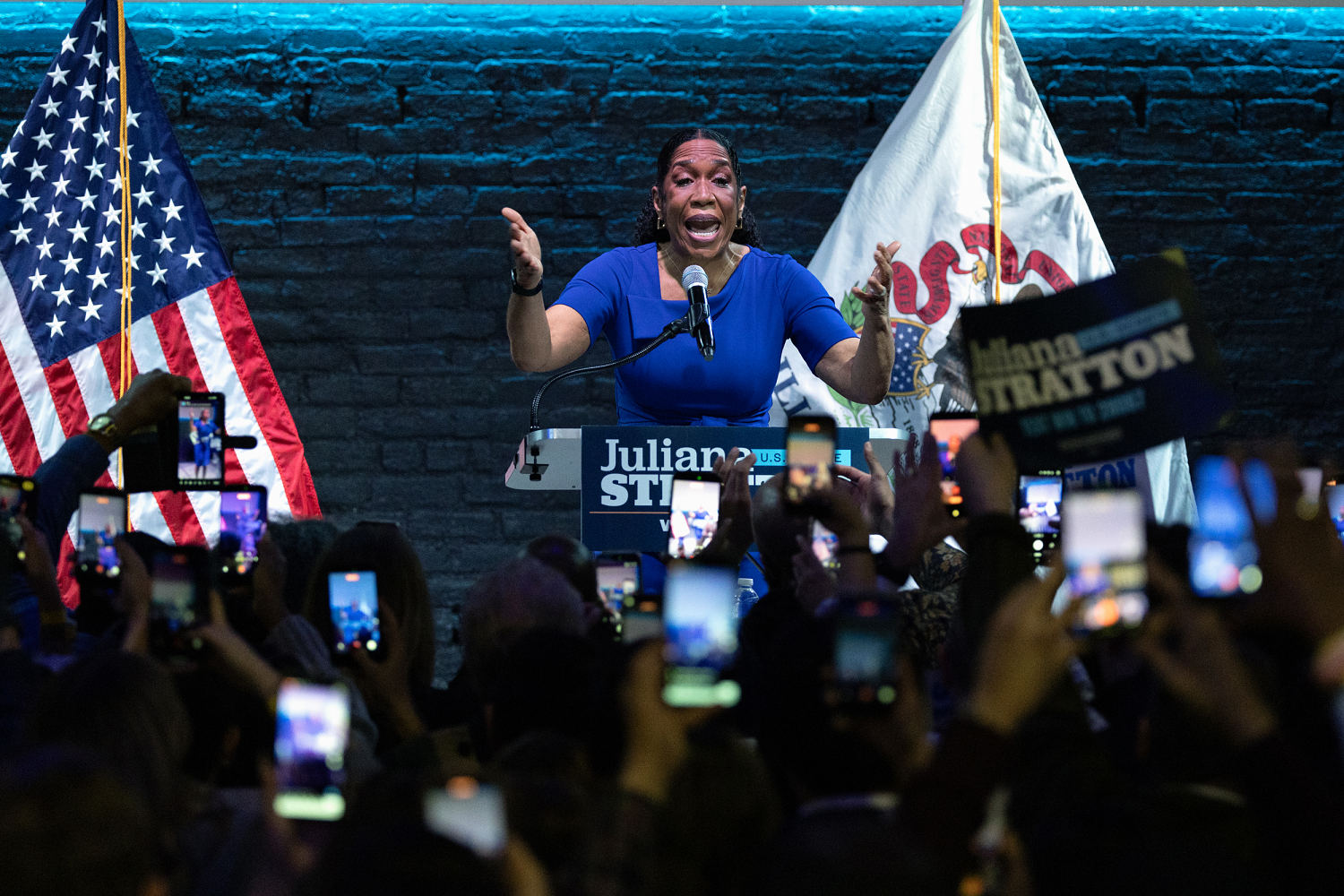
The air inside the Chicago campaign headquarters didn't smell like victory. Not yet. It smelled like industrial-strength coffee, damp wool coats, and the electric, ozone scent of a dozen laser printers working overtime. There is a specific kind of silence that exists in the moments before a race is called. It isn't quiet. It is a vibrating, heavy thing, filled with the rhythmic tapping of nervous pens against clipboards and the muffled glow of a hundred smartphones lighting up darkened faces.
Juliana Stratton stood in the center of it.
To the news tickers and the data analysts, she was a series of polling percentages and demographic blocks. They saw a Lieutenant Governor with a law degree and a background in restorative justice. They saw a strategic move by the Democratic party to solidify a seat. But if you looked at the way she adjusted her blazer—a sharp, intentional movement—you saw something else. You saw the weight of a map that has been under construction for generations.
The news broke with a jagged edge. The primary was over. Stratton had won.
Illinois is a state of deep, structural contradictions. You have the glass and steel of the Loop, where billions of dollars move through fiber-optic cables in the blink of an eye. Then, you drive three hours south, and the horizon flattens into cornfields and quiet towns where the primary concern isn't global trade, but whether the local clinic can stay open another year. For a Senatorial candidate, the challenge isn't just winning; it’s proving that you can stand in both worlds without losing your footing.
The Geography of the Invisible
Imagine a woman named Elena. She lives in Peoria. Elena isn't a political strategist. She’s a mother of three who works two jobs and wonders why the "economic recovery" everyone talks about on the news hasn't made it to her grocery bill. To Elena, a Senate primary feels like a distant weather pattern—something that happens high up in the atmosphere that might eventually result in rain or a storm, but rarely provides shade.
When Juliana Stratton stepped onto that stage to claim her victory, she wasn't just talking to the donors in the front row. She was answering Elena.
The standard political narrative would tell you that this win was about "base mobilization" or "shifting electoral landscapes." Those are cold words. They strip the marrow out of the bone. The reality is that Stratton’s victory represents a shift in how power is perceived in the Midwest. For a long time, the Senate was seen as a mahogany-paneled club, a place where policy was distilled into abstractions. Stratton’s career has been the opposite. It has been about the grit. It has been about sitting in circles with people the system had written off and asking, "What does justice actually look like to you?"
The Cost of the Climb
Progress is never a straight line. It’s a jagged, uphill scramble.
Before she was the projected Senator-elect, Stratton was the first Black woman to serve as Lieutenant Governor in Illinois. That title carries a certain prestige, but it also carries a tax. There is an invisible tax on being "the first" or "the only." It means your mistakes are magnified and your successes are often attributed to the "mood of the country" rather than your own exhaustion.
During the primary, the attacks were predictable. They were the standard-issue broadsides about being too "establishment" or, conversely, too "progressive." In the modern political arena, you are often asked to be a caricature. The media wants a hero or a villain. They rarely have space for a human being who is trying to balance the needs of a Chicago transit worker with the anxieties of a Southern Illinois farmer.
But the numbers told a story that the pundits missed. Stratton didn't just win the urban centers. She made inroads in places where the Democratic brand had been fading for years. Why? Because she spoke about the "Restorative Justice" model not as a legal theory, but as a way to keep families together. She spoke about economic development not as a corporate handout, but as a way to ensure a kid in East St. Louis has the same shot as a kid in Winnetka.
The Echo in the Hall
History has a long memory in Illinois. This is the land of Lincoln and Obama. The shadows are long here. When a candidate like Stratton wins, they aren't just running against their contemporary opponents; they are running alongside the ghosts of those who came before.
There is a specific kind of pressure that comes with that lineage. It’s the pressure of the "unspoken expectation." You aren't just expected to vote correctly on a budget bill; you are expected to embody the hopes of people who have been told "wait" for fifty years.
Consider the mechanics of the win. $15 million. $20 million. The figures fly around like confetti. We talk about campaign finance as if it’s a scoreboard, but for the voter, those numbers are nauseating. They represent a barrier to entry. Yet, within that sea of capital, Stratton managed to maintain a narrative of accessibility. That is the needle she had to thread. She had to be powerful enough to win, yet grounded enough to be recognized by the woman in Peoria.
The Breaking of the Fever
The primary win is a release of tension, but it’s also a commencement. The "cold facts" of the victory are simple: she secured the majority of the delegates, she outperformed her rivals in key suburban tracts, and she enters the general election as the heavy favorite.
But facts don't move people. Meaning moves people.
The meaning of this moment lies in the shattering of the idea that a candidate has to choose a side of the "Illinois divide." For too long, the state has been narrated as a war between the city and the "rest of us." It’s a convenient story for cable news, but it’s a lie. The farmer and the bus driver are both worried about the cost of insulin. They are both worried about whether their children will be able to afford a home.
Stratton’s campaign wasn't built on ignoring the differences, but on finding the common ache.
The night of the primary, as the balloons drifted toward the ceiling and the music pumped through the speakers, there was a moment when she looked out at the crowd. It wasn't the look of someone who had just finished a race. It was the look of someone who had just been handed a very heavy, very important tool.
The Senate is that tool.
It is a place where a single voice can hold up the entire country or move it an inch forward. For the people in that room, and the people watching on flickering screens in diners across the state, the victory wasn't about a party seat. It was about the hope that the map of the "invisible Illinois" was finally being drawn by someone who had actually walked the ground.
She didn't offer a "game-changer." She didn't promise a "paradigm shift."
She offered a hand.
And in a world that feels increasingly like a series of closed doors, that was enough to make people turn out in the rain, stand in the lines, and cast a vote for a future that hadn't been written yet. The primary is over. The work of proving that the victory belonged to everyone—not just the woman on the stage—is the only thing that matters now.
The map is still unfinished. But for the first time in a long time, the lines are starting to make sense.