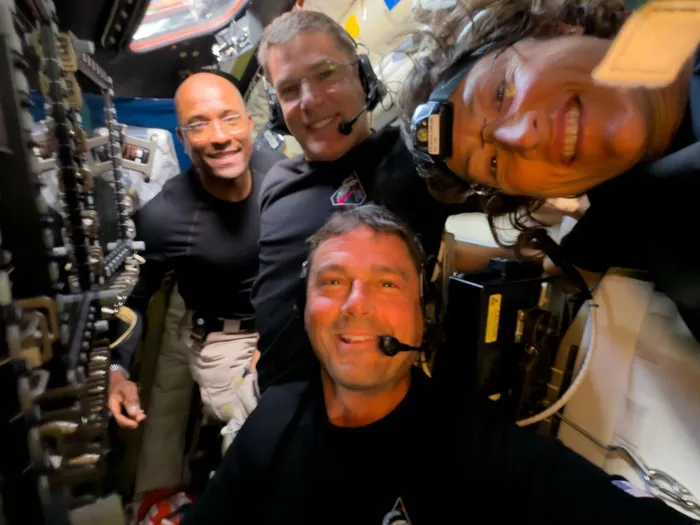
NASA is betting the lives of four astronauts on a series of experiments that have nothing to do with rocket thrust or orbital mechanics. While the public focuses on the historical significance of the first crewed lunar flyby in half a century, the internal engineering anxiety centers on the Deep Space Radiation Genomics (DSRG) study. This isn't just another lab task. It is the definitive test of whether human biology can actually withstand the environment beyond Earth’s magnetic protection for extended durations. If the biological countermeasures tested on Artemis II fail to provide clear data on cellular repair, the entire roadmap for a permanent Moon base or a Mars landing effectively hits a dead end.
The Invisible Wall Beyond Low Earth Orbit
We have spent decades getting comfortable in Low Earth Orbit (LEO). On the International Space Station, crews are still shielded by the Van Allen Belts, which deflect the brunt of solar energetic particles and galactic cosmic rays. Artemis II changes the math. Once the Orion capsule breaks away from Earth's protective "bubble," the crew will be exposed to a relentless bombardment of high-energy ionizing radiation.
This isn't just about a slightly higher risk of cancer thirty years down the line. We are talking about Acute Radiation Syndrome and central nervous system degradation. The primary mission of the Artemis II science manifest is to quantify how deep-space radiation shatters DNA strands in real-time. By flying a suite of biological samples—and monitoring the crew's own physiological responses—NASA is looking for the "breaking point" of human tissue.
The hardware is ready. The rockets have the lift capacity. But the "wetware"—the human body—remains the most volatile variable in the mission profile.
Why the ERM is the Only Sensor That Matters
Inside the Orion cabin, a device called the External Radiation Monitor (ERM) will be working overtime. Unlike previous sensors that simply measured total dose, the ERM is designed to track the specific types of heavy ions that slice through aluminum hulls like hot knives through butter.
Engineers have long known that shielding has a diminishing return. If you make the hull too thick, the weight makes the rocket too heavy to launch. If you use the wrong materials, incoming cosmic rays hit the shield and create a "secondary spray" of neutrons that are actually more dangerous to the crew than the original strike. Artemis II is the first time we will see how the Orion’s hull composition performs as an integrated shield against a live deep-space environment.
The data gathered here will dictate the design of the Gateway station and every future lunar habitat. If the ERM shows that secondary radiation spikes are higher than simulated, the current plan for "lightweight" shielding is toast. We would be forced to go back to the drawing board, potentially delaying the Artemis III landing by years.
The Mitochondrial Crisis in Deep Space
Beyond the sensors, the real investigative story lies in the mitochondrial stress research being conducted on the crew. Recent data from the "Twin Study" and subsequent ISS missions suggests that spaceflight causes a systemic "power failure" at the cellular level.
In deep space, this effect is amplified. When radiation hits the mitochondria, it triggers an oxidative stress response that can lead to organ dysfunction. On Artemis II, the crew will be testing specific nutritional and medicinal protocols designed to "prime" their cells against this damage.
The Limitations of Earth-Bound Testing
You cannot simulate the full spectrum of galactic cosmic rays (GCRs) on Earth. We have particle accelerators, but they usually fire one type of ion at a time. The actual "soup" of radiation in the lunar vicinity is a chaotic mix of protons, alpha particles, and heavy nuclei moving at relativistic speeds.
- Protons: Plentiful but easier to stop with hydrogen-rich materials like polyethylene.
- Heavy Ions (HZE): Rare but devastating. A single HZE particle can leave a trail of destroyed cells through an astronaut's brain or retina.
Artemis II is the only laboratory we have that offers the "full-strength" cocktail. This is why the mission's science load is dominated by passive and active dosimeters. They are trying to build a high-fidelity map of the danger zones within the cabin.
The Water Wall Strategy
One of the more pragmatic—and overlooked—experiments on Artemis II involves the management of the ship's consumables. Hydrogen is the best shield against radiation. Since water is $H_2O$, it serves as a dual-purpose barrier.
The crew will be practicing "shelter-in-place" maneuvers. During a solar flare event, the astronauts will move to the center of the capsule and surround themselves with storage bags filled with water, food, and even waste. It is a low-tech solution to a high-tech problem. The investigative reality, however, is that we don't know if these "water walls" are enough to stop a massive Solar Particle Event (SPE).
If a major solar storm hits during the 10-day mission, we will find out very quickly if the "shelter" strategy is a legitimate survival tactic or just a psychological comfort for a crew with nowhere to run.
Counter-Arguments to the Current Shielding Philosophy
Not everyone in the aerospace community agrees with NASA’s "shielding-heavy" approach. Some biophysicists argue that we should be focusing on pharmacological hardening. Instead of building thicker walls, we should be engineering the human body to repair itself faster.
There is a quiet tension between the engineers who want to add more mass to the Orion and the biologists who believe that's a losing battle. The Artemis II results will likely settle this internal debate. If the radiation monitors show that even Orion’s advanced alloys can't keep the dose below "safe" career limits, the focus will shift sharply toward genetic medicine and radical new drugs that prevent DNA ionization.
The Reliability of the BioSentinel Heritage
The Artemis II experiments are built on the back of BioSentinel, a small satellite that launched with Artemis I to study the effects of radiation on yeast. Why yeast? Because its DNA repair mechanisms are remarkably similar to humans.
The early data from BioSentinel was sobering. It showed that even in the relatively "quiet" periods of solar activity, the rate of genetic mutation was measurable and consistent. Artemis II takes this a step further by using human biological samples that will be returned to Earth for immediate sequencing.
We are no longer guessing. We are about to have a definitive "before and after" snapshot of human biology exposed to the lunar environment.
Logistics of the Ten Day Window
The brevity of the Artemis II mission—roughly ten days—is its biggest limitation. Some critics argue that a ten-day flyby cannot accurately predict the health outcomes of a 30-day lunar surface stay or a 500-day Mars transit.
However, the mission's trajectory is designed to take the crew through the High-Altitude Radiation Environment at a specific velocity. This allows researchers to gather "peak load" data. By observing how the body handles the transition through the heart of the Van Allen belts and into the lunar void, they can extrapolate the long-term degradation curves.
It is a high-speed stress test. Think of it like redlining an engine for ten minutes to see if it will eventually explode during a ten-hour drive.
The Data Sovereignty Issue
There is a looming question of who owns this biological data. With private companies like SpaceX and Blue Origin planning their own lunar missions, the physiological data gathered on Artemis II is the most valuable currency in the space industry.
While NASA generally shares its findings, the specific "raw" genetic data of the astronauts is protected by privacy laws. This creates a bottleneck. Future commercial missions will need this data to design their own life-support systems, but they may be flying blind if the full results of the Artemis II radiation trials aren't fully transparent.
The industry is watching to see how much of the "brutal truth" regarding radiation damage NASA is willing to make public. Significant health risks could dampen investor enthusiasm for lunar tourism and long-term colonization.
Structural Integrity vs. Biological Integrity
We have perfected the art of keeping the vacuum of space out of the cabin. We can maintain pressure, temperature, and oxygen levels with near-perfect reliability. But radiation is different. It doesn't care about airlocks or O-rings.
The Artemis II mission represents a shift in the hierarchy of spaceflight risks. In the Apollo era, the primary fear was a mechanical failure—a thruster not firing or a heat shield cracking. In the Artemis era, the machinery is more robust, but our understanding of the long-term biological cost is still in its infancy.
The sensors tucked away in the corners of the Orion cabin are not just "science payloads." They are the ultimate arbiters of our future as a multi-planetary species. If those sensors return numbers that are too high, the "Moon to Mars" vision remains a fantasy.
The mission isn't just a lap around the Moon. It is a desperate search for a way to survive the journey. We are sending four people into the radiation fire to see if they come back changed at the molecular level, and the answer will determine whether anyone follows them.
The biological data from this mission will either greenlight the next century of exploration or serve as a permanent "Keep Out" sign for the deep-space void.