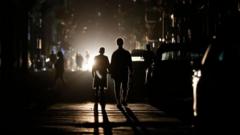
The total failure of Cuba’s National Electric System (SEN) in late 2024 is not an isolated mechanical event but the culmination of a decade-long degradation of three interdependent pillars: fuel logistics, infrastructure thermal efficiency, and fiscal solvency. When the Antonio Guiteras thermoelectric plant—the island’s largest synchronized power provider—tripped, it triggered a frequency collapse that the rest of the aging grid lacked the inertia to absorb. To understand why a single plant failure plunged ten million people into darkness, one must analyze the physics of the grid’s "black start" limitations and the economic bottleneck of the island's energy mix.
The Thermal Efficiency Deficit
Cuba’s energy generation relies heavily on seven aging thermoelectric plants (CTEs) that are, on average, 40 years old. In the field of power engineering, the reliability of a thermal plant is governed by its maintenance cycle and the quality of its fuel. The Cuban grid operates at a permanent disadvantage due to its reliance on heavy domestic crude oil with a high sulfur content.
This high-sulfur fuel is corrosive, accelerating the fouling of boiler tubes and reducing the heat transfer coefficient. Consequently, the plants operate well below their nameplate capacity. When a plant like Antonio Guiteras is forced to run continuously to meet base load demand without scheduled "preventative maintenance" windows, the probability of a catastrophic tube leak or turbine trip increases exponentially. The 2024 collapse was the thermodynamic breaking point where the "forced outage" rate finally exceeded the grid’s total spinning reserve.
The Decentralization Paradox
In an attempt to mitigate the failure of massive CTEs, the Cuban government previously implemented "Distributed Generation"—thousands of small diesel and fuel oil generators spread across the island. While this strategy was intended to provide resilience, it created a massive logistical friction point.
- The Transportation Tax: Unlike a centralized plant fed by a pipeline or deep-water port, distributed generators require a constant fleet of fuel trucks.
- Fuel Quality Sensitivity: Small-bore diesel engines are less tolerant of the heavy, unrefined crudes used in the larger plants, requiring imported refined diesel that Cuba struggles to finance.
- Synchronization Complexity: Reconnecting a fragmented grid of small generators after a total collapse (a "black start") is technically more difficult than restarting a centralized system. It requires precise frequency matching across hundreds of nodes, a task made nearly impossible by the lack of modern automated control systems.
The Cost Function of Energy Sovereignty
The economic mechanism driving the blackout is a broken feedback loop between energy production costs and revenue. The Cuban state heavily subsidizes electricity. When the global price of oil rises or when key allies like Venezuela reduce their subsidized shipments, the state’s fiscal deficit widens.
This creates a "Maintenance-Fuel Trap." The government must choose between spending its limited hard currency on fuel to keep the lights on today or on spare parts to ensure they stay on next year. For the past half-decade, the choice has consistently been fuel, leading to a "cannibalization" strategy where non-functional plants are stripped of parts to keep a few turbines spinning.
The Floating Power Plant Variable
To fill the gap left by crumbling domestic plants, Cuba has increasingly relied on Karadeniz Powerships—floating Turkish power plants moored in Cuban harbors. These ships provide a significant percentage of the island's electricity, but they represent a high-risk operational dependency:
- Lease Costs: These units are paid for in hard currency, creating a constant drain on the central bank.
- Fuel Requirements: They often require specific fuel grades that the island cannot produce, making the grid a hostage to international supply chains.
- Grid Integration: Because these ships are concentrated in specific ports (like Havana and Mariel), the transmission lines leading away from them become bottlenecks. If a high-voltage line fails in the central provinces, the power from the ships cannot reach the eastern end of the island, leading to regional "islanding" and eventual collapse.
The Mechanics of a Total Grid Collapse
A power grid is a massive, synchronized machine that must maintain a precise frequency (60Hz in Cuba). When the Antonio Guiteras plant went offline, the sudden loss of megawatts caused the frequency to drop instantly. In a modern grid, automated load-shedding would cut power to specific neighborhoods to balance the system.
In Cuba, the infrastructure is so brittle that the drop was too fast for the control systems to manage. When the frequency falls below a critical threshold, other generators automatically trip to protect themselves from mechanical damage. This creates a "cascading failure" where each plant that goes offline puts more strain on the remaining ones, leading to a total system shutdown in a matter of seconds.
The "black start" process—restarting the grid from zero—is a delicate operation. You cannot simply flip a switch; you must start a small generator, use it to start a larger one, and slowly add "load" (consumers) while keeping the frequency stable. If too many people turn on their refrigerators at once, the system crashes again. This explains why, in the days following the initial collapse, the Cuban grid "flickered" on and off; the system was repeatedly failing the synchronization test.
Strategic Realignment Requirements
The current Cuban energy strategy is reactive, not structural. To transition out of a permanent blackout state, the following shifts are thermodynamically and economically necessary:
- Conversion to Natural Gas: Moving away from high-sulfur crude to Liquefied Natural Gas (LNG) would reduce plant corrosion and increase the mean time between failures. This, however, requires massive investment in regasification terminals.
- Utility-Scale Solar Integration: Cuba has high solar irradiance, but the grid currently lacks the battery storage capacity to handle the intermittency of renewables. Without storage, adding more solar panels actually increases grid instability during cloud cover or sunset.
- Tariff Reform: The current subsidy model prevents the state from recovering the "Levelized Cost of Energy" (LCOE). Without a move toward market-clearing prices for at least the industrial sector, there is no internal capital for infrastructure reinvestment.
The immediate priority for the Cuban energy ministry must be the stabilization of the "Central-East Transmission Axis." Until the physical wires connecting the power-rich west to the power-starved east are reinforced and automated, any failure at a major plant will continue to result in a national, rather than regional, blackout. The focus should shift from "generating more power" to "hardening the synchronization nodes" to prevent the next frequency excursion from becoming a total system reset.