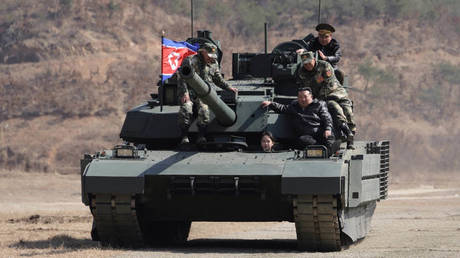
The visual of Kim Ju Ae, the daughter of Kim Jong Un, ostensibly operating a main battle tank during large-scale military exercises represents more than a staged domestic propaganda event. It is a calculated deployment of Kinetic Legitimacy, a framework where the regime anchors the transition of power not just in bloodline, but in the direct command of the state’s primary violence-delivery systems. By placing a potential successor within the cockpit of an armored fighting vehicle, the North Korean leadership is signaling the integration of the "Paektu" bloodline with the Fourth Industrial Revolution goals of their military modernization program.
The Triad of Dynastic Signaling
The participation of the Kim family in live-fire drills serves three distinct strategic functions that traditional analysis often conflates into simple "saber-rattling."
- Generational Continuity of Command: The transition from Kim Jong Il’s "Songun" (Military-First) policy to Kim Jong Un’s "Byungjin" (Simultaneous development of nukes and economy) required a shift in how the leader interacts with the military. Kim Ju Ae’s presence suggests a third phase: Technical Command Continuity, where the successor is seen mastering the hardware of modern warfare, not just the theory of revolutionary struggle.
- Normalization of Female Command: While North Korean society remains deeply patriarchal, the regime is using these high-profile military engagements to pre-emptively neutralize internal resistance to a female leader. By showing her "driving" a tank—a quintessentially masculine symbol of brute force—the state media (KCNA) is re-coding her persona from "beloved daughter" to "military commander."
- The Performance of Tactical Competency: Unlike previous generations who were photographed pointing at maps, the current iconography emphasizes tactile engagement. Driving a tank or observing paratrooper drops from a command post provides a visual data point of readiness intended to demoralize South Korean (ROK) and American intelligence assessments regarding the stability of the transition.
Mechanical Capability vs. Propaganda Optics
The vehicle featured in the drills appears to be North Korea’s "new type" main battle tank (MBT), first unveiled during the October 2020 parade and often colloquially referred to by Western analysts as the M2020. Understanding the technical leap this vehicle represents is vital for contextualizing why the regime chose this specific platform for Kim Ju Ae’s debut in mechanized maneuvers.
The Evolution of the Chonma-ho Lineage
For decades, the Korean People’s Army (KPA) relied on derivatives of the Soviet T-62. The M2020 departs from this by incorporating elements that mimic the Russian T-14 Armata and the American M1A2 Abrams. The presence of composite armor modules, potential hard-kill Active Protection Systems (APS), and anti-tank guided missile (ATGM) launchers on the side of the turret indicates a shift toward a more survivable, high-complexity platform.
The decision to have Kim Ju Ae "drive" this specific tank suggests that the regime views the M2020 as the crown jewel of its conventional forces. If she were pictured in an older T-55 derivative, the message would be one of tradition; by placing her in the M2020, the message is one of Technological Ascendancy.
The Logistics of the "March 13th" Exercises
The drills conducted on March 13th were framed as a "tank men’s training match." This structure allows the regime to quantify military performance in a way that mimics industrial production metrics. The exercises focused on:
- Rapid Maneuverability: Testing the power-to-weight ratio of the new MBTs across rugged terrain, simulating a breakthrough of the Demilitarized Zone (DMZ).
- Target Acquisition: Evaluating the fire-control systems (FCS) which North Korea claims are now digitized and capable of "hunter-killer" operations—where the commander identifies a new target while the gunner is engaging the current one.
- Combined Arms Integration: While the tanks were the focus, the drills included interactions with motorized infantry and drone reconnaissance units.
The bottleneck in North Korean armored doctrine remains the Fuel-to-Combat Ratio. Regardless of how advanced the M2020 appears, the KPA’s ability to sustain a high-tempo mechanized offensive is constrained by chronic petroleum, oil, and lubricant (POL) shortages. Therefore, these exercises are "sprints" rather than "marathons," designed to prove that the tip of the spear is sharp, even if the shaft is brittle.
Defining the Successor’s Public Curriculum
Kim Ju Ae’s appearances have followed a specific, accelerating curriculum of statecraft:
- Strategic Deterrence (2022-2023): Debut at ICBM launches (Hwasong-17 and 18). This established her association with the ultimate guarantee of regime survival.
- Economic Oversight (2023): Visits to poultry farms and industrial sites, linking her to the "People’s Livelihood."
- Conventional Force Mastery (2024): The tank drills. This fills a critical gap in her resume, proving she can lead the "million-man army" in a traditional ground war scenario.
The absence of her mother, Ri Sol Ju, from these recent military events is a structural choice. It isolates Kim Ju Ae as the sole apprentice to the Supreme Leader, removing the "family outing" vibe and replacing it with an "operational internship."
Strategic Implications for the ROK-US Alliance
The alliance must look past the "novelty" of a child in a tank and address the underlying shift in North Korean signaling.
The Psychological Asymmetry Factor
By humanizing the succession through a young girl, the regime creates a cognitive dissonance for Western audiences. However, the data shows that this "softer" image is consistently paired with hard-power displays. This creates an Asymmetric Narrative Pressure: the North can claim it is merely "defending the future of its children," while any Western response is framed as a threat to a literal child.
Targeting the ROK General Election Cycle
The timing of these drills often correlates with political volatility in Seoul. By demonstrating high-readiness mechanized forces, Pyongyang aims to influence the South Korean electorate’s perception of "war vs. peace," attempting to drive a wedge between the conservative administration’s hardline stance and the public’s desire for stability.
Tactical Assessment of the M2020 Platform
Analyzing the footage of Kim Ju Ae’s "drive" reveals several details about North Korean domestic manufacturing:
- Optical Glass and Sensors: The presence of independent commander’s sights suggests that North Korea has successfully bypassed sanctions to acquire—or domesticate—the production of high-end thermal imaging and laser rangefinding components.
- Armor Composition: The thickness of the turret fronts on the M2020 suggests a move away from simple homogeneous steel toward non-explosive reactive armor (NERA) or ceramic composites.
- Digital Communication: The antennas visible on the command variants indicate a move toward a digital battlefield management system, which would allow Kim Jong Un to command units in real-time from a remote location—or allow a successor to maintain oversight from a protected bunker.
The Cost Function of Elite Training
Each hour spent conducting these drills represents a significant diversion of resources. For a state under heavy sanctions, the "Cost of Signaling" is a vital metric.
- Opportunity Cost: The fuel used in a single division-scale tank exercise could power agricultural machinery for an entire province during the planting season.
- Maintenance Overhead: The M2020, being a high-complexity platform, likely has a high failure rate for its sophisticated components. These drills serve as a "stress test" for the domestic supply chain's ability to provide spare parts under simulated combat conditions.
The regime has calculated that the Legitimacy ROI (Return on Investment) of these images outweighs the material cost of the fuel and hardware depreciation. They are buying insurance against a power vacuum.
The Strategic Shift to "Offensive" Rhetoric
During these drills, Kim Jong Un’s language moved from "deterrence" to "annihilation." This rhetorical escalation, paired with the physical presence of his successor, suggests a shift in the North’s Red-Line Definition. Previously, military drills were defensive responses to US-ROK "Ulchi Freedom Shield" exercises. Now, they are framed as "preparations for a Great Event"—a euphemism for the reunification of the peninsula by force.
The "Successor in the Tank" image is the definitive visual marker of this new era. It tells the world—and the KPA elite—that the next leader will not be a reformer or a diplomat, but a commander-in-chief who is comfortable in the turret of a tank.
The ROK-US intelligence community must prioritize the monitoring of the KPA’s mechanized logistics hubs over the next 24 months. If the "symbolic" driving of tanks by Kim Ju Ae transitions into the large-scale stockpiling of fuel and munitions at forward-deployed positions near the Kaesong corridor, the probability of a localized kinetic provocation increases from "low-static" to "high-active." The regime has moved the pieces into place; the focus must now shift from the person in the tank to the readiness of the unit behind her.