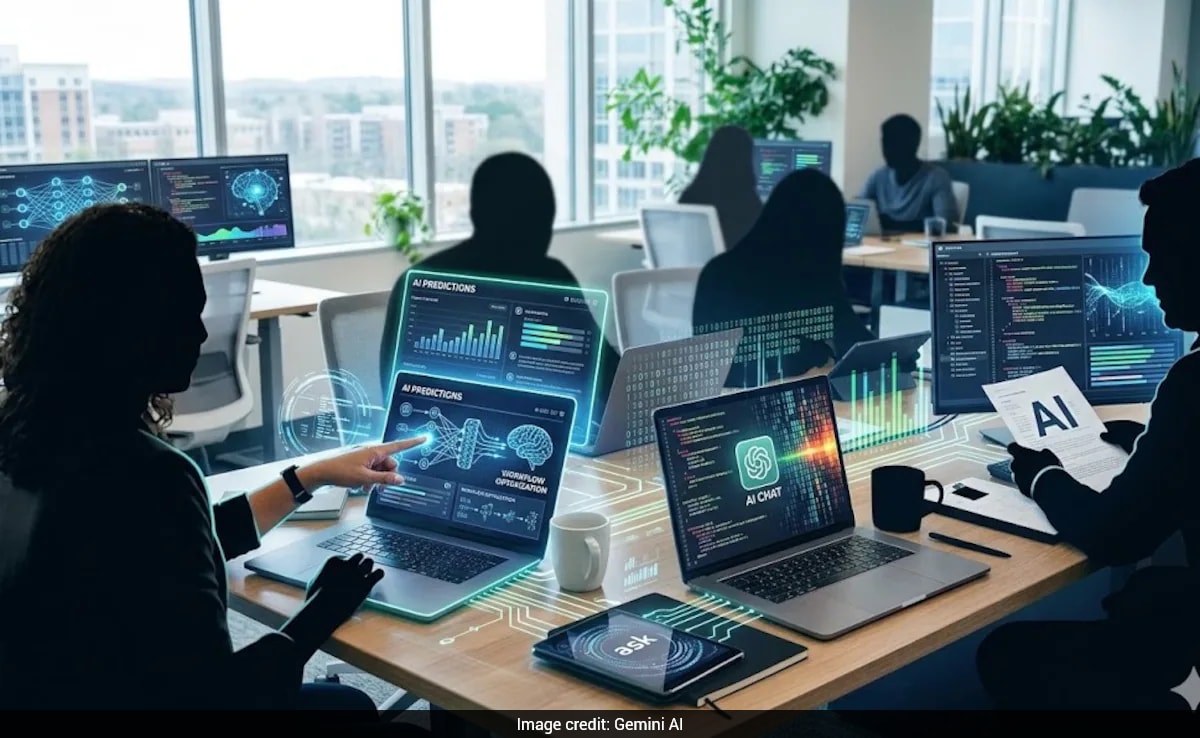
The glow of a laptop at 10:00 PM is a specific kind of light. It’s clinical. It’s lonely. Sarah, a mid-level project manager at a firm that prides itself on "innovation," stares at a blank spreadsheet that should have been finished three hours ago. Her company recently integrated a suite of high-end generative AI tools. The CEO sent an email blast about efficiency. The HR department held a webinar. Yet, Sarah is typing every formula by hand.
She knows the tool exists. She knows it could probably shave two hours off her night. But she won't touch it.
This isn’t a story about a glitch in the software. It’s a story about a glitch in the human psyche. Recent industry reports reveal a startling contradiction in the modern office: while the presence of AI in the workplace has surged—upwards of 60% in some sectors—a massive contingent of the workforce is actively choosing to look the other way. They are opting for the long road, the manual labor, and the mental exhaustion.
The statistics tell us the what. To understand the why, we have to look at the silence in the breakroom.
The Ghost in the Cubicle
Fear is a quiet passenger. When we talk about AI resistance, we often default to the "Luddite" trope—the idea of an older generation clinging to a typewriter while the world turns digital. That is a myth. The resistance is coming from every demographic, and it stems from a fundamental lack of psychological safety.
Imagine a hypothetical employee named Marcus. Marcus is twenty-four, tech-savvy, and fast. He realizes he can use an LLM to draft his weekly reports in seconds. He tries it once. The result is good. He feels a rush of relief, followed immediately by a cold, prickling dread.
If his manager finds out, does Marcus look lazy? If the software can do his job in thirty seconds, what is Marcus worth for the other thirty-nine hours and fifty-nine minutes of the week?
By choosing not to use the tool, Marcus is buying job security with his own time. It is a tax he pays to remain "essential." This isn't a failure of technology. It is a failure of leadership. When companies introduce these tools without redefining what "value" looks like, they inadvertently create a culture of digital shadows. People use AI in secret, or they don't use it at all, fearing that to adopt it is to sign their own pink slip.
The Paradox of Choice
We were promised that automation would gift us the "four-hour work week." Instead, it gave us the "four-minute panic."
The barrier to entry for AI isn't the interface. It's the cognitive load of verification. Every time a worker uses an AI tool, they enter into a high-stakes contract with an unpredictable partner. Reports indicate that "hallucinations"—the tech industry’s polite term for when a machine simply makes things up—remain a primary deterrent.
Think of it like this: If you have a car that works perfectly 95% of the time but occasionally steers into a ditch for no reason, you don't drive it to work. You walk.
For a data analyst, one wrong figure is a catastrophe. For a lawyer, a fake citation is a career-ender. The "efficiency" promised by AI is often offset by the grueling, manual process of fact-checking the output. Many employees have crunched the numbers and realized that it’s actually faster to do the work correctly once than to do it with AI and check it three times.
Trust is a binary. Once it's broken, the tool becomes a paperweight.
The Identity Crisis
There is a deeper, more visceral reason for the holdout. We are what we do.
For decades, we have tied our self-worth to our "craft." A graphic designer finds joy in the curve of a vector. A writer finds pride in the rhythm of a sentence. When an algorithm offers to do these things, it doesn't just offer help; it offers to take away the very thing that makes the worker feel talented.
I remember talking to a veteran architect who refused to use AI for initial sketches. He told me that his brain "works through his fingers." To bypass the sketching was to bypass the thinking.
This is the "human element" that data reports often miss. We aren't just biological processors of information. We are creatures who seek meaning. If the "work" is reduced to clicking a "Generate" button, the worker is reduced to a spectator. The resistance we see in the workplace is, in many ways, a quiet rebellion against the deskilling of the human spirit.
The Invisible Divide
While some ignore the tools, others are building a "shadow workforce." This is where the divide becomes dangerous.
On one side, you have the "Aversions"—those who, like Sarah, stay late to do it manually. On the other, you have the "Optimizers"—those who use AI but keep it hidden from their bosses. They turn in their work early and spend the rest of the day looking busy.
The gap between these two groups isn't just about technical skill. It's about a lack of transparency. When a company doesn't have a clear, supportive policy on AI, it creates an environment of "every person for themselves." The knowledge isn't shared. The best prompts aren't discussed. The mistakes aren't analyzed.
The result is a fragmented culture where the loudest voice in the room is the one who isn't there: the algorithm.
Bridging the Chasm
How do we fix a problem that isn't about code?
We stop talking about "productivity" and start talking about "purpose."
If a company wants its employees to embrace AI, it has to prove that the tool is an exoskeleton, not a replacement. This requires a radical shift in how we measure success. If Sarah’s boss told her, "I want you to use this tool so you can leave at 5:00 PM and spend more time on high-level strategy," she might listen. If Marcus’s manager said, "Show me how you used the AI to get this result so we can teach the rest of the team," he might stop hiding.
The stats show that AI use is rising, but the human heart is still lagging behind. We are currently in the "uncanny valley" of work—a place where the machines are smart enough to be threatening but not yet integrated enough to be trusted.
The most important tool in the modern office isn't an LLM. It isn't a cloud-based server or a neural network.
It's a conversation.
Until we address the fear of replacement, the burden of verification, and the loss of craft, the most powerful technology in human history will continue to sit idle on millions of screens, ignored by the very people it was meant to set free.
Sarah finally closes her laptop. It is 11:15 PM. The spreadsheet is perfect, finished by hand, cell by painful cell. She feels a sense of accomplishment, but she is exhausted. She looks at the icon for the AI assistant in the corner of her screen. It’s a small, unblinking eye.
She reaches for the power button and shuts it down. In the darkness, she is still the one in control. For now.