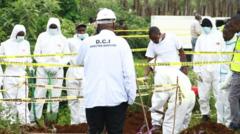
The dirt in the Chakama Ranch doesn't look like a graveyard. It is a deep, rusted ochre, the color of dried blood and sun-scorched hope. For miles, the scrubland of Kilifi County stretches out in a deceptive expanse of silence, broken only by the occasional cry of a bird or the rhythmic thud of a forensic investigator’s shovel hitting a shallow obstruction.
Underneath this silence lies a horror that the human mind instinctively tries to reject.
We talk about faith as a lighthouse. We describe it as a tether that keeps us grounded when the world turns volatile. But in the forest of Shakahola, faith was weaponized. It was turned into a hunger so profound that it led parents to watch their children wither into skeletal remains under the blistering Kenyan sun. The discovery of dozens of bodies—the vast majority of them infants and toddlers—is not just a headline about a doomsday cult. It is a visceral autopsy of what happens when desperation meets a predatory vacuum.
The Mechanics of the Void
Paul Mackenzie Nthenge did not start with a mass grave. He started with a screen. Through his Good News International Ministries, he broadcast a specific, lethal brand of hope to people who felt the world had already abandoned them.
To understand how a mother can carry her child into a thicket of thorns and refuse them water until their heart stops, you have to understand the specific anatomy of the "fast." This wasn't a symbolic religious rite. It was a structured, tiered descent into the grave. According to investigators and the harrowing accounts of the few who escaped the forest’s edge, the instructions were chillingly methodical: the children were to die first. The women followed. The men were next. The leadership would be the last to "meet Jesus."
This sequencing was tactical. By ensuring the children perished first, the cult stripped the parents of their primary biological and emotional reason to survive. A mother who has already buried her toddler in a shallow, unmarked hole in the red dust has very little left to fight for. Grief becomes the engine of the fast.
The Geography of a Secret
The ranch spans over 800 acres. It is a labyrinth of baobab trees and dense thicket. When the police first moved in, they didn't find a sprawling compound; they found "villages" named after biblical sites—Nazareth, Bethlehem, Judea. These weren't towns. They were clearings of misery.
The physical reality of the site is what haunts the forensic teams. You see the mounds. Small mounds. Sometimes, a single grave holds an entire family, layered like a grim geological record of a household's destruction. The statistics are a blunt instrument: hundreds of bodies have been exhumed over several phases of the investigation, and the count continues to climb as the shovels find new clearings.
But a number like "429" or "600" is too big to feel. It feels like a census. To feel the truth of Shakahola, you have to look at the discarded items left behind in the dirt. A plastic doll with one arm missing. A tiny, faded yellow sandal. A school notebook where the handwriting trails off into shaky, erratic lines. These are the artifacts of a stolen future.
The Anatomy of the Hook
Why did they stay? It’s the question everyone asks from the safety of their living rooms. We want to believe we are immune to such delusions. We tell ourselves we would see the madness for what it is.
But Mackenzie didn't recruit the cynical or the comfortable. He recruited the broken. He spoke to people who were drowning in the economic pressures of a changing Africa, people who felt that the "modern world" was a system of soul-crushing debt and moral decay. He offered an exit.
Consider a hypothetical man named Elias. Elias lost his job in Nairobi during the pandemic. His small plot of land was failing. He felt the weight of a thousand years of ancestral expectation on his shoulders, and he was failing it all. Then comes a voice on the radio, or a video on a shared phone, telling him that his suffering is actually a sign of his holiness. That the world is ending anyway. That the only way to protect his children from the "Great Tribulation" is to take them to the forest and prepare for a better kingdom.
When Elias gets to the forest, his phone is taken. His ID is burned. He is told that the outside world is now the enemy. By the time the hunger sets in, the forest has become his entire universe. There is no "outside" to go back to.
The Silence of the State
The tragedy of the mass graves is compounded by the fact that it was not a sudden explosion. It was a slow-motion car crash that the authorities heard happening for years.
Mackenzie had been arrested before. He had been flagged for inciting children to skip school. He had been investigated for his "extreme" teachings. Yet, each time, the gears of justice turned too slowly or jammed entirely. The "invisible stakes" here aren't just about religious freedom; they are about the catastrophic failure of the early warning systems meant to protect the vulnerable.
In the wake of the discovery, the Kenyan government has been forced into a mirror-darkly moment. How does a democratic state regulate the "un-regulatable" realm of the spirit? When does a sermon become a crime? The graves in Shakahola have turned these philosophical questions into a national emergency.
The Forensic Burden
The work of identifying the bodies is a grueling, clinical nightmare. Because many of the victims were children whose births were never formally registered, or who were brought to the forest in secret, DNA matching is a puzzle with missing pieces.
The pathologists describe the condition of the bodies with a clinical detachment that masks their own trauma. Many died of starvation. But others—and this is the detail that breaks the heart—show signs of strangulation or blunt force trauma. It suggests that when the "fast" didn't work fast enough, or when a child’s survival instinct drove them to cry out for food, the "enforcers" of the cult stepped in to finish the job.
They called it "helping them go to heaven."
The Lingering Dust
As the sun sets over Kilifi, the red dust hangs in the air, thick and suffocating. The ranch is now a crime scene, cordoned off by yellow tape that looks absurdly fragile against the backdrop of such monumental evil.
The survivors—those found wandering the woods like ghosts, refusing food even as they collapsed—are being treated in hospitals, their bodies slowly remembering how to process nutrients. But their minds are another matter. They are grieving for children they were told to sacrifice, for a prophet who promised them paradise and gave them a trench in the dirt.
We look for monsters in the dark, but the horror of Shakahola is that it happened in the bright, punishing light of day. It happened because a community was allowed to vanish into plain sight.
The wind blows across the ranch, stirring the surface of the soil. It’s just dirt. But for hundreds of families across East Africa, that red earth is now the only place where their children exist. They are waiting for the DNA results. They are waiting for the caskets. They are waiting for an explanation that will never be loud enough to drown out the silence of the forest.
The shovels continue their work, bite by bite, revealing the true cost of a hunger that was never meant to be satisfied. Over the next ridge, another clearing waits. Another mound of turned earth. Another tiny sandal.
The forest keeps its secrets until the steel of the spade forces them into the light.