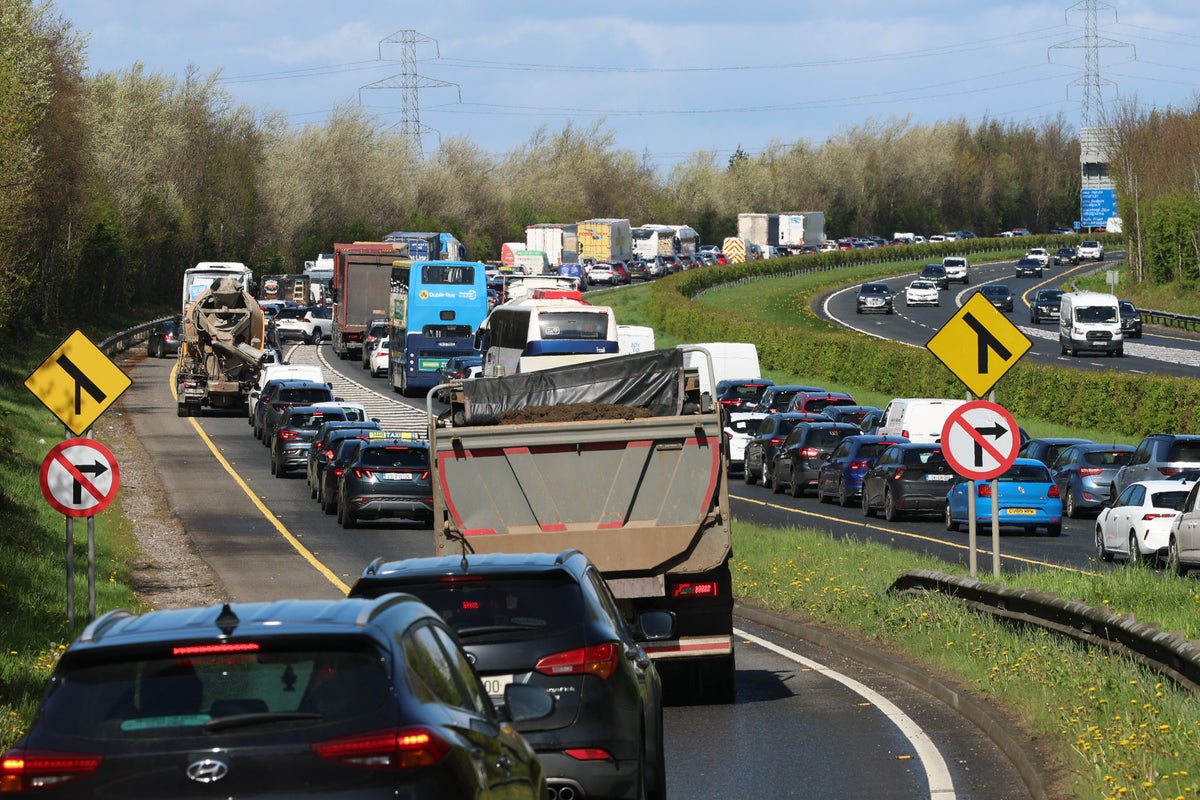
The dash glowed a soft, mocking amber. In the driver’s seat of a rusted-out delivery van idling near the Red Cow interchange, Seán watched the needle. It sat stubbornly on the left, vibrating against the peg of 'Empty.' Outside, the M50 was a graveyard of steel and glass. Five lanes of traffic held captive by a geography of frustration.
Ireland was not moving. It hadn't moved for three hours. For a different view, see: this related article.
When the conflict erupted across the Persian Gulf, the shockwaves didn't just rattle the halls of power in Tehran or Washington. They traveled thousands of miles, through undersea cables and commodities exchanges, until they manifested as a digit change on a plastic sign in a Kildare petrol station. Two euros and forty cents. Then fifty. Then sixty. The price of a liter of diesel had become a ransom note.
For a nation built on the spine of the haulage industry, this wasn't an economic adjustment. It was a cardiac arrest. Similar reporting on the subject has been shared by TIME.
The Mathematics of a Breaking Point
To understand the gridlock, you have to understand the thin margins of a life lived on the road. Consider a hypothetical independent trucker we’ll call Liam. Before the war in Iran spiked the global Brent crude index, Liam spent roughly 30% of his gross income on fuel. That is a manageable burden. It allows for a mortgage in the suburbs, a decent grocery shop, and the occasional pair of new boots for the kids.
But when the Strait of Hormuz becomes a theater of war, the global supply of oil constricts like a closing fist. Within forty-eight hours, Liam’s fuel costs jumped to 55%.
The math is brutal. Simple. Deadly.
If it costs more to deliver the milk than the milk is worth, the truck stays in the yard. But the truckers of Ireland didn't stay in their yards. They took their yards to the streets. They brought the machines of their livelihood to the gates of the Dáil and the arteries of the capital, turning the very tools of commerce into the barricades of a protest.
The Invisible Stakes
We often talk about fuel prices as a "consumer issue," a phrase so sterile it strips away the skin of the problem. This is about the fundamental physics of an island nation. Ireland imports nearly all of its energy. We are at the end of a very long, very fragile string. When someone pulls that string in the Middle East, the knot tightens around the neck of the Irish commuter.
The protest wasn't merely about the cost of a fill-up. It was a visceral reaction to the realization that the "just-in-time" economy is a house of cards. The gridlock Seán sat in was a physical manifestation of a broken contract. The protesters argued that if the government wouldn't cushion the blow of a geopolitical crisis through tax breaks or subsidies, the country simply wouldn't function.
The air smelled of exhaust and salt. People got out of their cars. They stood on the asphalt, hands in pockets, looking toward the horizon. There was a strange, eerie quiet that descends when thousands of engines are switched off simultaneously. It felt less like a traffic jam and more like an ending.
The Ripple and the Rock
The logic of the protest is a heavy thing. By blocking the ports and the motorways, the hauliers intended to force the state’s hand. They wanted a "fuel floor"—a guaranteed price that would allow them to keep their businesses solvent while the world burned.
But the secondary effects of the gridlock began to bite within hours. Ambulances were rerouted. Nurses, coming off twelve-hour shifts at St. James’s, found themselves trapped in their Corsas and Golfs, staring at the back of a trailer filled with refrigerated beef that was slowly warming.
This is the friction of civil disobedience. It pits the working class against the working class. The trucker, unable to feed his family because of the price of diesel, blocks the road for the carer, who cannot reach her elderly patient because of the truck. It is a tragedy of competing desperation.
The government’s response was a study in panicked bureaucracy. They spoke of "fiscal responsibility" and "international market pressures." They pointed to the fact that Ireland’s carbon tax was a necessary pillar of the green transition. But try explaining a twenty-year climate strategy to a man who is watching his bank account drain into a fuel tank in real-time.
The Anatomy of the Shortage
Why does a war in Iran hit an Irish pump so fast? It’s not just the physical oil; it’s the fear of the oil not being there tomorrow. Speculators buy up "futures," betting that the price will go even higher. This creates a self-fulfilling prophecy. The price jumps not because the world has run out of oil today, but because the world is terrified it will run out next month.
The Irish gridlock was the physical residue of that fear.
As the sun began to dip behind the Dublin mountains, casting long, orange shadows across the stalled convoy, the mood shifted. It moved from anger to a weary, heavy-lidded resolve. Small fires were lit in braziers at the sides of the road. Sandwiches were shared between strangers. A heavy-duty mechanic from Monaghan shared a thermos of tea with a tech executive from Sandyford.
They talked about the war. They talked about the drones over the refineries and the carriers in the gulf. They talked about how strange it was that their entire lives depended on a dark, viscous liquid buried under a desert thousands of miles away.
"We’re just a big engine with no oil," the mechanic said, gesturing to the silent city.
The Quiet Return
The resolution of such a moment is rarely a clean victory. It’s a slow dissipation. A few cents knocked off the duty here, a promise of a future meeting there. The trucks eventually cranked to life, their engines coughing out plumes of black smoke that hung in the cold Irish air like ghosts.
Seán finally saw the line move. The brake lights in front of him flickered off, and he crept forward in first gear. The red needle stayed on the peg. He didn't know if he had enough to get home, or if he would become just another stationary monument to the crisis on the shoulder of the road.
We think of our world as a series of digital connections, a "seamless" web of data and light. We forget the heavy lifting. We forget that every loaf of bread, every pill, and every piece of lumber has to be carried over the earth by a person sitting in a vibrating cab, watching a needle.
The gridlock ended, but the tension remained. The war in the East continued, and the price at the pump hovered like a bird of prey. The road was open again, but the sense of security had evaporated. We are all passengers on a very long journey, fueled by a resource we don't control, driven by forces we can barely name, hoping the needle holds just long enough to reach the driveway.
The lights of the city twinkled in the distance, oblivious to the fact that they were powered by the same fragile thread that had just been pulled taut. Seán shifted into second, the van groaning as it took the weight of the climb. He kept his eyes on the road, but his mind was on the dial, waiting for the light to turn from amber to a final, definitive red.