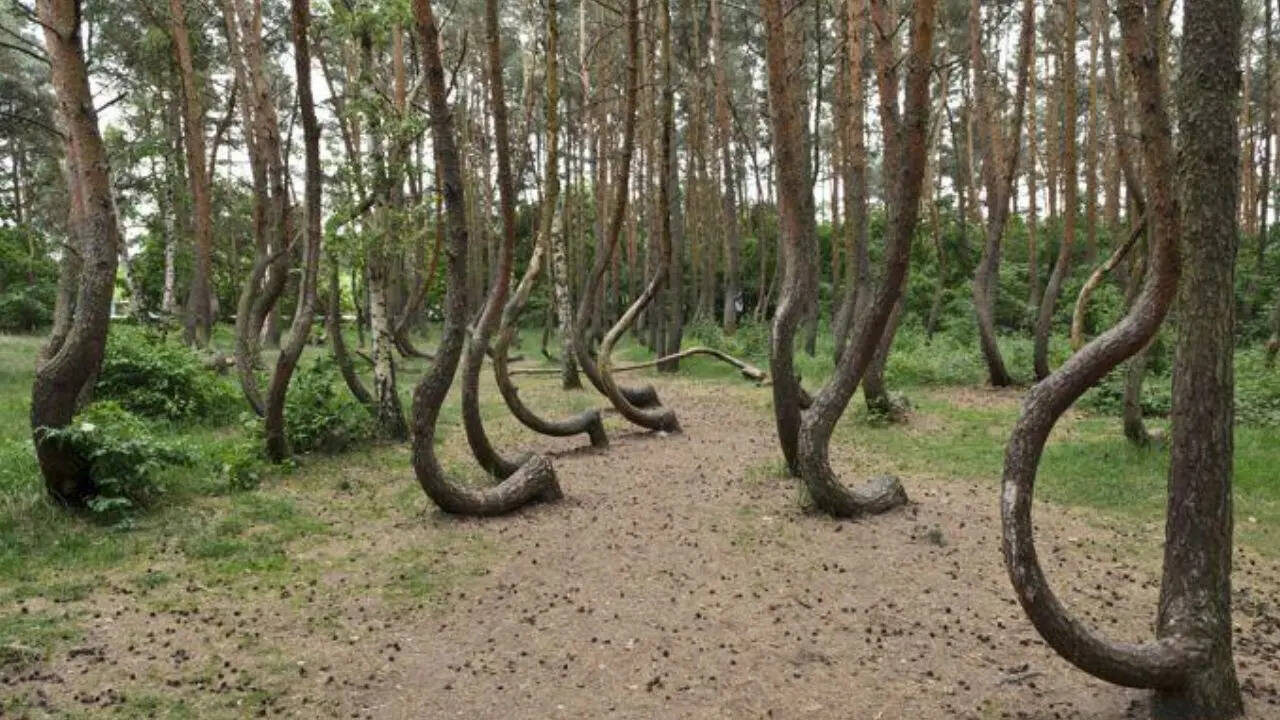
You’ve probably seen the photos. Hundreds of pine trees, all uniform in their absurdity, curving 90 degrees at the base before stretching toward the sky. It looks like a glitch in the matrix or a scene from a dark fairy tale. This is the Crooked Forest, or Krzywy Las, located just outside the town of Gryfino in West Pomerania, Poland. For decades, people have tried to pin a single explanation on this grove of 400 trees. Most of those people are wrong.
If you’re looking for a simple, natural phenomenon, you won't find it here. Trees don't just decide to grow in perfect J-shapes because the wind blew too hard one Tuesday. There’s a specific, human reason behind this landscape, but the "how" and "why" remain buried under the weight of World War II history and a lack of surviving witnesses.
What Actually Happened in Gryfino
The Crooked Forest isn't a vast wilderness. It’s a small patch of pines planted around 1930. Back then, this region was part of the German province of Pomerania. Every tree in this specific group bends toward the north. They stay horizontal for about three to nine feet before curving back up.
Nature doesn't work with that kind of geometric precision. If it were a heavy snowfall or a landslide, the damage would be messy. You’d see broken bark, varied angles, and stunted growth. Instead, these trees are healthy. They’re smooth. They look intentional because they were.
The most widely accepted theory among arborists and historians is that local farmers manipulated these saplings. They likely cut the central leader of the tree—the main trunk—and allowed a side branch to take over as the new leader. By weighting the trees down or using frames, they forced the wood to grow at a right angle.
The Furniture Theory and Lost Crafts
Why would anyone spend years hovering over saplings just to make them crooked? It wasn't for an art project. In the early 20th century, "grown" timber was a massive industry. Before we had steam-bending or complex lamination, if you needed a curved piece of wood for a ship’s hull, a sled runner, or a high-end armchair, it was stronger to use a tree that had grown into that shape naturally.
When you saw through straight grain to make a curve, you weaken the wood. But if the grain follows the curve of the chair back or the boat rib, the structural integrity is vastly superior. The Gryfino trees were almost certainly destined to become ribs for small boats or specialized bentwood furniture.
Then 1939 happened. Germany invaded Poland, the war devastated the region, and the people who knew the secret of the grove either fled or died. The "harvest" never happened. The trees just kept growing, eventually turning from a planned timber crop into a biological mystery.
Debunking the Supernatural Nonsense
If you search for the Crooked Forest online, you’ll run into some wild claims. Some people swear it’s a magnetic anomaly. Others think it’s aliens or some localized gravitational pull.
Let's be real. If there were a magnetic force strong enough to bend a pine tree, your compass would spin like a top and your phone would likely melt the moment you stepped into the clearing. None of that happens. Gravity also doesn't pick and choose a 20-meter square patch of dirt to act funky while the rest of the forest grows straight as an arrow.
The snow theory is also a popular one. The idea is that a massive, multi-year snowpack weighed down the saplings during their first decade of growth. It sounds plausible until you look at the surrounding forest. The Crooked Forest is surrounded by perfectly straight pine trees of a similar age. Unless the snow had a very specific grudge against these 400 trees and ignored the rest, that theory falls apart immediately.
Why These Trees Still Matter Today
The Crooked Forest is currently a protected natural monument. But there’s a problem. These trees are roughly 90 years old, and they won't live forever. Pines in this region typically start to decline after a century or so. We’re reaching the point where the grove might naturally start to thin out.
Walking through the grove feels different than a standard hike. There’s a silence there that’s heavy. You’re looking at a physical manifestation of interrupted history. It’s a ghost of a pre-war industry that vanished overnight.
For travelers, it’s a reminder that the world is full of "intentional" mysteries. Sometimes, the truth isn't a miracle; it's just a guy with a saw and a plan who never got to finish his work.
How to See the Grove Without the Crowds
If you want to visit, don't expect a massive national park experience. It’s tucked away near a power plant. It’s small, intimate, and best visited at sunrise when the light hits the curves and creates long, distorted shadows.
- Get to Gryfino first. It’s a short train ride from Szczecin.
- Follow the red trail. It leads right from the town to the grove. It’s about a 10-minute walk once you hit the forest edge.
- Respect the barrier. People love to sit in the "bends" for Instagram photos. Don't do that. The bark is old, and the soil compaction around the roots is already a threat to the trees' longevity.
The Crooked Forest isn't just a photo op. It’s a lesson in how humans and nature interact, even when the humans are long gone. The real mystery isn't how the trees bent—it's imagining the lives of the people who bent them and why they never came back to claim their prize.
Check the local weather before heading out. Pomerania is notorious for sudden rain, and the forest floor turns into a swampy mess pretty quickly. Pack boots, bring a decent camera, and leave the magnetic sensors at home. You won't need them to see the truth.