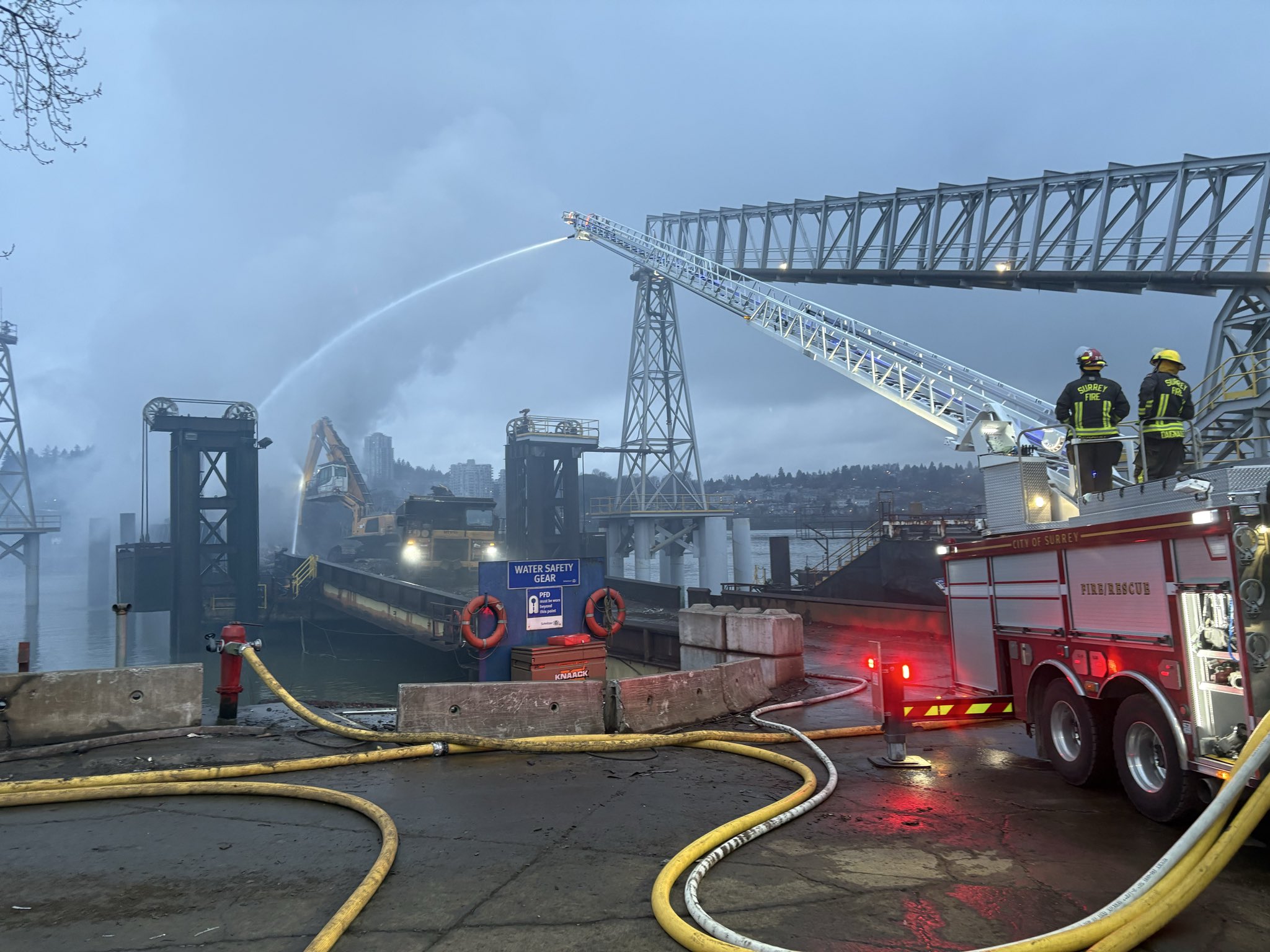
Waking up to the smell of burning metal and rubber isn't how anyone in Surrey or New Westminster wanted to start their Friday. If you looked out your window late Thursday night or early Friday morning, you probably saw the massive plume of black smoke choking the skyline near the stal̕əw̓asəm Bridge. A two-alarm fire on a barge moored along Musqueam Drive turned a quiet night into a massive emergency response, and now the big question is what exactly we're all breathing in.
What happened at the stal̕əw̓asəm Bridge
Around 11 p.m. on Thursday, April 2, 2026, Surrey Fire and Rescue Services received reports of a fire on the river. By the time crews arrived, the barge was fully engulfed. This wasn't a small wood fire. It was a stubborn, industrial-grade blaze that required 22 firefighters and aerial apparatus to get under control.
The fire burned through the night. Because the barge was sitting on the Surrey side of the Fraser River, the wind pushed that thick, acrid smoke directly toward residential areas and over the new stal̕əw̓asəm Bridge (the replacement for the old Pattullo). If you've noticed a metallic or chemical scent in the air, you aren't imagining it. Deputy Chief Greg McRobbie confirmed that the distinct, foul odor is likely due to burning metal and materials on the barge itself.
Why air quality monitoring is tricky right now
Metro Vancouver quickly issued a notice that they're monitoring air quality, but there's a catch you need to understand. Ground-level sensors don't always pick up the full story of a fire like this.
Smoke plumes often rise rapidly and hover in upper layers of the atmosphere. This means your local air quality station might show a "Low Risk" or a green rating, while you're literally looking at a gray haze outside your window. Metro Vancouver has openly admitted that their current readings might not fully capture the localized impact of this specific barge fire.
If you are in the North Surrey or New Westminster area, trust your nose over the app for the next 24 hours. If it smells like smoke, the particulate matter is there, even if the nearest sensor is a few kilometers away and hasn't spiked yet.
Health risks you should actually worry about
Smoke from industrial fires isn't just "wood smoke." It's a cocktail of fine particulate matter, known as PM2.5. These particles are tiny enough to enter your bloodstream through your lungs. When you add burning metal or scrap into the mix, you're potentially looking at trace amounts of:
- Lead and other heavy metals
- Dioxins and furans (if plastics or treated materials were involved)
- Polycyclic aromatic hydrocarbons (PAHs)
The BC Centre for Disease Control usually warns that the elderly, children, and people with pre-existing respiratory issues like asthma or COPD are the most at risk. Honestly, even if you're healthy, breathing this stuff in can cause throat irritation, stinging eyes, and a lingering cough. It’s basically a localized smog event.
How to handle the next 24 hours
The fire is largely extinguished, but the "smolder phase" can be just as annoying for your lungs. Don't wait for a formal air quality advisory to take basic precautions.
First, keep your windows shut. It sounds obvious, but even a "cracked" window will let in enough PM2.5 to irritate your lungs while you sleep. If you have a portable HEPA filter, run it on high in the room where you spend the most time. Most modern HVAC systems have a "recirculate" setting—use it. You want to avoid pulling in fresh air from outside until the smell dissipates.
If you have to be outside near the stal̕əw̓asəm Bridge or the Musqueam Drive area, an N95 mask is your best bet. A standard surgical mask or a cloth scarf won't filter out the fine particulates found in industrial smoke.
The investigation is just starting
Surrey Police Service has already stated the fire doesn't appear suspicious, but that doesn't mean we have answers. Determining the cause of a barge fire is notoriously difficult because of the amount of water used to put it out, which can wash away evidence or shift the debris.
We’re also waiting for a full manifest of what was on that barge. Until we know exactly what burned, the long-term environmental impact on the Fraser River remains a question mark. For now, focus on your immediate environment. Check the AirMap.ca website for updates, but remember that your own senses are the most reliable tool you have for localized smoke. If it smells bad, stay inside.