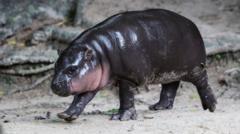
The viral phenomenon of Moo Deng, the pygmy hippopotamus at Thailand’s Khao Kheow Open Zoo, has transitioned from a harmless internet obsession to a security nightmare. What began as a surge in ticket sales has devolved into a series of dangerous physical breaches, culminating in the recent arrest and fining of a man who climbed into the animal’s enclosure. This is no longer a story about a cute animal. It is a case study in the total collapse of the boundary between digital consumption and physical reality.
When a video goes viral, the audience feels a sense of ownership over the subject. They want to touch, provoke, and interact with the "content" regardless of the biological reality of a wild animal. The man who breached the enclosure walls was not an anomaly; he was the inevitable result of a tourism model that prioritizes social media engagement over physical barriers. The fine leveled against him serves as a temporary deterrent, but it fails to address the systemic vulnerability of zoos that are currently struggling to manage the "Moo Deng Effect."
The Anatomy of the Breach
The incident at Khao Kheow was not a sophisticated infiltration. It was a failure of basic spatial management. Witnesses reported that the individual bypassed low-level fencing designed for visual aesthetics rather than high-security containment. In the race to provide "unobstructed views" for smartphone cameras, zoos have inadvertently lowered the physical threshold for impulsive behavior.
Investigating the security protocols at Khao Kheow reveals a startling reliance on social pressure rather than hard infrastructure. For decades, the "open zoo" concept relied on a silent contract between the visitor and the institution: the visitor stays behind the line, and the zoo provides the view. That contract is dead. The drive for a unique TikTok angle or a "main character" moment has rendered symbolic barriers useless.
Behavioral Contagion and the Crowd
The offender in this case didn't act in a vacuum. Reports from the ground suggests a growing culture of harassment around the hippo's enclosure. Visitors have been caught throwing water at the sleeping animal to wake it up for photos or tossing shells to get a reaction. When a crowd watches ten people throw pebbles with no consequence, the eleventh person feels empowered to jump the fence.
This is behavioral contagion. In a high-density tourist environment, the standard for acceptable behavior is set by the most disruptive person in the room. If the zoo's response is merely a verbal warning or a modest fine after the fact, the message sent to the public is that the "cost" of a viral moment is simply a fee. To a modern influencer or a clout-seeker, a fine is not a punishment. It is a production expense.
The Business of Viral Conservation
Zoos are in an impossible position. They are non-profits or government-funded entities that desperately need the revenue generated by stars like Moo Deng. The Khao Kheow Open Zoo saw its daily visitor count quadruple within weeks of the hippo’s rise to fame. This influx of cash is vital for conservation, but it creates a perverse incentive to keep the "content" accessible at any cost.
If you harden the enclosure with high plexiglass or electrified wires, you ruin the "vibe" that made the animal famous. The business model of the modern zoo is now tethered to the aesthetic quality of the visitor’s Instagram feed.
Revenue Versus Risk
- Ticket Sales: Dramatic increases in foot traffic provide funding for endangered species programs.
- Merchandising: Moo Deng apparel and toys have created a secondary economy for the zoo.
- Security Overhead: The cost of hiring 24/7 security details for a single enclosure often eats into those very profits.
- Liability: A single injury—or the death of a viral animal due to stress or human interference—would be a PR catastrophe that could shutter the institution.
The math doesn't always add up. While the fine for the intruder was publicized to show "toughness," the actual cost of repairing the security breach and the potential trauma to the animal far outweigh the legal penalty. We are seeing a shift where animals are no longer viewed as biological entities, but as intellectual property that must be defended against its own fans.
The Dangerous Myth of the Pygmy Hippo
Part of the problem lies in the "Bambi-fication" of Moo Deng. Because she is small, bouncy, and frequently seen biting her handlers in a way that looks like a cartoon, the public perceives her as a pet. This is a lethal misunderstanding.
Pygmy hippos are solitary, highly territorial, and possess bone-crushing jaw strength. In a wild setting, they are elusive and defensive. By marketing Moo Deng as a "bouncy pig" or a "living potato," the zoo’s marketing department has stripped the animal of its predatory respect. When you treat an apex-adjacent mammal like a plush toy, you cannot be surprised when someone tries to climb into its crib.
The handler paradox
The proximity of the zookeepers to Moo Deng also fuels this fire. Visitors see handlers touching, washing, and playing with the animal. They assume that if the handler can do it, the animal is "tame." They lack the expertise to see the years of habituation and the constant monitoring of body language that makes those interactions possible. The intruder likely believed he was entering a play area, not a predator’s territory.
Rebuilding the Fourth Wall
To stop the next breach, zoos must move beyond the "fine and shame" method. The current strategy of posting CCTV footage of bad actors on social media only gives the offenders more of what they want: attention.
True security in the age of the viral animal requires a return to hard infrastructure. This means the end of the "open" in "open zoo." We are looking at a future where popular animals are viewed through reinforced glass or from elevated platforms that make physical contact impossible. It is a step backward for the "immersive" zoo experience, but a necessary step forward for the survival of the species.
Surveillance is not Security
The Khao Kheow incident proved that cameras are passive. They record the tragedy; they do not prevent it. The zoo has announced the installation of more cameras, but unless those cameras are tied to an immediate, physical intervention team, they are just providing high-definition footage for the news.
Real security requires:
- Physical Barriers: Obstacles that cannot be cleared by an unathletic tourist in a moment of impulse.
- Immediate Ejection: A zero-tolerance policy where any violation of the barrier results in a lifetime ban from all national parks and zoos.
- Digital De-platforming: Zoos should work with social media companies to ensure that footage filmed during a security breach is demonetized or removed, stripping the incentive for the act.
The Human Problem
The man who climbed into the enclosure is a symptom of a larger cultural rot. We have become a society of voyeurs who view the world through a five-inch screen, forgetting that the things on the other side of that screen are real, breathing, and capable of violence.
The fine was a slap on the wrist for an act that could have resulted in the death of the man or the euthanasia of a priceless animal. If a hippo kills an intruder, it is the hippo that pays the ultimate price, not the trespasser. We are currently valuing the "right" to a close-up photo over the fundamental right of an animal to exist without being harassed by a mob.
The walls need to go back up. Not because we want to hide the animals away, but because we have proven, as a collective, that we are not mature enough to be trusted with their proximity. If the only way to protect a viral animal is to put it behind a thick sheet of acrylic where no one can throw a shell or jump a fence, then that is the price of our obsession.
Stop looking for the perfect angle and start looking at the fence. It’s there for a reason.