The sound of a tropical paradise is usually a rhythmic, percussive lullaby. It is the syncopated thrum of trade winds hitting palm fronds and the distant, predictable heartbeat of the surf. But on a Tuesday in Hawaii, the sound changed. It became a low-frequency growl that you felt in your molars before you heard it with your ears.
It wasn't the ocean. It was the mountains.
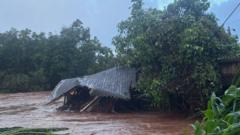
When two feet of rain fall on a volcanic island in the span of forty-eight hours, the geography stops being scenery and starts being a delivery system. The steep, emerald flutes of the Waianae and Koolau ranges, usually the backdrop for honeymoon selfies, transformed into vertical spillways. This wasn't just weather. It was a twenty-year anomaly, a "Kona Low" storm system that stalled over the archipelago, turning tranquil streams into churning flumes of red mud and debris.
The Threshold of the Doorstep
Consider a woman named Leilani—a hypothetical resident, but one whose story is mirrored in the thousands currently sheltering in community centers. She lives in a modest home in Hanalei, a place where the dirt is rich and the history is deeper. At 3:00 AM, the world outside her window didn't look like Hawaii anymore. It looked like a dark, moving sea of chocolate milk.
The first sign isn't the water coming under the door. It’s the smell. It is the scent of ancient earth, pulverized asphalt, and the metallic tang of everything the river has swallowed upstream. When the water finally hits the floorboards, it doesn't trickly. It surges.
By the time the emergency alerts began screaming on every smartphone from Kauai to Oahu, the choice to leave had already been made by the elements. Over 2,000 people found themselves displaced in a matter of hours. This wasn't a slow-motion evacuation. This was a scramble for high ground, clutching pets, hard drives, and children, while the roads behind them dissolved into the Pacific.
The Anatomy of a Twenty Year Event
Statistically, we call this a "one-in-twenty-year" flood. But statistics are a poor comfort when you are watching your car float toward a drainage canal. To understand why this hit so hard, you have to look at the unique plumbing of the islands.
Most continental flooding happens on flat plains where the water has nowhere to go. In Hawaii, the water has everywhere to go, but it wants to get there all at once. The islands are essentially massive sponges made of basalt. Usually, they drink the rain. But even a sponge has a limit. When the soil reaches total saturation, the next drop of rain doesn't sink in. It slides.
$$R = P - I$$
In this simplified hydrological balance, the runoff ($R$) is the precipitation ($P$) minus the infiltration ($I$). When infiltration hits zero because the ground is a sodden mass, every inch of rain becomes an inch of moving floodwater. On this particular Tuesday, the precipitation wasn't measured in inches, but in feet.
The infrastructure, built for "normal" tropical cycles, simply buckled. Culverts designed for heavy rain were choked by uprooted albizia trees. Bridges that had stood since the mid-century found their foundations scoured away by the sheer kinetic energy of the surge.
The Invisible Stakes of a Marooned Paradise
The news reports focus on the "thousands evacuated," a number that feels clinical. What they miss is the peculiar claustrophobia of island disasters. On the mainland, you drive north, south, or east to escape a storm. In Hawaii, you drive until the road ends, and then you stare at the rising water.
There is no "away."
The stakes are higher here because the resources are finite. When the main arteries like the Kuhio Highway are severed by landslides, entire communities become accidental islands within an island. Food, medicine, and clean water suddenly become luxury items delivered by Black Hawk helicopters.
For the small business owners in the flood zones, the water represents more than a mess. It represents the erasure of a decade of work. Most of these shops—the surf boutiques, the family-owned plate lunch spots—aren't backed by multinational insurance conglomerates with "act of God" clauses that actually pay out. They are built on sweat equity. When the mud settles, it leaves a fine, silty layer of ruin over everything.
The Physics of the Aftermath
Once the clouds finally break and the sun returns—as it always does in the islands, with a cruel, sparkling indifference—the real work begins.
Floodwater is deceptive. It looks like water, but it behaves like a solvent. It carries bacteria, fuel from sunken gas stations, and the chemical ghost of every fertilizer used on every lawn in the valley. When it recedes, it leaves behind a toxic sludge that hardens like concrete.
The psychological toll follows a similar pattern. There is the initial adrenaline of the escape, the communal warmth of the evacuation center, and then the long, silent walk back into a home that smells like a swamp.
We often talk about "resilience" as if it’s a natural resource, something the people of Hawaii have in abundance like pineapples or volcanic rock. But resilience is exhausting. It is the act of dragging a waterlogged mattress to the curb for the third time in a generation. It is the anxiety that returns every time the wind shifts and the sky turns that specific, heavy shade of charcoal.
A Different Kind of Mapping
If you look at the flood maps, they are covered in red zones and blue lines. They tell you where the water went. They don't tell you where the community went.
While the state government declared a state of emergency to unlock federal funds, the real recovery was happening in the mud. It was the neighbor with the lifted Toyota Tacoma pulling a stranger's sedan out of a ditch. It was the aunties cooking massive pots of chili for people whose kitchens were currently underwater.
This is the hidden mechanics of survival in the Pacific. The government provides the helicopters; the people provide the hope.
But as the climate shifts and these "twenty-year" events start appearing every five or ten years, the math changes. We are forced to ask if we are living in harmony with the islands or if we are merely guests whose lease is being revoked by the weather.
The red mud will eventually be washed off the driveways. The Kuhio Highway will be patched, and the tourists will return to snap photos of the waterfalls that, for a few terrifying days, tried to swallow the towns below them. But for the thousands who stood on their roofs or huddled in gymnasiums, the sound of the rain will never be just a lullaby again. It will always carry the faint, low growl of the mountain coming down to meet the sea.
The sun came out this morning over Hanalei, glinting off the standing pools of water in the taro patches. It looked beautiful, provided you didn't look too closely at the high-water marks on the sides of the houses. Those lines stay. Long after the news trucks leave and the dry-wall is replaced, the line remains—a silent, horizontal reminder of the night the Pacific decided to come inside.