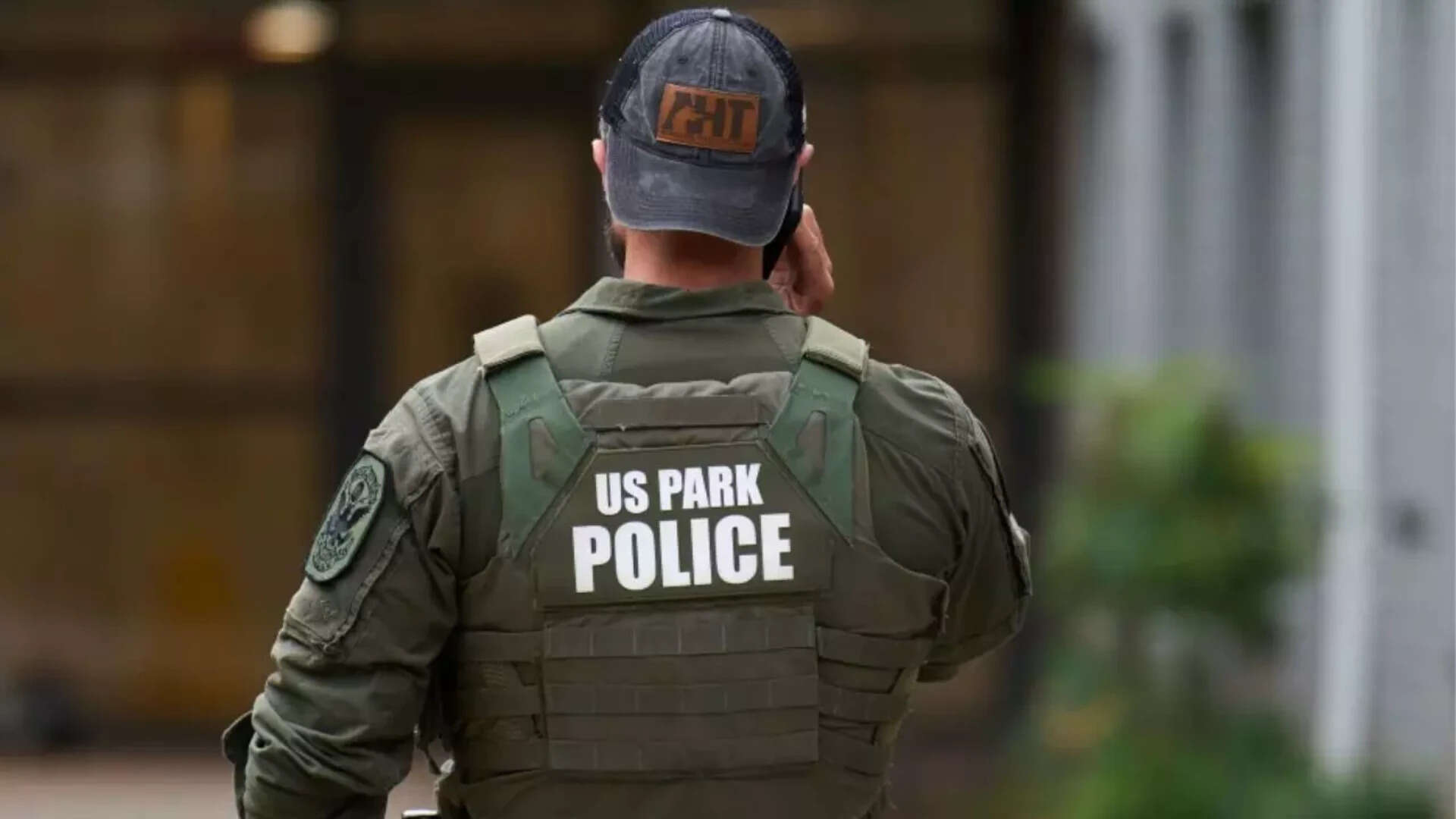
The siren didn't wail at first. It was more of a rhythmic, mechanical pulse, a frantic heartbeat echoing off the cold stone of the capital's monuments. In Washington D.C., sound travels differently at night. The heavy humidity of a swamp-turned-city dampens the chatter of tourists but amplifies the sharp, sudden cracks of reality. When a United States Park Police officer was shot on duty this week, the sound didn't just pierce the air; it tore through the fragile illusion of safety that guards the nation’s front yard.
We often view these men and women in the grey-and-green uniforms as living statues. They stand by the Reflecting Pool. They patrol the winding, wooded paths of Rock Creek Park. They are the silent sentinels of our history. But that night, one of those sentinels became a target. It wasn't an accident. It wasn't a crossfire tragedy. Investigators are looking at the jagged edges of a suspected targeted attack.
Two suspects are now in custody. The handcuffs clicked shut, but the vibration of that violence still hums in the pavement.
The Anatomy of the Watch
Consider the life of a patrol officer in the District. Your office is a patch of land that belongs to everyone and no one. One moment, you are giving directions to a family from Ohio; the next, you are staring into the dark void of a wooded trail where the city’s light doesn't reach. The shift is a long stretch of monotony punctuated by seconds of pure, adrenaline-soaked terror.
The officer involved in this shooting was doing what thousands do every day—simply being present. But presence is a provocation to some. When the shots rang out, the geography of the city shifted. The transition from "officer on patrol" to "officer down" happens in a heartbeat. It’s a radio call that every dispatcher dreads, a sequence of codes that turns a routine Tuesday into a life-or-death scramble.
Federal agents and local police swarmed the area. The blue and red lights painted the nearby trees in a macabre strobe effect. For hours, the perimeter was a kingdom of yellow tape and hushed, urgent voices. This wasn't just about a crime scene; it was about the realization that the symbols of our democracy are guarded by flesh and blood, and that blood is terrifyingly easy to spill.
The Shadow of the Targeted Strike
There is a specific kind of chill that comes with the word "targeted." It suggests a coldness, a premeditated choice to strike at the uniform rather than the person. It strips away the nuance of a heated moment and replaces it with the calculated intent of an executioner. This is the invisible stake that law enforcement faces in the current climate—the feeling that the badge on their chest has been transformed into a bullseye.
While the motive remains under the microscope of federal investigators, the impact is already felt in every roll call across the city. Imagine standing in a briefing room, drinking lukewarm coffee, knowing that someone out there isn't looking to commit a robbery or escape a chase. They are looking for you.
The two individuals arrested are now faces in a booking photo, but before that, they were shadows moving through the park with a purpose. The legal system will now begin its slow, grinding process of discovery. We will hear about their backgrounds, their digital footprints, and the moments leading up to the trigger pull. But for the officer in the hospital bed, those details are secondary to the searing heat of the lead and the long road of recovery ahead.
A City of Invisible Borders
Washington D.C. is a map of jurisdictions. You cross a street and move from the Metropolitan Police Department’s watch to the Secret Service’s domain, or into the hands of the Park Police. To a visitor, it’s all one city. To the criminal element, these borders are gaps to be exploited. To the officers, they are a patchwork quilt of responsibility.
When an attack like this happens, those borders vanish. The brotherhood of the badge is a cliché until you see the wall of uniforms outside a trauma center. There is no competition then. No jurisdictional bickering. Just a collective, heavy silence.
The fear isn't just for the person in the uniform. It extends to the runner who uses those trails at dawn, the commuter who walks through the park to reach the Metro, and the residents who live in the shadow of federal land. When the guardians are hunted, the entire community feels the exposure. We realize that the peace we take for granted is actually a high-maintenance construction, held together by the bravery of people we rarely bother to thank.
The Cost of the Quiet
We tend to look away from the grit. We prefer the postcard version of D.C.—the cherry blossoms, the white marble, the soaring obelisk of the Washington Monument. We don't want to think about the dark patches of grass where a man nearly lost his life for the crime of standing watch.
But the grit is where the truth lives.
The truth is that the officer survived, but "survived" is a heavy word. It carries with it the weight of physical therapy, the haunting replay of the flash in the dark, and the knowledge that the world changed in a millisecond. The arrests of the two suspects bring a sense of closure to the "who," but they rarely answer the "why" in a way that satisfies the soul.
As the yellow tape is cleared away and the joggers return to the paths, the city tries to reset. The grass will grow over the spot where the evidence was bagged. The sirens will fade into the white noise of the urban sprawl. But the gray-and-green uniform will be back out there tonight.
The officer will step out of the cruiser. They will adjust their belt. They will look into the dark woods of the District, knowing exactly what might be looking back. They will do it because the alternative—a city where no one stands watch—is a darkness we aren't prepared to face.
The monuments remain. The stone is cold and indifferent. It’s the breathing, aching human beings between those stones that keep the heartbeat of the city steady, even when their own heartbeats are under threat.
Would you like me to look into the specific history of the U.S. Park Police and the unique dangers they face in federal jurisdictions?