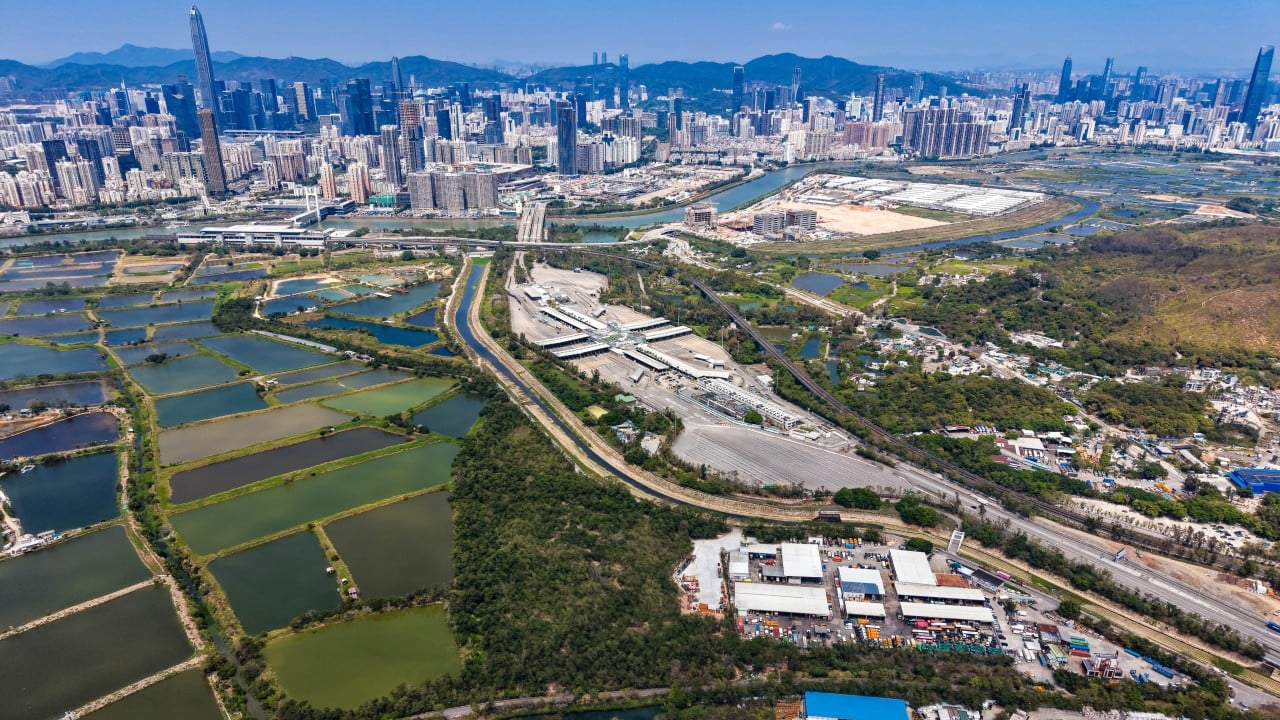
The humidity in Hong Kong has a way of blurring the line between the physical and the digital. On a Tuesday afternoon in Kowloon, the air is thick enough to feel, yet the invisible signals of a world-class financial hub hum through the skin. For decades, this city thrived on the tangible—the clatter of shipping containers, the frantic shouting on the trading floor, the smell of roasted goose wafting into the street. Now, a different kind of energy is being harvested. It isn't found in the docks or the vaults. It is being built in the quiet, sterile laboratories of the newly minted Hong Kong Generative AI Research Institute (HKGAI).
Consider a man named Mr. Lam. He is seventy-two years old and lives in a walk-up apartment in Sham Shui Po. To Mr. Lam, "Artificial Intelligence" sounds like something out of a late-night science fiction movie, something designed for teenagers or billionaire tech moguls. He struggles with his banking app. He gets lost in the labyrinthine menus of government websites. For him, the digital revolution has felt less like an invitation and more like a barrier.
But the architects of Hong Kong’s latest technological push aren't just building faster processors for the elite. They are trying to find a way to make the machines speak Mr. Lam’s language.
The Ghost in the Language
When we talk about AI, we usually talk about Silicon Valley. We talk about models trained on the vast, Western-centric oceans of the English-speaking internet. But Hong Kong is a city of layers. It is a place where Cantonese, English, and Mandarin collide in a unique linguistic dance. To build an "AI for all" in this specific corner of the world, you cannot simply import a brain from California and expect it to understand the nuance of a wet market transaction or the specific legal jargon of the Basic Law.
This is the hidden friction of our modern era. If the tools that define the next century don't understand your culture, your slang, or your local regulations, you are effectively being written out of the future. The HKGAI, spearheaded by the Hong Kong University of Science and Technology (HKUST) alongside five other universities, isn't just another government project. It is an act of digital sovereignty.
The institute is developing its own proprietary large language model. This isn't just about pride. It’s about utility. A localized model means a doctor in a public hospital can use AI to synthesize patient records written in a mix of medical English and Cantonese shorthand. It means a small business owner in Mong Kok can automate their logistics using a system that actually knows how the streets of the New Territories are laid out.
Beyond the Silicon Curtain
The stakes are higher than mere convenience. We are currently witnessing a global fracturing of technology. As trade tensions simmer and data regulations tighten, the flow of information across borders is becoming more like a series of gated communities. For a city like Hong Kong, which has always functioned as a bridge between East and West, this fragmentation is an existential threat.
The government’s injection of 100 million HKD into this initiative is a bet against obsolescence. They are building a foundation—a "Common Foundation Model"—that other companies can plug into. Imagine it as a public utility, like water or electricity. You shouldn't have to be a tech giant to benefit from the power of a generative model. A local graphic designer should be able to use it to generate culturally relevant imagery. A schoolteacher should be able to use it to create lesson plans that resonate with a kid growing up in a public housing estate.
But there is a nervous energy beneath the surface. In any conversation about AI, the shadow of replacement looms large. People ask, "Will it take my job?" rather than "Will it help me do my job better?"
The reality is more complex. The HKGAI isn't just throwing code at a wall; they are focusing on "Human-Centric AI." This is a phrase that often gets buried in white papers, but in practice, it looks like a system designed to be a co-pilot, not an autopilot. It’s the difference between a machine that replaces a translator and a machine that allows a social worker to communicate instantly with an ethnic minority resident who speaks a different dialect.
The Weight of the Data
To make a machine smart, you have to feed it. You need data. Millions of lines of it. Thousands of terabytes. In the past, this was done haphazardly, scraping the web without much thought for the bias or the "hallucinations" the machine might inherit.
The scientists at the HKGAI are taking a more surgical approach. By focusing on high-quality, localized data, they are attempting to solve the "black box" problem. They want to know why the AI says what it says. This transparency is crucial for sectors like healthcare and law, where a "guess" isn't good enough. In these fields, a mistake isn't a glitch; it’s a catastrophe.
Consider the hypothetical case of a young lawyer, Sarah. She’s overwhelmed by ten thousand pages of discovery documents for a commercial dispute. A standard, Western-trained AI might miss the subtle implications of a contract written under Hong Kong’s specific legal framework. But a model trained on the city’s own precedents, its own quirks, and its own history becomes a superpower. It allows Sarah to find the needle in the haystack in seconds rather than weeks. This isn't about replacing Sarah. It’s about letting Sarah be a lawyer instead of a filing clerk.
The Invisible Infrastructure
There is a tendency to view these research institutes as ivory towers—places where academics debate the number of neurons on the head of a digital pin. But the ripple effects of the HKGAI are intended to reach the street level.
The Secretary for Innovation, Technology and Industry, Sun Dong, has been vocal about this being a "ramp-up" period. The city isn't just looking for one big breakthrough; they are looking for an ecosystem. They want to attract the "phoenixes"—the startups that will rise from this research and transform the local economy.
Hong Kong has often been criticized for being too reliant on finance and real estate. We have been the city of the skyscraper and the ledger. But as the world shifts toward a knowledge-based economy, the ledger is becoming digital, and the skyscrapers are being filled with servers. The challenge is ensuring that this transition doesn't leave the "Mr. Lams" of the city behind.
True "AI for all" means accessibility. It means a user interface that feels as natural as a conversation. It means privacy protections that aren't just buried in a fifty-page terms-and-conditions document. It means a tech sector that reflects the diversity of the people it serves.
The Long Game
We are in the early, messy stages of a transformation that will likely be compared to the Industrial Revolution. There will be mistakes. There will be models that fail and projects that run over budget. The 100 million HKD is a start, but it is a drop in the bucket compared to the billions being poured into the field by global tech titans.
However, Hong Kong has a secret weapon: its density.
In this tiny, vertical city, the distance between a research lab and a practical application is incredibly short. You can develop a smart traffic management system in a lab and test it on the streets of Central the next day. You can build a fintech tool and have it in front of a banker by lunchtime. This proximity allows for a feedback loop that sprawling tech hubs can't replicate.
The HKGAI is the heart of this loop. By bringing together the best minds from HKUST, the University of Hong Kong, and others, they are creating a concentrated burst of intellectual capital. They are trying to solve the problem of "localized intelligence" before the global giants decide it’s not profitable enough to care about.
The air in the lab is cooler than the air on the street. It smells of ozone and new plastic. On the screens, lines of code scroll by—a language that is neither Cantonese nor English, but something entirely new. It is a binary pulse, a digital heartbeat.
If they succeed, the AI of tomorrow won't feel like a foreign invader or a cold, distant god. It will be a tool that fits the hand of the laborer, the student, and the retiree alike. It will be as much a part of the city as the Star Ferry crossing the harbor—an invisible, reliable force that carries us from where we are to where we need to be.
The city is waiting. The data is flowing. The machines are learning to listen.
Late at night, when the neon signs of Nathan Road flicker and the traffic finally thins, the servers continue their work. They are processing the history, the language, and the dreams of seven million people, turning them into a map for the future. It is a future where the "all" in "AI for all" isn't a marketing slogan, but a lived reality for every person walking the crowded, beautiful streets of the harbor.
The transition won't be televised, and it won't happen overnight. It will happen in the quiet moments: when a grandmother finally understands a digital medical prompt, when a student finds the perfect resource in their mother tongue, and when a city known for its past realizes it has successfully built its own future.
The pulse is steady. The harbor is bright. The work goes on.