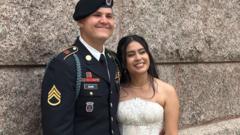
Military families expect a certain level of protection when they sign up for service. You'd think that wearing the uniform or being married to someone who does would provide a shield against the most aggressive forms of domestic immigration enforcement. That wasn't the case for Sandra Villalobos Cordero.
Her story isn't just a headline about a sudden arrest. It's a wake-up call for every military family navigating the broken intersection of Department of Defense (DoD) security and Immigration and Customs Enforcement (ICE) priorities. When Sandra walked onto a military base to support her husband, she didn't expect to leave in handcuffs. She was a newlywed wife of a US soldier freed by ICE after detention at a military base, but the fact she was there at all points to a massive systemic failure.
The Security Gate Capture
Sandra Villalobos Cordero is married to a US Army soldier stationed at Fort Liberty—formerly known as Fort Bragg—in North Carolina. In late 2023, she went to the base. It was a routine move. Most military spouses do it every day to go to the commissary, the gym, or home. But Sandra was undocumented.
When she presented her identification at the gate, the system flagged an old deportation order. Instead of a warning or a simple denial of entry, the base security detained her and called ICE. This wasn't a high-speed chase or a raid on a dangerous criminal hideout. It was a bureaucratic trap set at the front door of a military installation.
The military has always had a complicated relationship with the immigrant community. We rely on non-citizens to fill our ranks, yet we don't always protect their families. Sandra’s detention sparked immediate outrage because it felt like a betrayal of the "we take care of our own" military ethos.
Why the Military Identity Didn't Save Her
You might wonder why her status as a military spouse didn't immediately stop the process. Usually, the "Parole in Place" program is the go-to solution for people in her shoes. It's a special immigration benefit for the families of active-duty service members, reservists, and veterans. It allows them to stay in the US and apply for a green card without having to leave the country.
Sandra had an active application. She wasn't hiding. She was trying to follow the rules. But immigration law is a tangled mess of "may" and "might." Even with a pending application, an old removal order can act like a landmine.
Gate guards at military bases use the Defense Biometric Identification System (DBIDS). It’s designed to keep terrorists and criminals out. When Sandra’s name popped up with an outstanding warrant for deportation, the guards followed a rigid protocol. They don't have the legal training to weigh the nuances of immigration stay-of-removal requests. They see a hit, they make the call.
The Public Pressure That Led to Her Release
Sandra was held for several days. During that time, her husband and legal team scrambled. The community didn't stay quiet. Advocacy groups like the American Civil Liberties Union (ACLU) and local immigrant rights organizations jumped in. They pointed out the obvious. Splitting up a military family harms readiness. A soldier worried about his wife in a detention center isn't a soldier focused on the mission.
Publicity is often the only thing that moves the needle in these cases. ICE has "sensitive locations" policies. These guidelines generally discourage enforcement actions at schools, hospitals, and places of worship. Military bases are a gray area. While they aren't explicitly listed as off-limits in the same way a church is, common sense suggests that detaining spouses of active-duty members at their place of work is a PR nightmare and a morale killer.
The pressure worked. ICE eventually granted her a stay of removal and released her. She went back to her husband, but the trauma remains. The "freedom" she has now is a temporary reprieve, not a permanent solution.
The Reality of Parole in Place
If you're a military family in this situation, you need to understand how Parole in Place (PIP) actually functions. It isn't an automatic right. It's a discretionary grant from United States Citizenship and Immigration Services (USCIS).
- Eligibility: You must be the spouse, child, or parent of an active-duty member, a member in the Selected Reserve, or someone who previously served.
- The Catch: If you already have a final order of removal, PIP becomes much harder to secure. You often have to get the immigration court to reopen your case first.
- The Risk: Applying puts you on the radar. For most, it's the path to a green card. For others, it’s a roadmap for ICE.
Sandra’s case shows that having the paperwork in the works isn't a guarantee of safety. It's a brutal reality of our current system.
How to Protect Your Family Today
Don't wait for a gate guard to be the one who tells you there's a problem with your status. If you are a non-citizen military spouse, you have to be proactive.
First, get a scanned copy of every immigration document you've ever had. If there was a missed court date ten years ago, it's still in the system. Second, talk to a JAG (Judge Advocate General) officer on base, but remember they usually can't represent you in civilian immigration court. They can, however, point you toward civilian pro-bono resources that specialize in military immigration issues.
Never go to a federal building or a high-security military installation to "check on the status" of an application without your lawyer's green light. The system isn't designed to be helpful; it's designed to be a filter.
The Future of Military Spouse Protections
There’s a push in Congress to make protections for military families mandatory rather than discretionary. The "Veteran Service Recognition Act" and similar bills aim to ensure that those who serve—and their immediate kin—aren't subjected to the whims of changing political administrations.
Until those laws pass, the burden falls on the soldier. It's an unfair weight to carry while also training for combat or maintaining national security. Sandra Villalobos Cordero is home for now, but her story is a stark reminder that the uniform doesn't always protect the ones you love most.
Keep your paperwork updated. Stay in constant contact with your legal counsel. If you're flagged at a gate, stay silent and demand your lawyer immediately. Don't sign anything ICE hands you without a representative present. Your service earned you these rights. Use them.