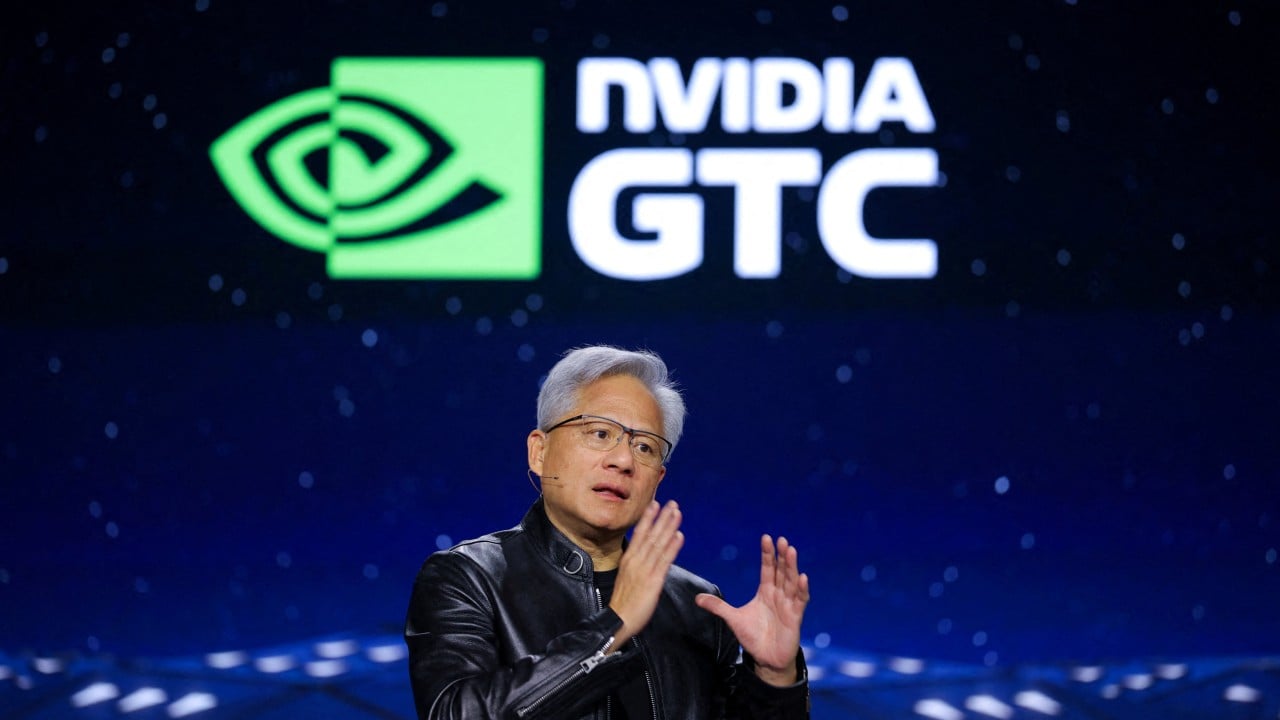
Jensen Huang stands on a stage, usually clad in a black leather jacket that has become a sort of high-tech suit of armor. He isn’t just selling chips anymore. He is selling a prophecy. When he speaks about China’s "formidable" progress in robotics, he isn’t merely acknowledging a competitor in a spreadsheet. He is pointing toward a fundamental shift in how the floor of a factory—and eventually the floor of your kitchen—will function.
We have spent the last decade obsessed with "Cyber AI." This is the intelligence that lives in the cloud, the one that writes your emails, generates your vacation itineraries, and occasionally hallucinates a third leg onto a digital cat. It is ethereal. It is weightless. But Nvidia is now betting the house on something much heavier. They call it Physical AI.
Imagine a specialized arm in a Shenzhen manufacturing plant. Let’s call the worker overseeing it Chen. For years, Chen’s job was repetitive, grueling, and required him to act as the "brain" for a machine that was essentially a blind, deaf, and dumb tool. If a part was half an inch out of alignment, the machine would crash or crush the component. The machine had no "sense" of the world. It was a ghost in a shell, minus the ghost.
Now, that has changed. The "formidable" nature of the Chinese robotics sector that Huang referenced isn't just about the number of units shipped. It’s about the integration. In these new facilities, the machines are beginning to understand the laws of physics. They aren't just following a line of code; they are perceiving the resistance of a screw, the weight of a chassis, and the unpredictable nature of a human coworker stepping into their workspace.
Nvidia’s strategy is to provide the nervous system for these metallic bodies. Their Isaac platform is designed to be the digital womb where these robots learn to exist before they ever touch a physical factory floor.
The Simulation Before the Reality
The stakes are invisible because they happen in a place that doesn't exist. Before a robot is deployed in the real world, it lives a thousand lifetimes in a simulation. In this digital void, the robot "dies" millions of times. It tips over. It drops a glass. It fails to navigate a doorway.
But it learns.
This is the bridge between the digital and the physical. By the time the robot is bolted to a concrete floor in the real world, it possesses a "lived experience" that no human could acquire in a single lifetime. It has already practiced the same task ten million times under a billion different lighting conditions and gravitational variances.
Huang knows that China is uniquely positioned to dominate this space because they have the "physical" part of the equation down to a science. They have the factories. They have the supply chains. They have the raw necessity of an aging workforce that needs mechanical help to maintain productivity. When Huang calls them formidable, he is acknowledging that the race isn't about who can write the best code—it's about who can make that code move a three-ton arm with the grace of a surgeon.
Consider the sheer complexity of a robot picking up a strawberry. To you, it is effortless. Your brain calculates the pressure needed to grip the fruit without bruising it, adjusts for the slippery texture, and moves your arm in a fluid arc. For a computer, this is a nightmare of calculus. Physical AI is the attempt to turn that nightmare into a reflex.
The Great Decoupling of Labor and Body
The emotional core of this transition isn't about "losing jobs" in the way we usually discuss it. It’s about the decoupling of human presence from physical danger.
Think of a hypothetical search-and-rescue worker named Sarah. Today, if a building collapses, Sarah has to risk her life crawling through unstable rubble. In the world of Physical AI—the world Nvidia is building the foundation for—Sarah doesn't go in. A quadruped robot, powered by a chip that can process trillions of operations per second, enters the ruins.
This robot doesn't just "see" via a camera. It feels the vibration of the floor. It calculates the structural integrity of the beams above it. It communicates with other robots in a silent, instantaneous language of data.
The fear, of course, is that we are building our replacements. But if you talk to the engineers in the trenches, they see it differently. They see a world where the "dull, dirty, and dangerous" tasks are finally handed off to something that doesn't have a family to go home to.
Nvidia is positioning itself as the toll booth on the road to this future. If China is the world's factory, Nvidia wants to be the operating system that runs every machine inside it. This is why the "formidable" comment is so loaded. It’s a recognition of a superpower that has moved past the era of cheap plastic toys and into the era of autonomous precision.
The Ghost Becomes Solid
We are moving away from the era of the "General Purpose Computer" and into the era of the "General Purpose Robot."
The shift is jarring. For decades, computers were boxes we looked at. Now, the computer is becoming something that can look back at us. It has limbs. It has a sense of space. It has a "physicality" that demands a different kind of respect.
The "invisible stakes" are found in the supply chain of intelligence. If a country controls the physical AI, they control the means of production in a way that makes the Industrial Revolution look like a minor software update. Huang isn't just worried about losing market share; he is witnessing the birth of a new kind of entity.
The tech is complex, but the human reaction is simple: wonder mixed with a healthy dose of dread. We have always been the only things on this planet that could manipulate tools with high intelligence. Now, the tools are starting to manipulate themselves.
Nvidia’s bet is that the world will eventually be populated by more "intelligent moving things" than there are people. They are building the brains for a billion metallic citizens.
When you see a robot dog navigating a sidewalk or a robotic arm perfectly sorting recyclables, you aren't just seeing a machine. You are seeing the culmination of billions of dollars in R&D and a geopolitical chess match that spans the globe. You are seeing the moment the digital ghost finally found a way to touch the world.
The black leather jacket on that stage isn't just a fashion choice. It's a signal. The world is getting harder, faster, and more physical. And the machines are finally ready to meet us there.
The silicon is waking up, and it has finally learned how to walk.