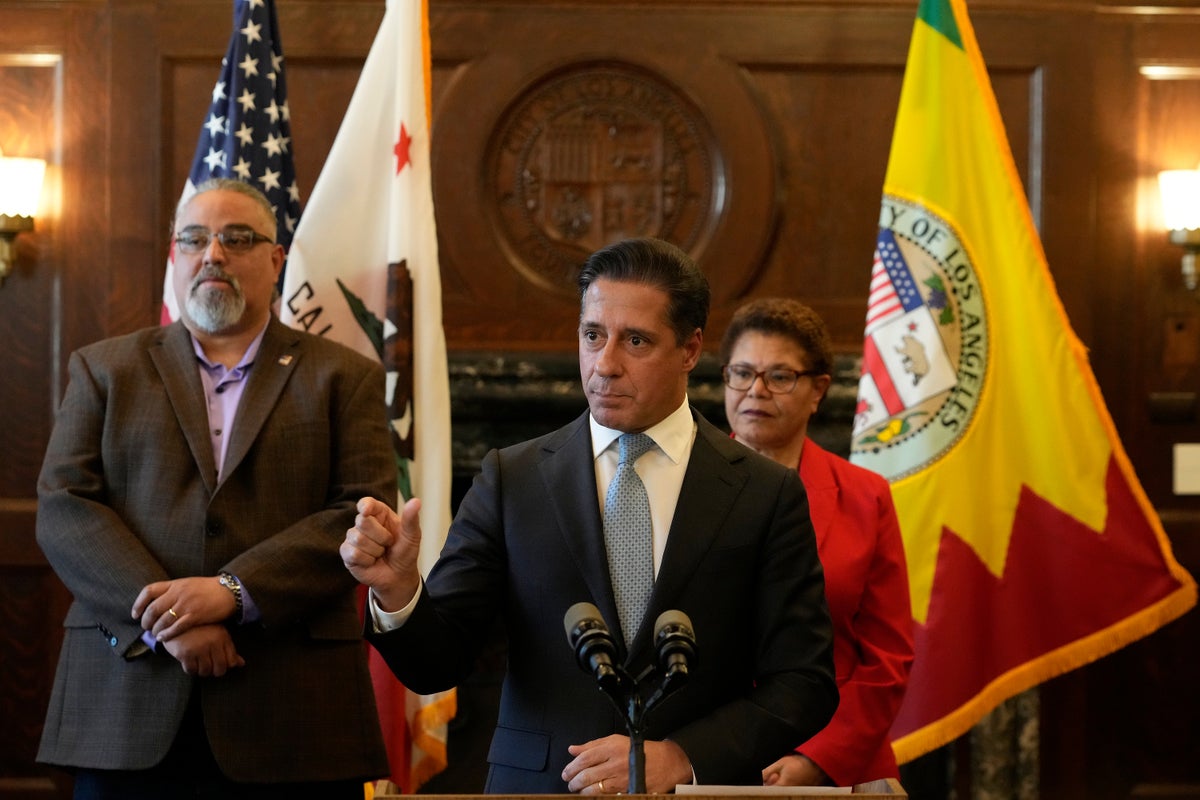
The suspension of a major metropolitan school superintendent under the shadow of a federal investigation is not merely a personnel issue; it is a systemic failure of institutional governance and risk management. When Alberto Carvalho—or any executive at the helm of a multi-billion dollar public entity—faces federal scrutiny while maintaining a stance of absolute denial, the organization enters a state of operational stasis. This analysis deconstructs the structural implications of the Los Angeles Unified School District (LAUSD) leadership vacuum, the legal anatomy of federal probes into public officials, and the cascading impact on the district’s $18 billion budgetary commitments.
The Architecture of Federal Oversight in Public Education
Federal investigations into high-ranking school officials typically bypass local administrative grievances and focus instead on the intersection of public funds and private interests. The current probe into the LAUSD leadership exists within three primary legal vectors:
- The Misappropriation of Federal Grant Funding: LAUSD receives significant allocations from the Elementary and Secondary School Emergency Relief (ESSER) fund. Mismanagement or redirection of these funds for purposes outside of legislative intent triggers Department of Justice (DOJ) involvement via the False Claims Act.
- Contractual Quid Pro Quo: The procurement process for educational technology and facilities management represents a high-risk area for "honest services" fraud. Investigators look for a breakdown in the competitive bidding process where contracts are awarded to entities with undisclosed ties to district leadership.
- Obstruction and Material Misrepresentation: The most frequent "trap" for public officials lies not in the original act, but in the subsequent response. Denials made to federal agents that are later contradicted by digital forensics or whistleblower testimony form the basis for 18 U.S.C. § 1001 charges.
The Cost Function of Administrative Suspension
The decision to place a superintendent on administrative leave creates an immediate "uncertainty tax" on the district. This is not a neutral act; it generates specific, quantifiable frictions that degrade the quality of service delivery to nearly 500,000 students.
Operational Deleveraging
In a centralized hierarchy like LAUSD, the superintendent acts as the primary signatory and strategic filter. Suspension halts the momentum of long-term initiatives—such as the "2022-26 Strategic Plan"—because interim leaders lack the political mandate to execute controversial or high-capital reallocations. This leads to a "waiting room" effect where departmental heads delay decisions to avoid misalignment with an eventual permanent successor.
Reputation Risk and Bond Rating
School districts function as municipal bond issuers. Legal instability at the executive level signals governance weakness to credit rating agencies like Moody’s or S&P. If a federal probe suggests systemic corruption rather than isolated misconduct, the district’s cost of borrowing for capital projects increases. A 25-basis-point increase in interest rates on a $500 million bond measure results in millions of dollars diverted from classrooms to debt service over the life of the loan.
The Logic of Executive Denial
The public stance of "denying any wrongdoing" is rarely a statement of fact and more frequently a strategic legal posture. In the context of federal white-collar investigations, the denial serves three tactical purposes:
- Preservation of Indemnification: Most executive contracts include clauses where the district covers legal fees unless a "finding of fact" or a "guilty plea" occurs. Admitting to even minor procedural errors could trigger a breach of contract, forcing the individual to fund a multi-million dollar defense out of pocket.
- Controlling the Media Narrative: A vacuum of information is filled by speculation. By asserting a firm denial, the executive provides a counter-weight to the "leak culture" that often accompanies DOJ investigations, aiming to keep the board of education from feeling immediate public pressure to terminate for cause.
- Negotiation Leverage: In the event that investigators find technical violations, an early and consistent denial maintains the individual’s position for a "no-contest" settlement or a structured departure that preserves pension benefits.
Categorizing the Vulnerabilities in LAUSD Governance
To understand how a federal probe reaches this level, one must examine the specific failure points in the district's internal controls. The "Three Lines of Defense" model in risk management appears to have been bypassed.
First Line: Management Controls
Departmental leaders are responsible for identifying risks in real-time. In large districts, "islands of autonomy" often form in the procurement or IT departments, where oversight is thin. If the superintendent's office exerts top-down pressure to fast-track specific vendors, the first line of defense is neutralized.
Second Line: Financial Oversight
The Chief Financial Officer and internal compliance officers serve as the checks on executive spending. A federal probe suggests that either these controls were ignored or that the documentation provided to these offices was intentionally obscured.
Third Line: The Board of Education
The Board’s primary role is the hiring and oversight of the superintendent. However, school boards are often comprised of political actors rather than auditors. This creates a "monitoring gap" where the board relies on the superintendent’s self-reporting rather than independent verification of district health.
The Strategic Path Forward for the District
The resolution of this crisis requires a decoupling of the individual's legal fate from the district's operational continuity. The board must move beyond the binary of "support or fire" and adopt a forensic governance posture.
Immediate Appointment of a Compliance Monitor
Rather than relying on internal legal counsel—who may be conflicted due to their prior proximity to the superintendent—the board must appoint an independent third-party auditor to review all contracts signed within the last 24 months. This "cleansing" of the books is the only way to restore the trust of federal regulators.
The Resilience of the Interim Mandate
The interim superintendent must be empowered with a "stabilization mandate." This includes a moratorium on new high-value vendor contracts and an immediate audit of ESSER fund spending to ensure compliance with the September 2024 and 2026 liquidation deadlines.
Transparency as a De-escalation Tool
The district should proactively release redacted versions of the subpoenas received. While legal teams usually advise against this, the "information asymmetry" between the district and the public is what fuels the most damaging speculation. Proactive disclosure shifts the narrative from "what are they hiding" to "how are we fixing this."
The success of LAUSD in the coming 12 months depends on its ability to treat the federal probe as a diagnostic tool for systemic reform rather than a personal scandal to be survived. If the district focuses solely on the fate of the superintendent, it misses the opportunity to harden its procurement and governance frameworks against the next inevitable crisis. The move from a "culture of personality" to a "culture of process" is the only viable exit strategy.


