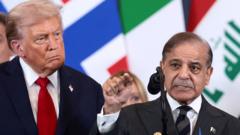
The stability of the Persian Gulf hinges on a paradox: the primary antagonists, the United States and Iran, lack formal diplomatic channels, necessitating a third-party intermediary that possesses both geographic proximity and high-level military-to-military access to both sides. Pakistan functions as this critical buffer, not out of altruism, but as a survival mechanism to prevent a regional conflagration that would destabilize its own western border and disrupt the China-Pakistan Economic Corridor (CPEC). Analyzing the recent de-escalation reveals a tri-lateral signaling framework where Islamabad acts as the "validator" of intent, reducing the risk of kinetic miscalculation between Washington's "maximum pressure" holdover tactics and Tehran's "forward defense" doctrine.
The Geopolitical Cost Function of Pakistani Neutrality
Pakistan’s involvement in securing a fragile ceasefire is governed by a strict cost-benefit calculus. For Islamabad, a full-scale conflict between the US and Iran represents a catastrophic externality. The economic and security costs are distributed across three specific vectors:
- Refugee Influx and Border Kinetic Risk: A war would likely trigger a massive displacement of civilians from Iran’s Sistan-Baluchestan province into Pakistan’s Balochistan. This complicates an already volatile security environment where ethno-nationalist insurgencies operate.
- Energy Supply Disruption: Pakistan remains chronically energy-deficient. While the Iran-Pakistan (IP) gas pipeline remains stalled due to US sanctions, any regional war spikes global Brent crude prices, devastating Pakistan’s foreign exchange reserves.
- The Sectarian Equilibrium: Pakistan hosts one of the world's largest Shia populations outside Iran. Domestic stability relies on maintaining a neutral stance that does not alienate the pro-Saudi Sunni establishment or the significant Shia minority.
By facilitating a ceasefire, Pakistan minimizes these risks while simultaneously earning "strategic equity" with the US State Department and the Iranian Supreme National Security Council.
Mechanisms of Intermediation: The Validator Model
The failure of direct communication between the US and Iran stems from a "Verification Gap." When one side offers a concession, the other interprets it as a tactical ruse. Pakistan bridges this gap through a mechanism known as Proximate Validation.
The process operates through two distinct layers:
The Intelligence Layer
The Inter-Services Intelligence (ISI) maintains a functional relationship with the Iranian Revolutionary Guard Corps (IRGC), specifically regarding border security and counter-terrorism. When the US signals a desire to de-escalate—often through the Swiss embassy or Omani channels—Pakistan provides the "ground-truth" context. Islamabad can signal to Tehran whether a US carrier strike group movement is a routine rotation or a genuine pre-emptive posture. This reduces the "fog of war" that typically leads to accidental escalations in the Strait of Hormuz.
The Military-Diplomatic Layer
Unlike civilian diplomats, Pakistani military leadership carries weight with the Iranian security apparatus. The Iranian leadership views the Pakistani military as a rational, non-Western actor that understands the regional "honor-shame" culture. When General Headquarters (GHQ) in Rawalpindi communicates a message to Tehran, it is received with a level of trust that a Western envoy cannot replicate. This "military-to-military" channel was instrumental in defining the parameters of the current "freeze-for-freeze" understanding, where Iran curtails certain enrichment activities or proxy attacks in exchange for limited sanctions relief or the unfreezing of assets.
The Structural Fragility of the Ceasefire
The current ceasefire is not a peace treaty; it is a Tactical Pause defined by the absence of a long-term framework. The stability of this arrangement is threatened by three structural bottlenecks.
- The Proxy Agency Problem: Iran utilizes a "Network of Managed Proxies" (the Axis of Resistance). While Tehran can signal a general de-escalation, local commanders in Iraq, Syria, or Yemen often operate with varying degrees of autonomy. A single miscalculated rocket attack on a US base by a sub-national actor can collapse the Pakistani-mediated agreement.
- The US Electoral Cycle: Iranian strategic planners are hesitant to commit to long-term concessions when the current US administration's executive orders can be reversed by a successor. This creates a "Time-Horizon Mismatch" where Iran seeks permanent relief and the US offers only temporary waivers.
- The Israeli Variable: Israel remains an external actor not bound by the US-Pakistan-Iran signaling loop. Kinetic actions taken by Israel against Iranian nuclear infrastructure or personnel force Tehran into a "retaliation loop" to maintain domestic and regional credibility, effectively bypassing the ceasefire logic.
Quantifying the Strategic Buffer
To understand Pakistan's effectiveness, one must look at the Threshold of Kinetic Tolerance. In the months leading up to the ceasefire, the frequency of "gray zone" incidents—cyberattacks, tanker seizures, and drone strikes—approached the threshold where a conventional military response from the US became statistically probable.
Pakistan’s intervention lowered this "Kinetic Temperature" by introducing a Delayed Feedback Loop. By injecting a third party into the communication chain, the response time for both Washington and Tehran is artificially extended. This "Strategic Latency" allows cooler heads within the respective National Security Councils to evaluate the costs of escalation before orders are issued to tactical units.
The Limitations of Middle-Power Mediation
Pakistan's role is effective only as long as both primary antagonists perceive the status quo as more beneficial than war. Islamabad lacks the "Carrot and Stick" capability of a superpower. It cannot offer massive economic bailouts to Iran, nor can it provide security guarantees to the US.
The mediation is further constrained by Pakistan's own internal economic fragility. As Islamabad negotiates IMF bailouts, its leverage with Washington is often viewed through the lens of financial desperation rather than independent strategic agency. If the US perceives Pakistan as too aligned with Tehran, it risks its FATF standing and military aid. Conversely, if it appears too subservient to Washington, it loses its "honest broker" status with the Iranian leadership.
Strategic Vector: The Move Toward a Non-Paper Agreement
The current trajectory suggests that the Pakistani-mediated ceasefire is moving toward a "Non-Paper Agreement." This is a diplomatic state where both sides adhere to a set of unwritten rules without a formal signing ceremony. This allows for:
- Deniability: Both regimes can claim to their domestic audiences that no concessions were made to the "enemy."
- Flexibility: The parameters can be adjusted in real-time based on the regional security environment without the need for legislative approval.
- Containment: The focus shifts from solving the nuclear issue to managing the "Regional Footprint," which is a more attainable short-term goal.
The primary strategic recommendation for regional stakeholders is to institutionalize the "Islamabad Channel." While the Omani and Qatari channels are effective for prisoner swaps and financial transfers, the Pakistani channel is the only one capable of managing Kinetic De-confliction.
The ceasefire will remain fragile as long as the underlying drivers of the US-Iran rivalry—regional hegemony and nuclear proliferation—remain unaddressed. However, the Pakistani buffer has successfully shifted the conflict from a "High-Probability War" state to a "Managed Hostility" state. The next strategic move involves expanding this channel to include maritime security protocols in the North Arabian Sea, where the interests of the US Navy, the Iranian Navy, and the Pakistani Navy overlap. Failure to formalize these maritime rules of engagement remains the most likely trigger for the next systemic shock to the ceasefire.