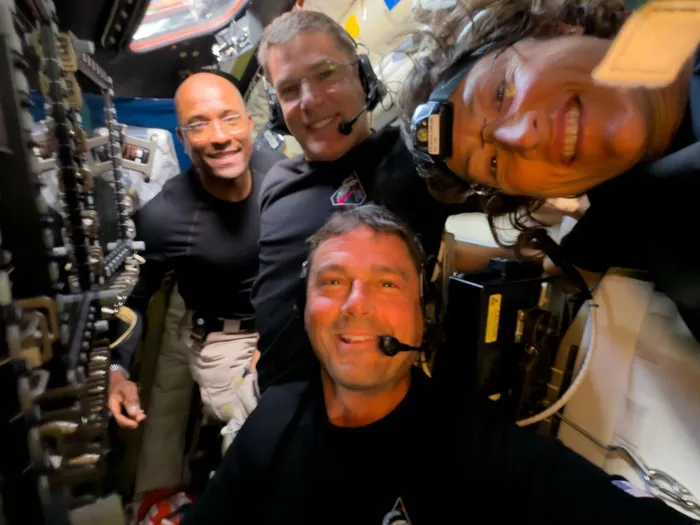
The four astronauts strapped into the Orion capsule for the Artemis II mission will not be dining on the romanticized "space food" of the 1960s. There are no silver pouches of Tang or chalky cubes of freeze-dried ice cream on this manifest. Instead, NASA is grappling with a brutal math problem where every gram of weight and every calorie of energy is a calculated risk against the vacuum of deep space. For the first crewed lunar mission in over half a century, the menu is less about culinary innovation and more about preventing a physiological breakdown during a high-stakes slingshot around the Moon.
Feeding Reid Wiseman, Victor Glover, Christina Koch, and Jeremy Hansen requires solving a puzzle that hasn't been touched since the end of the Apollo era. Unlike the International Space Station (ISS), where supplies are ferried up regularly and heavy freezers can preserve a variety of textures, the Orion spacecraft is a cramped, weight-sensitive lifeboat. The mission duration is roughly ten days, but the margin for error is zero. If a heating element fails or a seal breaks, there is no "Plan B" grocery run.
The Chemistry of Deep Space Survival
Nutrition in low-Earth orbit is a solved game. Nutrition in deep space, beyond the protection of the Van Allen belts, is a different beast entirely. The Artemis II crew will be exposed to higher levels of radiation than any humans in decades, which triggers oxidative stress in the body. To counter this, NASA’s food scientists have moved beyond simple calorie counting. They are looking at the specific chemical stability of micronutrients over the course of the mission.
The menu relies heavily on thermostabilized and rehydratable meals. Thermostabilized foods are heat-processed to destroy spoilage-causing microorganisms and then sealed in laminated pouches. Think of them as high-tech MREs. Rehydratable items are freeze-dried to strip away water weight—the enemy of any rocket launch—requiring the crew to inject hot water into the packaging before consumption.
This isn't just about keeping the astronauts full. It is about maintaining bone density and muscle mass under extreme stress. The crew must consume approximately 2,500 to 3,000 calories a day. If they under-eat due to "menu fatigue"—a real psychological phenomenon where astronauts simply lose interest in repetitive food—their cognitive functions can slip. On a mission where a few seconds of delayed reaction time during a manual burn can result in missing the Earth's atmosphere entirely, a lack of appetite is a mission-critical failure.
The Psychology of the Shared Plate
Food serves as the only clock in a place where the sun doesn't set or rise in a traditional sense. For the Artemis II crew, the psychological comfort of a familiar flavor is the strongest tether they have to Earth. This is why NASA includes "bonus containers." These are small allotments of off-the-shelf items or personalized favorites that allow an astronaut to have a sense of agency over their environment.
However, the physics of microgravity imposes strict limits on what those comforts can be. Crumbs are a lethal hazard. A floating speck of a cracker or a stray drop of liquid can drift into delicate electronics or be inhaled into a crew member's lung. Everything must be "surface tension-friendly." Condiments like salt and pepper are suspended in liquid form—salt in water, pepper in oil—to prevent them from becoming airborne debris.
The "smell factor" is another overlooked hurdle. In the closed-loop environmental system of the Orion, odors do not dissipate. They linger. A meal that smells slightly "off" or overly pungent can become an irritant for the entire crew within minutes. NASA’s sensory labs spend years testing these scents to ensure that the aroma of a beef stew doesn't turn into a source of cabin tension 200,000 miles from home.
Weight is the Ultimate Arbitrator
Every kilogram of food requires a massive amount of fuel to push it out of Earth’s gravity well. This creates a ruthless vetting process for every item on the menu. If a specific fruit provides excellent vitamins but requires heavy packaging, it is discarded in favor of a more efficient alternative.
The water used to rehydrate the food is largely recycled. Orion’s life support systems capture humidity from the crew's breath and perspiration, purifying it back into potable water. This closed-loop cycle is the only reason deep space travel is feasible. When an astronaut eats a bowl of rehydrated chili, they are participating in a masterpiece of regenerative engineering.
The Problem of Microgravity Taste Buds
In space, the human body undergoes a fluid shift. Without gravity to pull blood and interstitial fluid toward the legs, everything migrates toward the head. Astronauts often describe this as feeling like they have a permanent head cold. Their sinuses become congested, and their sense of smell—which accounts for the vast majority of what we perceive as flavor—is severely dulled.
To compensate, NASA has to over-engineer the flavor profiles. Space food is notoriously spicy and bold. If a dish tastes "balanced" on Earth, it will taste like cardboard in the Orion capsule. Food scientists use high concentrations of acidic ingredients and capsaicin to pierce through the "space fog" affecting the crew's palates. This isn't a culinary preference; it’s a biological necessity to ensure the astronauts actually eat enough to survive.
The Apollo Comparison
Critics often point to the Apollo missions and ask why we haven't "solved" space food after sixty years. The reality is that the Apollo-era astronauts were largely viewed as "test pilots" who could tolerate miserable conditions for the sake of the Cold War. The Artemis II crew are professional explorers intended to pave the way for a permanent lunar presence.
The food on Apollo was functional but biologically taxing. Many astronauts returned with significant gastrointestinal distress because the fiber content and probiotic balance were non-existent. For Artemis, the focus has shifted toward gut microbiome health. Scientists now understand that a healthy gut is linked to a strong immune system, which is vital when you are trapped in a pressurized metal can with three other people and a host of potentially mutating microbes.
Engineering the Packaging Waste
What happens to the trash? In a capsule the size of a small SUV, there is no room for a garbage bin. Every empty pouch and used utensil must be managed. The packaging for Artemis II is designed to be flattened and compressed to an extreme degree. NASA is even investigating ways to use waste packaging as radiation shielding, lining the walls of the "storm shelter" area of the capsule with dense layers of trash to provide an extra layer of protection during solar flare events.
This level of integration shows the difference between a "camping trip" and a "mission." On Earth, we view food and waste as separate cycles. In deep space, they are two ends of the same survival string.
The Limits of the Current System
Despite the advancements, the Artemis II food system is not perfect. It still relies on pre-packaged nutrients that begin to degrade the moment they are processed. For a ten-day mission, this is manageable. For the eventual three-year trip to Mars, it is a dealbreaker. Vitamin C and Thiamine, in particular, do not survive well in long-term storage under radiation exposure.
Artemis II is the final "stress test" for this generation of food technology. If the crew returns with significant weight loss or signs of nutritional deficiency, the entire roadmap for the Moon-to-Mars initiative will have to be redesigned. We are currently at the absolute limit of what "packaged" food can provide for human physiology.
The Biological Toll
Even with the best menu, the act of eating in space is a chore. The lack of "bolus" weight—the weight of food in your stomach—means the body doesn't send the same "I'm full" signals to the brain. Astronauts have to consciously track their intake to ensure they aren't accidentally starving themselves.
The Artemis II mission will be a grueling test of human endurance disguised as a technical flight. The food they eat is the fuel for the most complex machine in the capsule: the human brain. If the chemistry in the pouch is off by even a fraction, the mission's chance of success drops. Every bite taken in the shadow of the Moon is a calculated act of defiance against a vacuum that wants to shut the human body down.
The success of Artemis II will not be measured just by the splashdown in the Pacific, but by the physical condition of the four people who emerge from that hatch. If they are strong, clear-headed, and healthy, it will be because the unglamorous, high-pressure world of space food logistics did its job perfectly. There is no room for "gourmet" when survival is the only metric that matters. Pack the calories, stabilize the vitamins, and hope the spice is enough to cut through the congestion of deep space.