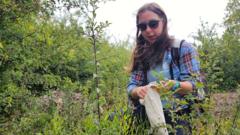
Deep within the climate-controlled vaults of the National Botanic Garden of Wales, a quiet war is being waged. It is not fought with weapons, but with desiccant beads, glass vials, and the patient, painstaking labor of experts who understand that the biological heritage of an entire nation is currently hanging by a thread. This is the Welsh Flora Archive, a high-stakes insurance policy against a botanical collapse that is already well underway. While the world watches melting glaciers, the hillsides of Wales are losing their genetic identity at a rate that should terrify anyone who eats, breathes, or values the stability of the British countryside.
The mission is simple but brutal. Collectors are racing to secure seeds from the country’s most vulnerable native species before they vanish from the wild entirely. We are talking about more than just aesthetic beauty. These seeds represent thousands of years of evolutionary adaptation to the specific, often harsh, Welsh environment. When a population of wild Meadow Thistle or Wood Bitter-vetch disappears, we don't just lose a plant; we lose a specific genetic "software" designed to survive local pathogens and shifting weather patterns.
The Genetic Erosion of a Nation
Most people assume that nature is a static backdrop, something that will always be there. That is a dangerous lie. Wales has seen a staggering decline in biodiversity over the last century, driven by intensive farming, urban sprawl, and the creeping influence of non-native invasive species. The problem isn't just that plants are dying; it’s that the remaining populations are becoming isolated.
When plant populations are cut off from one another by motorways or monoculture rye-grass fields, they can no longer cross-pollinate. This leads to genetic bottlenecks. The plants become inbred, losing the diversity they need to fight off new diseases or endure a freakishly dry summer. By the time a species looks like it’s in trouble, it might already be functionally extinct because its gene pool has become too shallow to support a recovery. This is why the seed collectors are focused on "provenance." A seed from a Snowdonia Lily is not the same as a lily from a garden center. The wild version carries the survivors' code.
The process of "saving" a species is far more rigorous than just picking flowers and putting them in a jar. It starts with a map and a massive amount of historical data. Collectors must find the few remaining sites where these plants still cling to life, often on steep cliff faces or hidden within ancient, neglected hedgerows. They have to time their visits perfectly—too early and the seeds aren't viable; too late and the wind or the birds have already taken them.
The Cold Hard Science of Survival
Once the seeds reach the lab, the real work begins. They aren't just tossed into a freezer. Each batch must be cleaned, counted, and meticulously dried. If a seed contains too much moisture when it is frozen, the water inside will expand and shatter the cell walls, killing the embryo. It is a delicate balance. The goal is to reach a moisture content of roughly 5%. At this level, the seed enters a state of suspended animation.
Biologists then seal these specimens in airtight containers and store them at temperatures of -20°C. In this deep-freeze state, many species can remain viable for decades, even centuries. But even this is not a permanent fix. Some seeds are "recalcitrant," meaning they cannot survive the drying and freezing process. For those plants, the archive must find other ways to keep the line alive, such as tissue culture or maintaining living collections in specialized nurseries.
The cost of this operation is significant, but the cost of inaction is higher. We rely on these plants for more than just oxygen. They are the foundations of the food chain. Insects that pollinate our crops rely on specific wild hosts. Birds that keep pest populations in check rely on the seeds and berries. When you pull a single thread out of the Welsh ecosystem, the whole fabric starts to fray.
The Problem with the Noahs Ark Approach
There is a growing criticism within the conservation community that seed banking creates a "false sense of security." Some argue that by focusing so heavily on saving seeds, we are neglecting the much harder work of saving the habitats themselves. A jar of seeds in a freezer is a museum piece, not a functioning part of the environment.
If we eventually lose the meadows, bogs, and woodlands where these plants belong, where will we put the seeds when we decide to "bring them back"? You cannot simply sprinkle ancient seeds onto a modern, pesticide-soaked farm and expect a miracle. Reintroduction is a notoriously difficult process with a high failure rate. Plants that have been sitting in a freezer for fifty years might find themselves waking up in a world that is several degrees warmer, with different pollinators and new pests. The genetic code we saved might be outdated.
The Invisible Threat of Nitrogen
One of the biggest hurdles facing Welsh flora isn't just direct destruction, but the invisible change in soil chemistry. For decades, the runoff from intensive agriculture and the deposition of nitrogen from car exhausts have fundamentally altered the ground. Welsh soil, historically nutrient-poor, is becoming "fat."
This favors a few aggressive, nitrogen-loving species like stinging nettles and coarse grasses, which quickly outcompete the delicate wildflowers that have evolved to thrive in lean soil. Even if we manage to protect a patch of land from development, the very air and water are changing the rules of the game. Seed collectors are essentially hoarding the blueprints for a world that is being chemically rewritten.
The archive is also a race against the clock regarding professional expertise. The number of people who can accurately identify rare sedges or grasses in the field is dwindling. We are losing "botanical literacy." Without the boots on the ground—the people who know exactly which gully on a specific mountain holds the last fifty individuals of a rare species—the high-tech labs become useless.
The Economics of Extinction
Funding for these projects is often precarious. While big-ticket animals like red squirrels or pine martens get the lion's share of public sympathy and donations, the "boring" plants that support them struggle for scraps. A rare orchid doesn't have big eyes or soft fur. Yet, from a purely economic standpoint, the loss of plant biodiversity is a disaster.
Native plants are the source of future medicines and crop resilience. As the global climate shifts, the genes found in a wild Welsh plant that can handle both heavy rain and sudden dry spells could be the key to breeding the wheat or barley of the 2050s. By letting these species go extinct, we are burning books in a library we haven't even finished reading yet.
The Strategy for Resilience
The National Botanic Garden of Wales isn't just acting as a warehouse; it is trying to become a hub for restoration. The "Saving Our Species" initiatives are beginning to move beyond the freezer and back into the mud. This involves working with local farmers to change grazing patterns and creating "green corridors" that allow plants to migrate naturally as temperatures rise.
The technology involved is also evolving. Researchers are now using DNA barcoding to map the genetic health of wild populations. This allows them to identify which specific groups of plants are the most diverse and therefore the most important to prioritize for collection. It is a data-driven approach to a crisis that was once managed purely by intuition.
We have to move away from the idea that conservation is something that happens "over there" in a nature reserve. The survival of Welsh flora depends on a fundamental shift in how we manage the entire geography of the country. This means rethinking road verges, urban parks, and the subsidies provided to agriculture. It means acknowledging that a diverse landscape is a functional necessity, not a luxury.
The collectors in Wales are buying us time. Every vial added to the freezer is a stay of execution. But time is a finite resource, and the freezer is only a temporary shelter. The real victory won't be found in the vault, but in the day we no longer need it. If the seeds stay in the jars forever, we haven't saved the species; we have merely curated its corpse.
The next time you see a patch of scrubby, "untidy" wildflowers on a Welsh hillside, realize you are looking at a high-performance survival machine that has been refining its code for millennia. If that machine breaks, there is no factory that can build a new one. We are down to the last few spare parts, and the mechanics are working in the dark.
Demand that local planning authorities prioritize biodiversity over aesthetic neatness. Support the transition to farming methods that allow for wild margins and diverse pastures. The preservation of our native species is a logistical challenge that requires immediate, aggressive intervention at the policy level. Start by identifying the native species in your own area and advocating for their protection. The vault is full, but the hills are emptying.