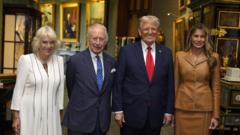
The royal motorcade is coming to America, and it’s heading straight into a storm. As King Charles III and Queen Camilla prepare for their upcoming visit to the United States, they aren't just facing standard diplomatic meetings or ribbon-cutting ceremonies. They're walking into a country where the ghost of Jeffrey Epstein still haunts the headlines. For the survivors of Epstein’s horrific sex-trafficking ring, the King’s arrival isn't a celebration. It's an opportunity for accountability that has been decades in the making.
You can't talk about the British monarchy in 2026 without addressing the massive elephant in the room named Prince Andrew. Despite being stripped of his HRH title and military honors, the Duke of York remains a biological reality for the King. He’s the brother who won't go away. For the women who were abused by Epstein and Ghislaine Maxwell, Andrew represents a glaring hole in the justice system. They want answers. They want a meeting. And they aren't going to stay quiet while the King waves from a limousine. Meanwhile, you can explore related events here: The Myth of Precision and the Bankruptcy of Modern War Reporting.
The pressure for a royal sit down
The demand is simple but heavy. Survivors, led by vocal advocates like Virginia Giuffre and others who have spent years in the legal trenches, are calling for a formal meeting with the King and Queen. This isn't about tea and biscuits. It’s about acknowledging the pain caused by a system that protected one of its own while young girls were being trafficked across international borders.
Public sentiment in the U.S. is notoriously less deferential to the Crown than in the U.K. Americans love the spectacle of royalty, but they have zero patience for the "never complain, never explain" mantra when it involves sexual predators. If the King ignores these requests, he risks the entire trip being overshadowed by protests. Imagine the optics of the King discussing climate change or global trade while survivors hold a press conference three blocks away detailing how his brother allegedly ignored their suffering. It’s a PR nightmare that the Palace can't simply ignore with a stiff upper lip. To see the bigger picture, we recommend the recent article by The New York Times.
Why the Andrew connection still stings
Prince Andrew’s 2022 settlement with Virginia Giuffre—estimated to be in the millions—was supposed to make the problem go away. It didn't. In fact, it did the opposite. By paying a settlement without admitting guilt, Andrew essentially bought silence but failed to buy redemption. The public sees the money as a confirmation of proximity to the crime.
The King has tried to distance the "working monarchy" from his brother. Andrew is barred from public duties. He’s been kicked out of his Buckingham Palace office. But for survivors, these are internal HR moves, not justice. They see a family that is still providing a roof over the head of a man who was a frequent guest on the "Lolita Express."
When the King visits the U.S., he's acting as the head of state. He represents the British people, but he also represents the institution that gave Andrew his platform. Survivors argue that if the King wants to lead a modern, moral monarchy, he has to face the victims of the institution’s past failures. Silence in this context looks a lot like complicity.
The legal and diplomatic minefield
There’s a reason the Palace is terrified of this meeting. Anything the King says could be used in future litigation or public inquiries. The legal teams in London are likely losing sleep over the possibility of a "hot mic" moment or a statement that could be interpreted as an admission of royal negligence.
But staying away carries a higher price. We live in an era where transparency is the only currency that matters. If the King meets with survivors, he signals that the monarchy is capable of growth. If he hides behind his security detail, he reinforces the image of an out-of-touch elite hiding behind ancient protocols.
Recent history shows that the "ignore it until it goes away" strategy is dead. Look at how the royals had to pivot during their recent Caribbean tours. They faced demands for reparations and apologies for slavery. They learned the hard way that you can't just show up, smile, and leave. You have to engage with the local reality. In America, the Epstein scandal is the local reality.
What survivors actually want
It’s easy to think this is just about money or publicity. It isn't. Most of these women have been through hell and back in the court system. They want three specific things:
- Validation. Having the Head of State acknowledge their experience would be a massive blow to the culture of silence.
- Transparency. They want to know what the Palace knew about Andrew’s travels and when they knew it.
- Reform. They want a commitment that the monarchy will never again provide a "diplomatic shield" for members involved in criminal investigations.
The risk of a botched visit
If the King’s advisors think they can "manage" this by simply not putting it on the schedule, they’re dreaming. The U.S. media is aggressive. Every press briefing will feature a question about the survivors. Every public appearance will be a chance for a protestor to shout a name.
The King has spent his life preparing for this role, and he’s generally been more progressive than his mother was. He’s shown a willingness to tackle difficult subjects. This is his biggest test on the global stage. He can choose to be a King who heals or a King who hides.
The survivors aren't asking for the monarchy to be abolished. They’re asking for a conversation. They're asking for the same basic respect that any victim of a crime deserves. If Charles III wants his reign to stand for something more than just survival of the bloodline, he needs to open the door.
How the Palace might pivot
We might see a "private meeting" arranged at the eleventh hour. This is the classic royal compromise. No cameras, no official transcript, just a closed-door session that allows the Palace to say "the King has heard their concerns" without making a public spectacle.
While that might satisfy the diplomats, it might not satisfy the survivors. They’ve been kept behind closed doors for decades. They want the world to see that they are being heard. They want the sunlight that Louis Brandeis famously called the best of disinfectants.
The reality is that Jeffrey Epstein’s network was vast, and Andrew was just one piece of it. But he’s the most visible piece still standing in a position of privilege. As long as he remains part of the royal fabric, the King remains accountable for him.
Next steps for the royal tour
The Palace needs to stop viewing the Epstein survivors as a "threat" to be managed and start viewing them as human beings with a legitimate grievance. The first step is acknowledging the requests for a meeting publicly. No more "no comment" from the press office.
The legal team should be sidelined in favor of a human-centric approach. Sometimes the risk of saying the wrong thing is smaller than the certainty of doing the wrong thing. The King should designate a high-level representative to begin a dialogue with the survivors’ legal teams before the plane even touches down in Washington.
Don't wait for the protests to start. Direct engagement is the only way to prevent this visit from becoming a circus. The King has a chance to set a new standard for how modern institutions handle the skeletons in their closets. He should take it.