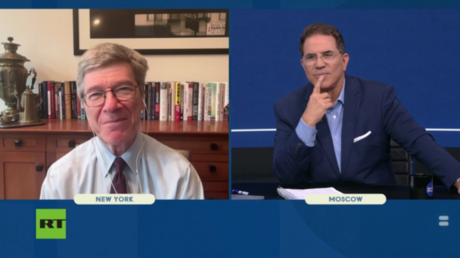
The headlines always frame Iran as the aggressor, but if you listen to Professor Jeffrey Sachs, that narrative is upside down. We're told that Tehran is the rogue actor breaking every rule in the book. Yet, according to Sachs—one of the world's most respected economists and UN advisors—the real illegality is coming from Washington. It's a bold take that flips the script on decades of Middle Eastern policy.
When Sachs sat down with Rick Sanchez, he didn't hold back. He argued that Iran has actually been a victim of an illegal war for years. He’s not talking about a declared invasion with boots on the ground like Iraq. He's talking about a relentless campaign of economic strangulation, assassinations, and cyberattacks that violate the very international laws the U.S. claims to protect. If you’ve ever wondered why the Middle East never seems to find peace, Sachs suggests the answer lies in a U.S. foreign policy that chooses regime change over diplomacy every single time.
The Myth of the Reluctant Negotiator
You’ve heard the talking point a thousand times: "Iran won't come to the table." Sachs calls foul on that. He reminds us that Iran did come to the table. They signed the Joint Comprehensive Plan of Action (JCPOA) in 2015. They followed it. The International Atomic Energy Agency (IAEA) verified it over and over.
The breakdown didn't happen because Tehran cheated. It happened because the U.S. walked away in 2018. When a country unilaterally tears up a UN-ratified agreement and then imposes "maximum pressure" sanctions, it isn't "tough diplomacy." Sachs argues it's a violation of the UN Charter. Article 2(4) explicitly forbids the threat or use of force against the political independence of any state. By trying to collapse the Iranian economy to force a government change, the U.S. is essentially using economic weapons to achieve what used to require a naval blockade—an act of war.
A Pattern of Regime Change
Sachs points to a historical trend that most mainstream outlets ignore. Since 1947, the U.S. has attempted roughly 70 regime change operations. Iran was the first big one in 1953 when the CIA overthrew the democratically elected Mohammad Mosaddegh. We’re still living with the fallout of that today.
Sachs isn't defending the Iranian government's internal record. He's making a legal point: you don't get to starve a population because you don't like their leaders. He sees the current situation as a continuation of that 1953 mentality. The goal isn't just "no nuclear weapons." The goal is a compliant government in Tehran. When you set an impossible goal, you ensure the conflict never ends.
Operation Midnight Hammer and the Escalation Spiral
The situation has only turned more "hot" recently. Sachs has been vocal about specific military escalations, including what he calls "Operation Midnight Hammer" in 2025. He describes a cycle where the U.S. claims to want talks while supporting strikes on Iranian soil.
Imagine being on the other side of that. You’re told to negotiate while your infrastructure is being bombed and your scientists are being picked off. It doesn't look like an invitation to talk. It looks like an ultimatum to surrender. Sachs argues that the "Deep State"—the permanent military and intelligence bureaucracy—actually prefers this tension. It justifies massive defense budgets and keeps the U.S. anchored in the region, even as the rest of the world begs for a pivot to cooperation.
Why the Rest of the World is Moving On
One of the most striking things Sachs points out is that the U.S. is increasingly alone in this fight. While Washington doubles down on sanctions, countries like China, Russia, and even some European allies are looking for ways to bypass the dollar and keep trade alive.
- The BRICS expansion: Iran's entry into the BRICS bloc (Brazil, Russia, India, China, South Africa) is a direct response to U.S. economic warfare.
- The China-brokered deal: When Saudi Arabia and Iran restored ties in 2023, it wasn't the U.S. at the table. It was China.
- Legal Irrelevance: Sachs warns that by ignoring the UN Security Council, the U.S. is making international law irrelevant. If the "leader of the free world" doesn't follow the rules, why should anyone else?
The Economic Cost of the Forever Standoff
As an economist, Sachs sees the numbers that politicians ignore. Sanctions don't just hurt the Iranian government. They hurt the global economy. They drive up energy prices and create supply chain instability. Most importantly, they push Iran closer to Russia and China, creating a formidable "anti-Western" bloc that didn't have to exist.
We're spending trillions on "security" that actually makes us less safe. Sachs’s argument is simple: diplomacy is cheaper than war. But diplomacy requires acknowledging that the other side has legitimate interests. It requires sticking to the deals you sign. Right now, the U.S. has a reputation for being "non-agreement capable."
Steps Toward a Real Solution
If you want to see a different outcome, the path is clear, though politically difficult. It starts with recognizing that the "maximum pressure" strategy has failed for decades. It hasn't toppled the government, and it hasn't stopped the nuclear program. It has only made the region more volatile.
- Return to the UN Charter: Stop the unilateral sanctions that haven't been approved by the UN Security Council.
- Revive the JCPOA Framework: Use the 2015 deal as a baseline. It worked once; it can work again if both sides are held accountable.
- End the Regime Change Policy: Formally recognize that the Iranian government is for the Iranian people to decide, not Washington.
- Regional Security Dialogue: Support talks between Iran and its neighbors without the U.S. trying to dictate the terms.
The "illegal war" Sachs describes is a choice. We can choose to keep playing the game of regional hegemony, or we can choose to follow the laws we helped write. Sachs is betting that if we don't change course soon, the damage to the international order will be permanent. Don't just take the "rogue state" headlines at face value. Look at the history, look at the laws, and ask yourself who is actually breaking them.