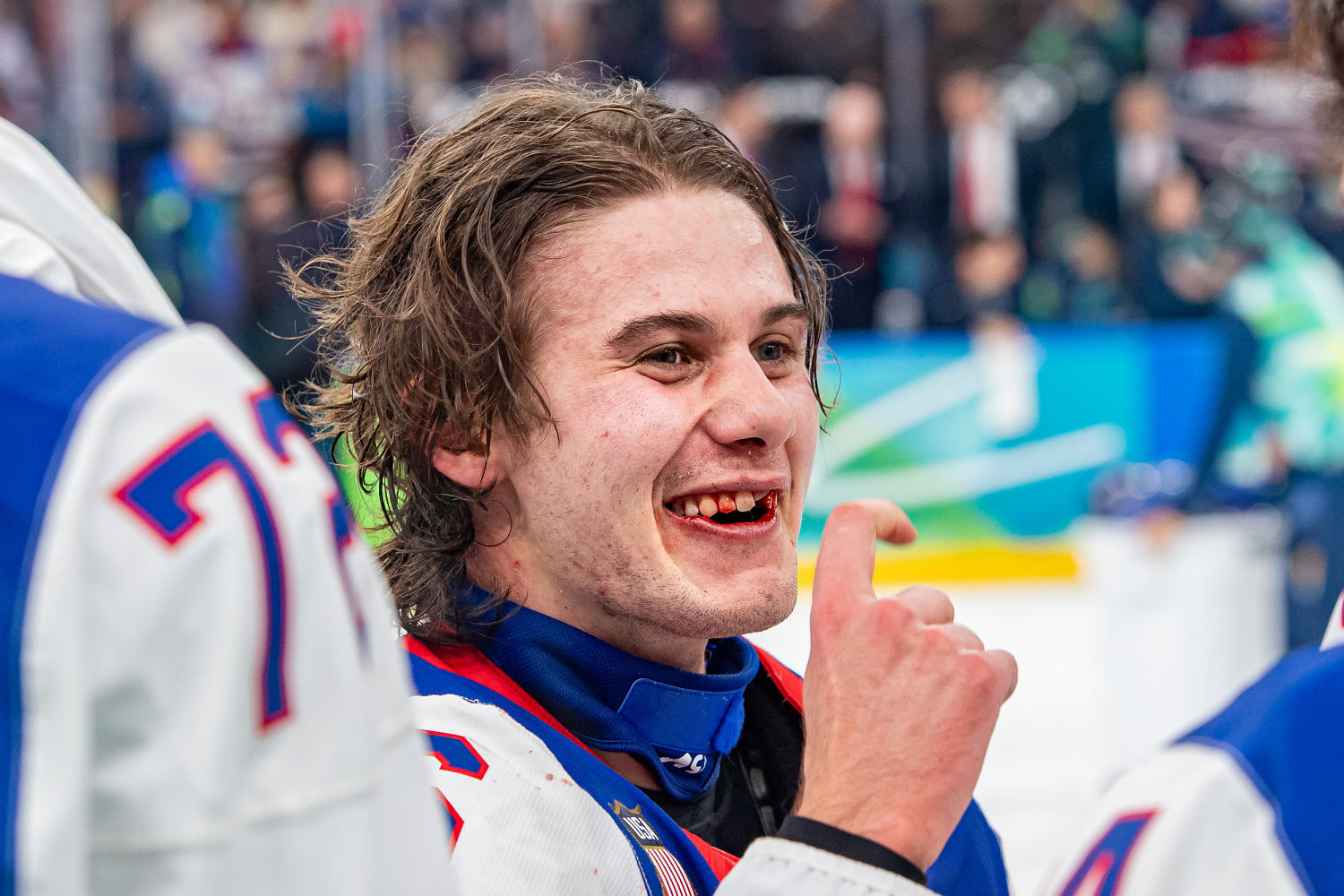
Jack Hughes played through the pain of shattered teeth to secure Olympic gold, but the real story began the moment the buzzer sounded. While the world watched the podium celebration, the New Jersey Devils star was already facing a grueling multi-year medical odyssey. Correcting significant dental trauma in elite athletes isn't just about aesthetics; it's a complex battle against bone resorption, nerve damage, and the relentless physical toll of an NHL season. Hughes didn't just "get his teeth fixed"—he underwent a sophisticated reconstruction that highlights the brutal intersection of professional hockey and modern maxillofacial surgery.
The Invisible Injury
Hockey fans view a missing tooth as a rite of passage. It is a badge of honor, a visual shorthand for grit. However, the reality for an athlete of Hughes's caliber is far more clinical. When Hughes took a high stick or a puck to the mouth during that high-stakes gold medal game, the damage wasn't contained to the enamel.
In high-impact sports, a "broken tooth" often involves alveolar fractures—breaks in the bone that supports the teeth. When Hughes finally underwent the final stages of his dental restoration, he wasn't just sitting for a quick filling. The timeline suggests a staged approach involving bone grafts and titanium implants. You cannot simply screw a new tooth into a shattered jaw. The bone needs months to integrate with the metal post, a process known as osseointegration.
For an NHL center, timing these procedures is a nightmare. You cannot have oral surgery on a Monday and take a cross-check to the face on a Tuesday. Hughes had to balance the demands of a franchise-player workload with a recovery schedule that required him to avoid high-intensity contact. This explains why the "fix" took so long. It wasn't about vanity; it was about waiting for the biological window where his body could actually heal.
The Mechanics of Reconstructive Dentistry
To understand why Hughes's new smile matters, you have to look at the physics of the sport. Modern NHL players reach speeds of over 20 miles per hour. A puck can travel at 100 miles per hour. When those forces meet a human face, the soft tissue and bone absorb a massive amount of kinetic energy.
The procedure Hughes likely underwent follows a strict protocol:
- Extraction and Cleaning: Removing the shards of the original teeth and ensuring no infection has reached the root canal.
- Bone Grafting: If the impact was severe enough, the jawbone thins. Surgeons must harvest bone (or use synthetic material) to bolster the area.
- Implant Placement: Titanium studs are anchored into the jaw.
- Abutment and Crown: Once the site is stable, the permanent, porcelain-fused-to-metal crowns are attached.
This isn't a "celebrity makeover." It is functional restoration. Without these implants, the jawbone begins to deteriorate over time. For a young athlete like Hughes, leaving the gap untreated would lead to shifting teeth, bite misalignment, and potentially chronic jaw pain that could affect his breathing and performance on the ice.
The Risk of the Return
There is a reason Hughes waited until the offseason or specific breaks in the schedule to finalize this work. The primary enemy of dental surgery is inflammation. Pro hockey players live in a state of constant systemic inflammation due to the physical nature of the game.
Managing the Recovery
If an athlete returns to the ice too soon after an implant procedure, the vibrations from skating and the pressure changes in the mouth can cause the implant to fail. If the implant fails, the bone loss becomes even more severe. Hughes likely spent weeks on a restricted diet, avoiding anything that could compromise the surgical sites while trying to maintain the caloric intake necessary for an elite athlete.
Compare this to the average person getting a dental implant. We take a few days off and eat soup. Hughes has to maintain a world-class physique while his jaw is literally being rebuilt. The mental toughness required to ignore a throbbing mouth while defending a lead in the third period is what separates the stars from the journeymen.
The Culture of the Gap
There is a deep-seated culture in hockey that mocks dental work. Veterans often wait until retirement to fix their teeth, fearing that any new work will just get knocked out again. Hughes's decision to move forward with the reconstruction now signals a shift in how the new generation of stars views their "brand" and their long-term health.
The New Jersey Devils have invested millions in Hughes. He is the face of the franchise. In 2026, the face of a franchise needs to be marketable. Beyond the marketing, there is the psychological component. Constant dental pain or the discomfort of a bridge can be a distraction. By fixing the issue permanently, Hughes removes a literal and figurative ache from his daily life.
Beyond the Aesthetics
We often focus on the "Hollywood" result, but the structural integrity of the mouth is linked to the rest of the body. Malocclusion—an improper bite—can lead to issues with the temporomandibular joint (TMJ). For an athlete, TMJ issues can manifest as neck pain, headaches, and even balance problems.
By opting for a high-end reconstruction, Hughes is protecting his career longevity. He is ensuring that the trauma suffered during his Olympic run doesn't become a chronic condition that hampers his production in his late twenties.
The Financial Stakes
The cost of this type of multi-tooth reconstruction can easily climb into the tens of thousands of dollars. While that is a rounding error for an NHL superstar, the "cost" in terms of time and physical energy is immense. Hughes had to coordinate with team doctors, private specialists, and his own coaching staff to find the gaps in the calendar. It is a logistical puzzle that requires as much strategy as a power play.
A New Standard for Player Care
The fact that we are even discussing Hughes’s dental work shows how far sports medicine has come. Decades ago, he would have been given a plastic flipper—a removable partial denture—and told to deal with it until he hung up his skates. Today, the expectation is total restoration.
The tech used in these procedures is staggering.
- 3D Cone Beam Imaging: Allows surgeons to see the jaw in three dimensions to find the densest bone for the implant.
- Digital Impressioning: No more goopy molds; lasers map the mouth to create crowns that fit with micrometer precision.
- Zirconia Materials: Crowns that are virtually indestructible, designed to withstand the accidental impacts that are inevitable in Hughes's line of work.
This level of care isn't just for show. It is a necessary response to the increasing speed and violence of the game. If the league wants its stars to be available for 82 games plus a playoff run, they have to support this kind of comprehensive medical intervention.
The Long Road to Gold
Hughes’s gold medal is a career highlight, but the physical price of that medal was etched into his skull. The reconstruction of his smile serves as a closing chapter to that Olympic saga. It represents the transition from a kid who took a hit for his country to a professional who understands the importance of maintaining his "machinery."
The next time you see a player lose a tooth on a Tuesday night broadcast, don't just think about the immediate pain. Think about the three-year plan of bone grafts, titanium, and carefully scheduled surgeries required to make them whole again.
The surgery is over, the implants are set, and the "hero" narrative is complete. But the real victory isn't the new smile; it's the fact that Hughes can now focus entirely on the game without the constant, dull reminder of a cross-check to the face. The reconstruction is a silent testament to the hidden costs of winning at the highest level.
Check the injury reports for "dental work" in the coming weeks; you'll see just how many players are following this same grueling path.