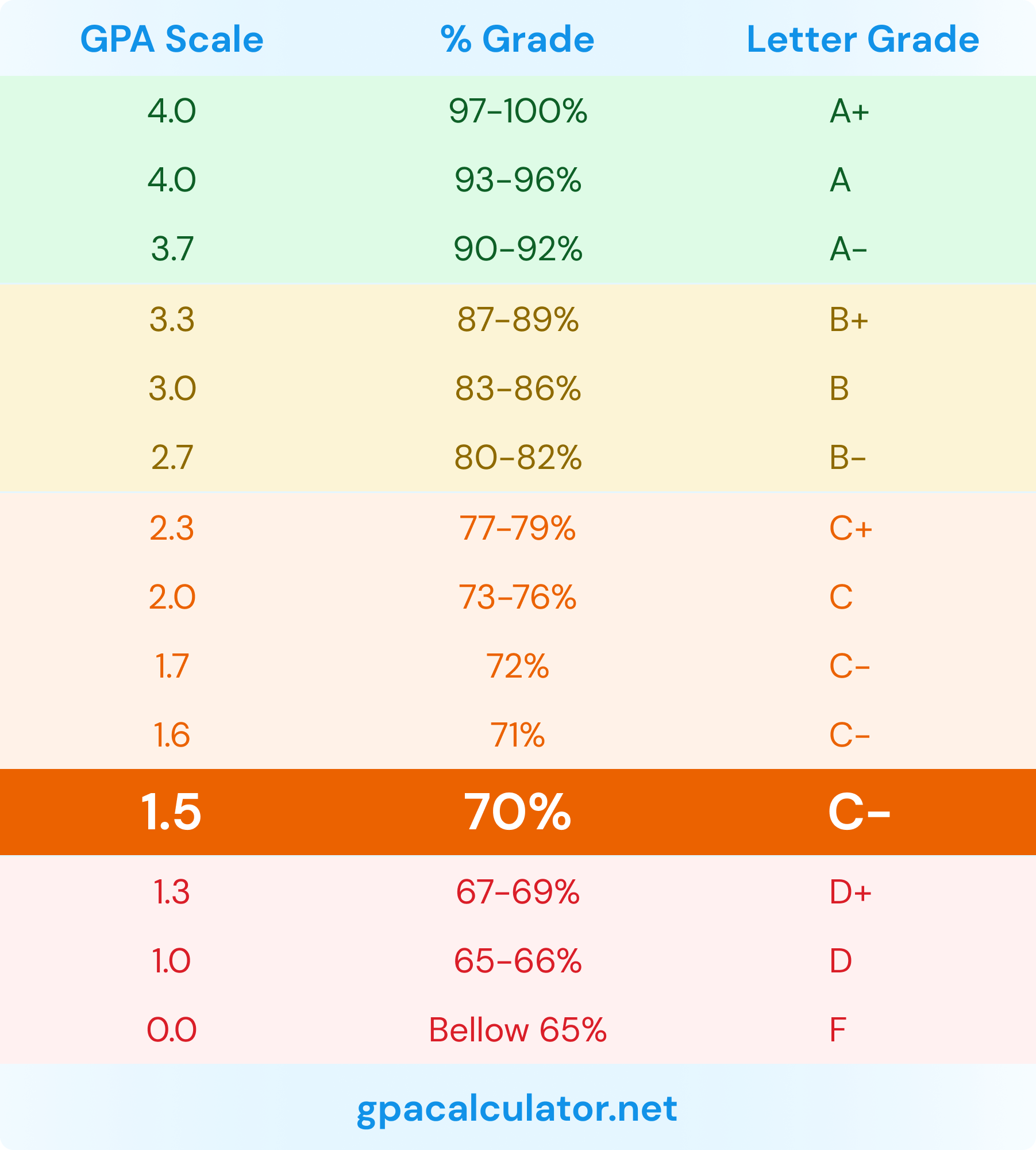
So, you’re looking at your transcript and you see it: a 2.5. Honestly, it’s one of those numbers that feels like it’s stuck right in the middle of a tug-of-war. It isn’t a disaster, but it’s definitely not making any dean’s list. If you’ve been wondering what's a 2.5 GPA in the eyes of a college admissions officer or a hiring manager, the answer is a bit more nuanced than just "it's a C+ average."
In the standard American 4.0 grading system, a 2.5 sits squarely between a B and a C. Specifically, it’s a C+. It means you’re passing. You’re doing the work. But it also suggests there’s a gap between just getting by and truly mastering the material. For some, a 2.5 is a hard-won victory after a semester of personal struggles or working two jobs. For others, it’s a wake-up call that maybe those 8:00 AM lectures weren’t the best idea.
Breaking Down the Math: What’s a 2.5 GPA Actually Made Of?
Let’s get technical for a second, though not too much. A GPA is a weighted average. To land at a 2.5, you’re likely looking at a transcript filled with mostly Cs and Bs. Maybe a stray A helped pull you up, or a D dragged you down. If we look at the percentage equivalent, you’re looking at roughly a 77% to 79% average across your classes.
Think about that. You know about three-quarters of the material. That’s enough to move on to the next level, but it’s a shaky foundation if you’re heading into a highly technical field like engineering or nursing where the concepts stack on top of each other like a game of Jenga. According to data from the National Center for Education Statistics (NCES), the average high school GPA has been creeping up over the years, now sitting closer to a 3.0. This "grade inflation" makes a 2.5 feel lower than it did twenty years ago.
It’s a "consistent" grade. It shows you showed up. It shows you turned in the assignments. But it doesn't scream "academic standout." And that's okay, provided you know how to play your other cards.
Will a 2.5 Get You Into College?
This is the big one. The short answer? Yes. The long answer? It depends on where you’re looking.
If you’re eyeing the Ivy League or top-tier state schools like UC Berkeley or the University of Michigan, a 2.5 is going to make things very difficult. Most of these institutions have an unwritten (and sometimes written) cutoff at a 3.0 or even a 3.5. However, the world of higher education is massive. There are hundreds of "Broad Access" colleges and universities that accept students with a 2.5.
Many public state universities have a minimum requirement right around the 2.0 to 2.5 mark. Then you have community colleges. They are the ultimate "second chance" machines. You can start at a community college with a 2.5 (or lower!), knock your general education requirements out of the park, and then transfer to a "prestigious" school with a brand-new 3.8 transfer GPA. Nobody looks at your high school grades once you have a college degree.
Beyond the Number: Holistic Review
Admissions officers at many mid-tier schools use what they call "holistic review." They aren't just robots scanning a spreadsheet. They look at:
- Your SAT or ACT scores: A high test score can sometimes "offset" a lower GPA by proving you have the raw intellectual capability.
- Your Trend: Did you start freshman year with a 1.5 and finish senior year with a 3.5? That upward trajectory matters more than the final average. It shows growth.
- Extracurriculars: If you have a 2.5 because you were busy running a small business or captaining a state-champion sports team, they’ll listen.
Real Talk: The Financial Aid Factor
Here is where a 2.5 GPA starts to hurt. It’s not necessarily about getting in; it’s about paying for it. Most "merit-based" scholarships start at a 3.0. If you are sitting at a 2.5, you are essentially leaving free money on the table.
Federal aid, like the Pell Grant, usually only requires you to maintain "Satisfactory Academic Progress" (SAP), which is often a 2.0. So, your federal loans and grants are likely safe. But those sweet, sweet institutional scholarships that shave $10,000 off your tuition? Those usually require a higher average. If you’re at a 2.5, you’re going to be leaning more heavily on need-based aid or student loans. That’s a reality you have to face.
Does a 2.5 GPA Matter in the Job Market?
I have some good news here. Once you land your first job, literally no one cares about your GPA. Seriously.
In most industries—marketing, sales, trades, creative arts—employers want to see your portfolio, your experience, and your ability to look them in the eye and hold a conversation. They want to know if you can solve problems.
However, there are exceptions. If you’re trying to get into high-end management consulting (think McKinsey or BCG) or investment banking (Goldman Sachs), they will ask for your transcript. And they will likely discard it if they see a 2.5. These industries use GPA as a proxy for "attention to detail" and "work ethic." It’s a filter.
But for the other 90% of jobs? Your internship experience, your GitHub repository, your volunteer work, and your networking skills matter ten times more. I've seen people with 2.2 GPAs out-earn 4.0 students within five years because they knew how to hustle and build relationships.
How to Turn Things Around (If You Want To)
Maybe you aren't happy with where you are. Maybe you're a sophomore and you've realized what's a 2.5 GPA actually doing to your options. You can fix it. You won’t jump to a 4.0 overnight—math doesn't work that way—but you can climb.
First, identify the "sinker" classes. We all have them. For me, it was Statistics. For you, it might be Spanish or Chemistry. If you can retake a class you failed or got a D in, many schools will "replace" the old grade with the new one in your GPA calculation. This is the fastest way to see the needle move.
Second, go to office hours. It sounds cheesy. It works. Professors are human. If they see you putting in the effort, they are much more likely to give you the benefit of the doubt on a borderline grade. Plus, they might offer extra credit opportunities that aren't on the syllabus.
Actionable Steps for the 2.5 Student
If you are currently holding a 2.5 GPA, don't panic. But don't be complacent either. Here is exactly what you should do next to ensure your future isn't limited by a decimal point:
- Audit your transcript immediately. Look for "Grade Forgiveness" policies at your school. Replacing a single 'F' with a 'B' can sometimes jump your GPA by 0.2 or 0.3 points in one semester.
- Focus on the "Major GPA." On your resume, if your overall GPA is a 2.5 but your grades in your specific major (like Graphic Design or History) are a 3.2, list the Major GPA. It’s honest, and it highlights your strengths.
- Secure "Character References." Since your numbers aren't doing the talking, your mentors must. Build strong relationships with two teachers or supervisors who can write a letter of recommendation that says, "Ignore the 2.5; this person is a rockstar for [X] reasons."
- Kill it in your internships. Real-world experience is the ultimate equalizer. If you have a solid internship on your resume, the GPA becomes a footnote.
- Broaden your college search. Look for "Test Optional" schools and those that emphasize "holistic admissions." Use sites like the Common App to filter for schools where the average incoming GPA aligns with yours.
- Consider the "Transfer Path." If your dream school is out of reach, go to a community college for a year. Crush your classes there. When you apply to transfer, your high school 2.5 GPA won't even be part of the conversation.
A 2.5 GPA is a crossroads. It’s a sign that you’re capable, but perhaps unfocused or overwhelmed. It doesn't define your intelligence, and it certainly doesn't cap your earning potential. It just means you have to be a bit more strategic about how you present yourself to the world. Focus on your skills, build your network, and keep moving forward.