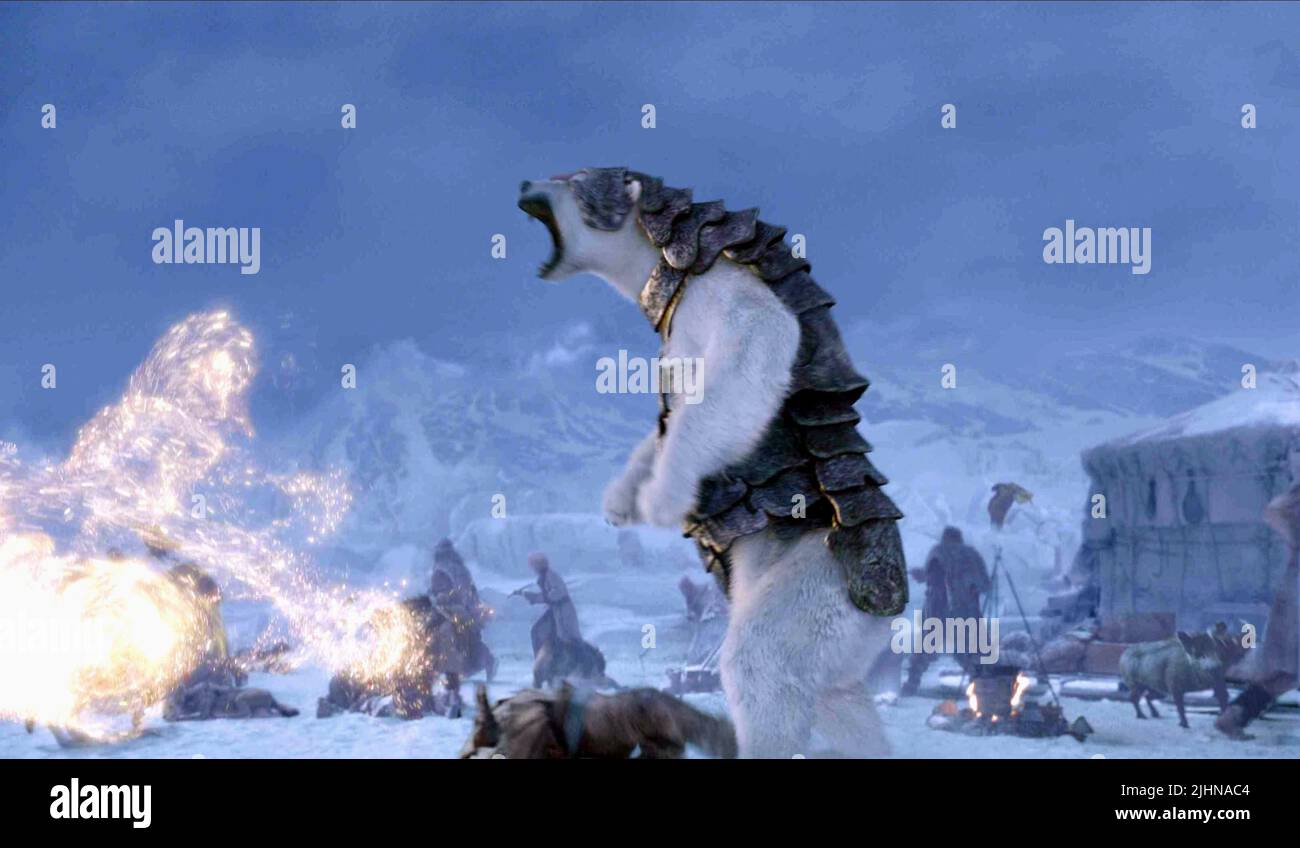
Honestly, if you're talking about The Golden Compass, you’re really talking about Iorek Byrnison. Sure, Lyra is the heart of Philip Pullman’s story, but Iorek? He’s the iron-clad backbone of the whole thing. Most people just see him as a big, talking polar bear in armor, but that’s barely scratching the surface of what makes him the most interesting character in the series.
He’s a panserbjørn. That’s the Norwegian word for "armored bear," and it’s not just a fancy title. These guys are a whole different species with a code of ethics that makes human politics look like a joke. When we first meet Iorek in the port town of Trollesund, he’s a total wreck. He’s drunk, he’s working as a common laborer for a bunch of humans he hates, and—most importantly—he’s lost his armor. Meanwhile, you can find similar developments here: The Structural Mechanics of Cinematic Escapism in the Italian Romance Genre.
For a bear like Iorek, losing his armor isn't like you or me losing a favorite jacket. It’s way worse.
Iorek Byrnison in The Golden Compass: The Bear Without a Soul
In Pullman’s world, humans have dæmons—external spirits that represent their souls. Bears don't have those. Instead, they have their armor. Iorek tells Lyra flat out that his armor is his soul. He forged it himself from "sky iron," which is basically meteoric iron. It’s a part of him. To explore the bigger picture, check out the recent analysis by Variety.
When the local humans tricked him by getting him drunk on spirits and stealing his gear, they didn't just rob him. They effectively castrated his spirit. That’s why he’s so miserable when Lyra finds him. He’s essentially a ghost inhabiting a 1,000-pound body.
Why he was in Trollesund in the first place
You’ve got to wonder how a literal prince of Svalbard ends up cleaning a fish-packing plant. It turns out Iorek was exiled for killing another bear. Now, in bear culture, ritual combat is the norm, but there are rules. You don't kill unless it's absolutely necessary for dominance.
The bear he fought, Hjalmur Hjalmurson, was acting weird. He wouldn't back down when he should have. Later, we find out the whole thing was a setup orchestrated by Iofur Raknison and Mrs. Coulter to get Iorek out of the way. Iorek killed him in the heat of the moment, which meant instant exile. No crown. No home. Just shame and cheap booze.
The Bromance with Lee Scoresby
You can't talk about Iorek without mentioning Lee Scoresby. Their friendship is probably the most genuine relationship in the entire trilogy. They met years before the events of The Golden Compass (detailed in the spin-off Once Upon a Time in the North). Lee is a Texan aeronaut who flies a hot-air balloon, and he’s one of the few humans Iorek actually respects.
Why? Because Lee treats him like a bear, not like a person.
That’s a big deal in the books. Most humans try to "humanize" bears, which bears find insulting. Lee knows Iorek is a wild, dangerous creature, and he loves him for it. When Iorek is at his lowest, Lee is the one who shows up to help, though it’s ultimately Lyra’s cleverness with the alethiometer that gets Iorek his "soul" back.
What Most People Get Wrong About the Duel
The fight between Iorek and Iofur Raknison is the climax of the Svalbard arc, and it’s brutal. In the movies and TV shows, they usually make it look like a standard wrestling match with teeth. But in the book, it’s a clash of ideologies.
- Iofur Raknison wants to be human. He wears silk, he wants a dæmon, and he’s built a palace.
- Iorek Byrnison is just a bear. He wants to be a bear.
Iorek wins not just because he’s stronger, but because he uses his "bear-ness" to trick Iofur. Bears are notoriously hard to deceive. You can’t lie to a bear; they see the truth of a person immediately. But because Iofur has tried so hard to become human, he’s become vulnerable to human weaknesses—like vanity and deception.
Lyra tricks Iofur into thinking she’s Iorek’s "dæmon" and that she’ll become Iofur’s if he kills him. Iofur falls for it because he wants a soul so badly. Iorek, despite being injured and exhausted, uses a classic feign—pretending his leg is broken—to lure Iofur in for the kill. It’s a masterclass in strategy.
The Skill of a Master Smith
Iorek isn't just a fighter. He’s an artist. Well, a blacksmith artist. Later in the trilogy, in The Amber Spyglass, he’s the only one capable of fixing the Subtle Knife. Think about that: a giant polar bear with paws the size of dinner plates has the precision to mend a magical blade that cuts between dimensions.
He uses "sky iron" and a level of focus that humans can't replicate. It shows that the panserbjørne aren't just "talking animals"—they are a highly sophisticated civilization with a deep understanding of metallurgy and the physical world.
Actionable Takeaways for Fans of the Lore
If you're diving back into the world of His Dark Materials or just discovered Iorek through the HBO series, here is how to appreciate his character on a deeper level:
- Read the Prequel: If you want to see a young, hot-headed Iorek, pick up Once Upon a Time in the North. It explains his bond with Lee Scoresby and shows him before he became the stoic king we know.
- Look for the "Humanity" Contrast: Pay attention to how Iorek reacts when people try to flatter him or treat him like a person. His strength comes from his rejection of human nature.
- The Armor Connection: Re-read the chapters where he loses and regains his armor. It’s a perfect metaphor for identity and depression. When he gets it back, he doesn't just get "powerful"—he becomes himself again.
- The Climate Context: In the later books, Iorek has to move his entire people because the world is changing (thanks to Lord Asriel’s meddling). It’s a subtle but powerful commentary on environmental displacement.
Iorek Byrnison remains one of the most compelling figures in fantasy because he is unapologetically "other." He doesn't want to fit in, he doesn't want your approval, and he won't break a promise. In a world of lies and shifting alliances, the bear is the only thing you can truly count on.
To truly understand Iorek, you have to look past the "warrior bear" trope. Look at the exile, the smith, and the king who had to lose his soul to find out what it was actually worth.
Next Steps for Readers: Check out the specific metallurgy descriptions in Chapter 10 of The Golden Compass to see how Pullman differentiates "sky iron" from normal human steel. You can also compare the 2007 film’s portrayal of the Iofur fight (where they renamed him Ragnar) to the 2019 HBO version to see how different directors interpret "bear combat."
Explore the official His Dark Materials companion materials to see original sketches of the panserbjørne armor designs, which were inspired by 16th-century plate mail.