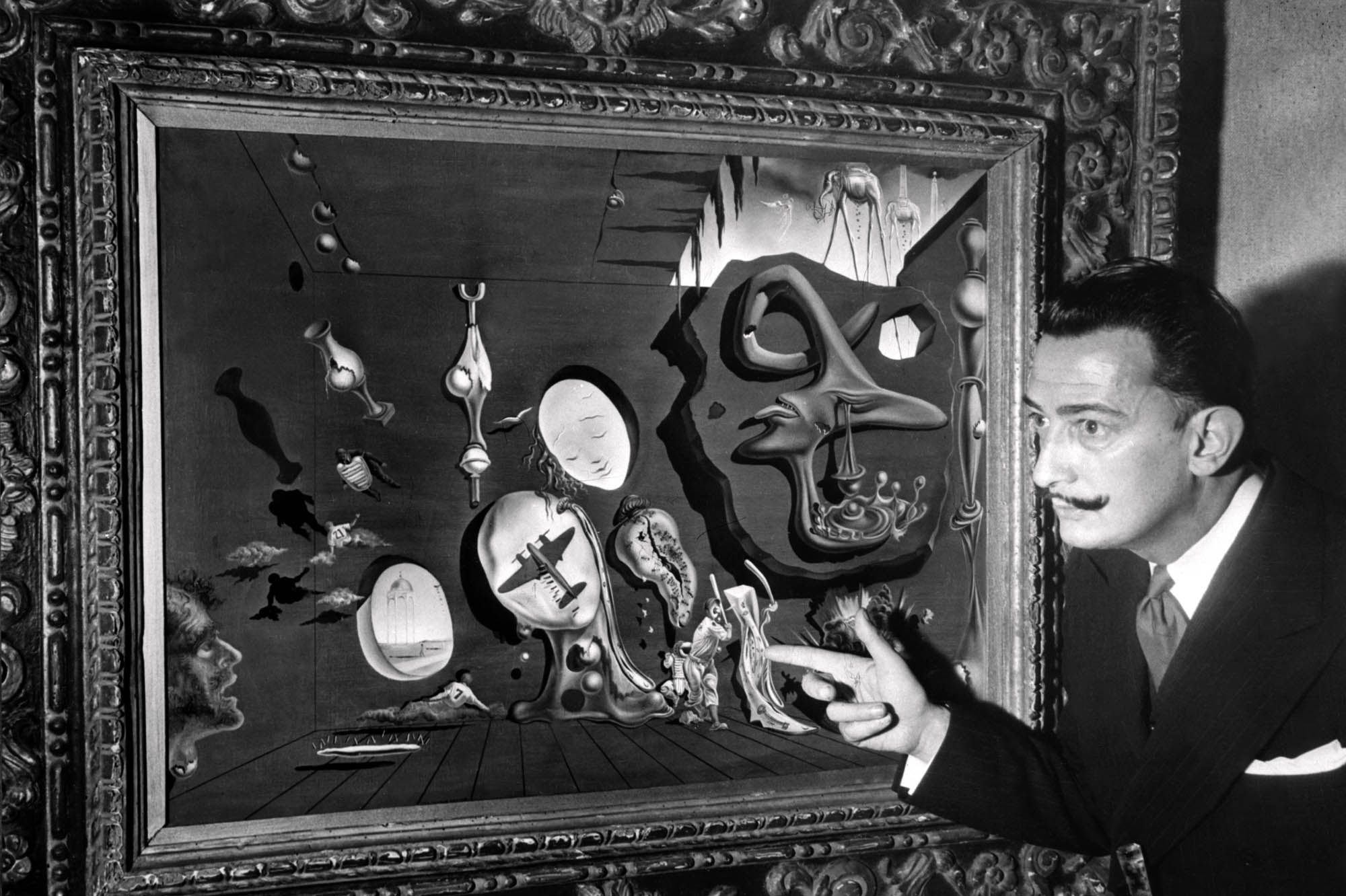
You probably know the mustache. It’s that gravity-defying, waxed-to-the-heavens signature that makes Salvador Dalí instantly recognizable even to people who couldn't tell a Surrealist painting from a bowl of cereal. But honestly, the man behind the melting clocks was way weirder—and significantly more calculating—than the "crazy artist" persona he sold to the world.
Dalí wasn't just a painter; he was a brand, a walking performance piece, and a guy who was deeply, genuinely convinced he was a ghost.
The Brother Who Died Twice
The most haunting thing about Dalí isn’t found in his art, but in his birth certificate. He was born on May 11, 1904, exactly nine months after his older brother died of gastroenteritis. The kicker? The older brother was also named Salvador.
When Dalí was five, his parents took him to the grave and told him—straight up—that he was the reincarnation of his dead sibling. Imagine being a toddler and being told you're basically a "Version 2.0" of a dead kid. It messed him up. He spent his whole life trying to prove he was the "living" one, often through extreme eccentricity. He once wrote that he and his brother resembled each other like two drops of water, but with different reflections.
The $10,000 Hair Scammed Off Yoko Ono
Dalí loved money. Like, he really loved it. His fellow Surrealists even gave him the nickname "Avida Dollars," which is an anagram of his name that basically means "eager for dollars."
There's a legendary story about Yoko Ono asking Dalí for a strand of his famous mustache hair. Most people would just say no or give it for free. Not Dalí. He was convinced Yoko was a witch and might use the hair for a spell. So, he sent her a blade of dried grass in a fancy box and charged her $10,000 for it. She paid. He kept the cash. Honestly, it's the ultimate hustle.
He Designed the Chupa Chups Logo (Yes, Really)
Next time you’re at a gas station grabbing a lollipop, look at the wrapper. That bright yellow daisy-shaped logo for Chupa Chups? That’s a Dalí original.
In 1969, his friend Enric Bernat (the founder of the company) complained about his branding. Dalí supposedly sat down at a sidewalk café and sketched the logo on a piece of newspaper right then and there. But the real genius wasn't just the drawing; it was the placement. Dalí insisted the logo be placed on the very top of the wrapper, not the side. That way, the branding stayed intact and visible while you were eating it. It’s been virtually unchanged for over 50 years.
The Persistence of... Camembert?
Everyone assumes "The Persistence of Memory" (the one with the melting watches) is some deep meditation on the Theory of Relativity or the fluid nature of time.
Nope.
Dalí claimed the idea came to him after eating a particularly "super-soft" piece of Camembert cheese at a dinner party. He went back to his studio, looked at a landscape he was working on, and decided the watches should look like melting cheese. Sometimes a masterpiece is just the result of a really good snack and a fever dream.
Why the Ants?
If you look closely at Dalí’s work, you’ll see ants everywhere. They’re crawling over watches, hands, and faces. For Dalí, ants were a symbol of decay and death. This obsession started when he was a kid and saw an army of ants devouring the carcass of a small animal. It stuck with him. In his "Paranoiac-Critical" method—which was basically a way he trained himself to have hallucinations without drugs—he would stare at objects until they transformed into these symbols of rot and desire.
He Almost Suffocated in a Diving Suit
Dalí was the king of the "stunt." In 1936, he showed up to the London International Surrealist Exhibition wearing a full deep-sea diving suit, carrying a billiard cue, and leading two wolfhounds.
The problem? The suit was airtight.
As he started his lecture, he began to suffocate. He was flailing his arms and gasping for air inside the glass helmet. The audience, thinking this was just part of his "genius" performance, stood there and cheered. They thought he was acting out the struggle of the subconscious mind. He was actually dying. Luckily, a friend realized he was turning blue and used a wrench to bolt the helmet off just in time.
The Ocelot Named Babou
In the 1960s, Dalí didn't walk a dog. He walked an ocelot named Babou. He took the big cat everywhere—into luxury restaurants, onto cruise ships, and into Manhattan hotels.
Once, in a posh Manhattan restaurant, a fellow diner got nervous about the wild animal tethered to Dalí's table. Dalí calmly told her that Babou was just a normal house cat that he had "painted over in an op-art design." The woman believed him.
Alice in Wonderland and the 2026 Mustache Mystery
One of Dalí's coolest, less-talked-about projects was a 1969 limited edition of Alice's Adventures in Wonderland. He created 12 illustrations (heliogravures) for it. It's wild—the Queen of Hearts looks like a bloody explosion and Alice is just a silhouette of a girl skipping rope.
But here is the weirdest fact of all: Dalí died in 1989, but his mustache lived on. In 2017, his body was exhumed for a paternity test (which turned out negative, by the way). When the forensic team opened the coffin, they were shocked. Even though his body had mummified, his mustache was still perfectly intact, pointed at "ten past ten," exactly as he wore it in life. As of 2026, he remains buried in his museum in Figueres, Spain, likely still sporting that defiant facial hair.
What We Can Learn From the Madman
Dalí’s life was basically a lesson in "fake it 'til you make it," except he actually had the talent to back up the faking. He understood that in the world of art, the story you tell about yourself is often just as valuable as the paint on the canvas.
If you want to dive deeper into the Dalinian world, don't just look at the paintings. Read his autobiography, The Secret Life of Salvador Dalí. It’s full of lies, half-truths, and insane stories that he probably made up just to see if people would believe them. That’s the real Dalí—the man who knew that reality is boring, so he decided to invent a better one.
Actionable Insights for the Aspiring Surrealist:
- Visit the Teatre-Museu Dalí: Located in Figueres, Spain, it’s the largest Surrealist object in the world and contains his crypt.
- Study the "Paranoiac-Critical" Method: If you're a creative, look into how Dalí used forced associations to find new meanings in ordinary objects.
- Check out the Chupa Chups Logo: Seriously, look at it. It's a masterclass in "commercial Surrealism" that we overlook every day.