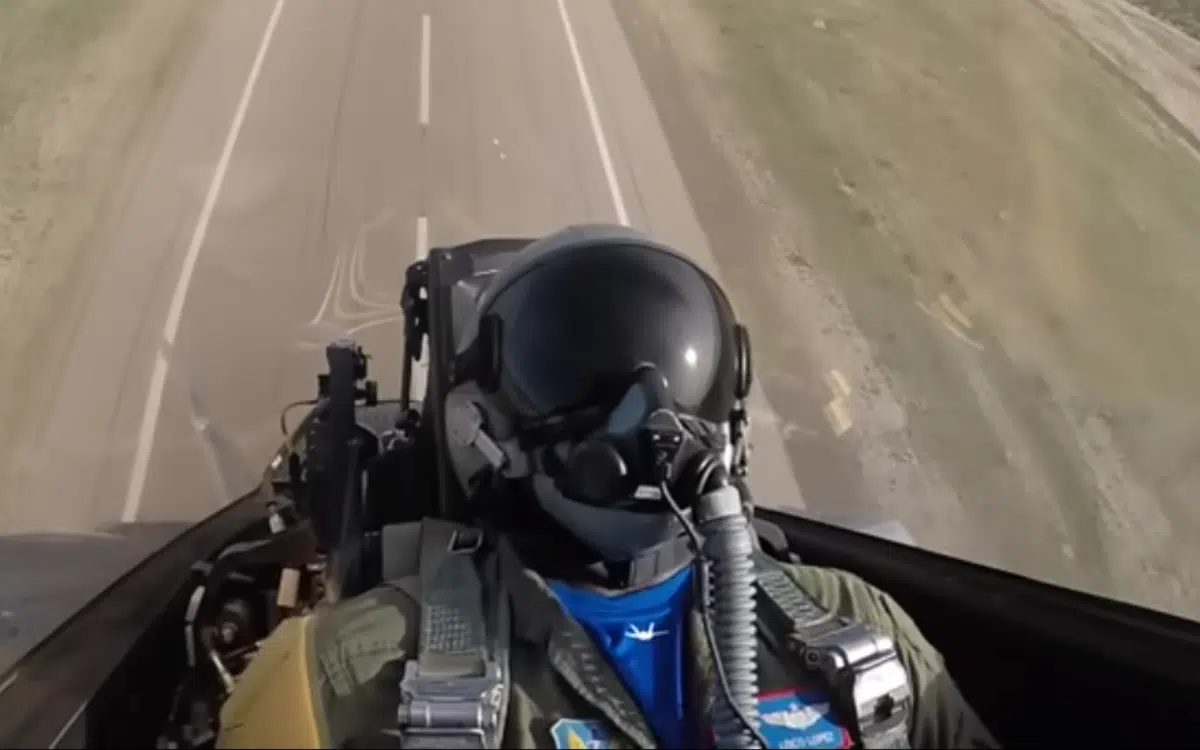
Ever wonder what it’s actually like to sit inside the cockpit of F-22 Raptor? It’s cramped. It’s quiet. Honestly, it feels less like a workspace and more like you’re wearing the airplane. Most people look at the F-22 from the outside and see a sleek, terrifying marvel of engineering—which it is—but the real magic happens in that tiny glass bubble where the pilot sits.
Lockheed Martin didn’t just build a jet; they built a sensory deprivation tank that turns a human being into a god of the sky. For a closer look into this area, we suggest: this related article.
The F-22 Raptor remains the gold standard of air superiority, even decades after its first flight. While newer jets like the F-35 get all the headlines for their fancy "helmet-mounted displays," the Raptor’s office is a masterclass in ergonomics and "sensor fusion" before that was even a buzzword. You don't just fly this thing. You manage a battlefield.
The Glass Canopy and the View You Can't Buy
The first thing you notice about the cockpit of F-22 Raptor isn't the screens. It's the glass. For additional details on this topic, extensive reporting is available at The Next Web.
It is a massive, single piece of polycarbonate. There’s no canopy bow. Most fighter jets have a metal frame right in front of the pilot's face or over their head, which creates blind spots. Not here. The Raptor gives you a 360-degree view that is basically unparalleled in the fighter world.
It’s thick, too. About 0.75 inches of material designed to withstand bird strikes at high speeds. It also has a distinct gold tint. That’s not for fashion; it’s a metallic coating that prevents radar waves from bouncing off the pilot's helmet and cluttering up the jet's stealth profile. If that coating wasn't there, the pilot's head would literally be the most visible thing on enemy radar.
What’s Actually on Those Screens?
Forget analog gauges. They don't exist here.
The cockpit of F-22 Raptor is dominated by the Integrated Control Panel (ICP) and four primary Multi-Function Displays (MFDs). In the center, you have the big 8x8 inch tactical display. This is where the pilot sees the "God’s eye view."
Instead of looking at raw radar blips, the pilot sees icons. Friendly planes are green circles. Enemies are red triangles. Unknowns are yellow squares. The computer does the hard work of "fusing" data from the radar, the electronic warfare suite, and other aircraft via the Intra-Flight Data Link (IFDL).
Basically, the pilot isn't squinting at noise; they are playing a high-stakes video game where the computer has already filtered out the junk.
To the sides, you have three 6x6 inch displays. These handle everything else—engine health, fuel status, weapon stores, and defensive systems. If something goes wrong, the system "cues" the pilot. It doesn't just scream; it provides the most relevant information for that specific moment.
The Side-Stick and Throttle: Control Without Looking
If you’ve ever played a flight sim, you’re used to a center stick between your legs. The F-22 changed the game with a side-stick controller on the right console.
Why? High G-force maneuvers.
When you’re pulling 9Gs, your arm weighs hundreds of pounds. It is much easier to make precise micro-adjustments with your wrist resting on a side console than trying to manhandle a center stick. The stick is a "force-transducer" type, meaning it barely moves. It senses the pressure you apply. It’s spooky how intuitive it feels once you get the hang of it.
On the left is the throttle. Together, they form the HOTAS (Hands On Throttle-And-Stick) system. A Raptor pilot can cycle through weapons, lock a target, fire, and drop flares without ever taking their hands off those two controls. There are about 30 different buttons and switches shared between them. It’s a lot of muscle memory.
Life Support and the "Pain" of Flying Stealth
Let’s talk about the seat. It’s an ACES II ejection seat, tilted at a slight angle to help the pilot tolerate high G-loads. But the real tech is in the flight suit.
Because the cockpit of F-22 Raptor allows for such extreme maneuvers, pilots wear a sophisticated G-suit that pumps air into bladders around the legs and abdomen to keep blood from pooling in the feet. Without it, the pilot would black out in seconds during a tight turn.
Then there’s the oxygen system. You might remember some years back when the F-22 fleet was grounded because of "hypoxia-like" symptoms. The On-Board Oxygen Generation System (OBOGS) had some teething issues. They eventually fixed it with better sensors and a backup manual oxygen switch, but it proves that even in a billion-dollar jet, the most basic human need—air—is the hardest thing to guarantee at 60,000 feet.
The Missing Link: Why No Helmet Display?
Here is the weirdest part about the cockpit of F-22 Raptor.
The F-35 pilot has a $400,000 helmet that lets them "see through" the floor of the plane. The F-22 pilot? They still use a traditional Head-Up Display (HUD).
The HUD is a clear piece of glass sitting right in the pilot’s line of sight. It projects airspeed, altitude, and targeting reticles. While it seems "old school," it’s incredibly crisp. The reason the F-22 didn't get the fancy helmet early on was purely a matter of timing and weight. Integrating that tech into a jet optimized for pure dogfighting was a challenge the Air Force didn't prioritize until recently.
Upgrades are happening, though. Through various "Capability Pipeline" updates, pilots are finally getting better integration with the JHMCS (Joint Helmet Mounted Cueing System), allowing them to aim missiles just by looking at the enemy.
Stealth is a Quiet Business
Inside the cockpit, it’s surprisingly quiet. The engines are far behind you. The cockpit is pressurized and sound-dampened.
But there’s a psychological pressure. In an F-15 or an F-16, you might be "loud" on radar, letting everyone know you're there. In the F-22, you are a ghost. The pilot has to manage "emissions." They can't just flip on the radar whenever they want, or they’ll give away their position.
Managing the cockpit of F-22 Raptor involves a constant dance of looking without being seen. The pilot is constantly monitoring their "RCS" (Radar Cross Section) on the displays, making sure they aren't showing a "leaf" or a "wing-flat" angle to an enemy tracker.
Actionable Insights for Aviation Enthusiasts
If you're looking to dive deeper into how these systems function or want to experience a slice of this tech, there are a few ways to get closer to the metal:
- Study the "Pilot's Manual" Mentality: Look into "The Day of the Raptor" by military analysts which details how sensor fusion changed air combat. It explains why the F-22's interface is actually more focused on "Tactical Management" than "Flying."
- Simulator Accuracy: If you use flight simulators like DCS (Digital Combat Simulator), look for high-fidelity F-22 mods. While the real F-22 flight software is classified, the cockpit layouts and "Cold and Dark" startup procedures in these mods are surprisingly accurate to the publically available tech manuals.
- Visit the Museum of the US Air Force: In Dayton, Ohio, you can get within feet of an F-22. Seeing the scale of the canopy in person gives you a much better perspective on the visibility the pilot actually has compared to older 4th-gen fighters.
- Monitor the 3.2B Upgrade: Follow defense news regarding the 3.2B software and hardware upgrades. This is the specific program currently modernizing the cockpit displays to keep the Raptor relevant against newer Chinese J-20 threats.
The Raptor's cockpit isn't just a place where a pilot sits; it's the brain of the world's most dangerous bird of prey. It balances old-school stick-and-rudder skill with futuristic data management. Even as we move toward an era of unmanned drones, the interface found in the F-22 remains the peak of human-machine integration in the sky.