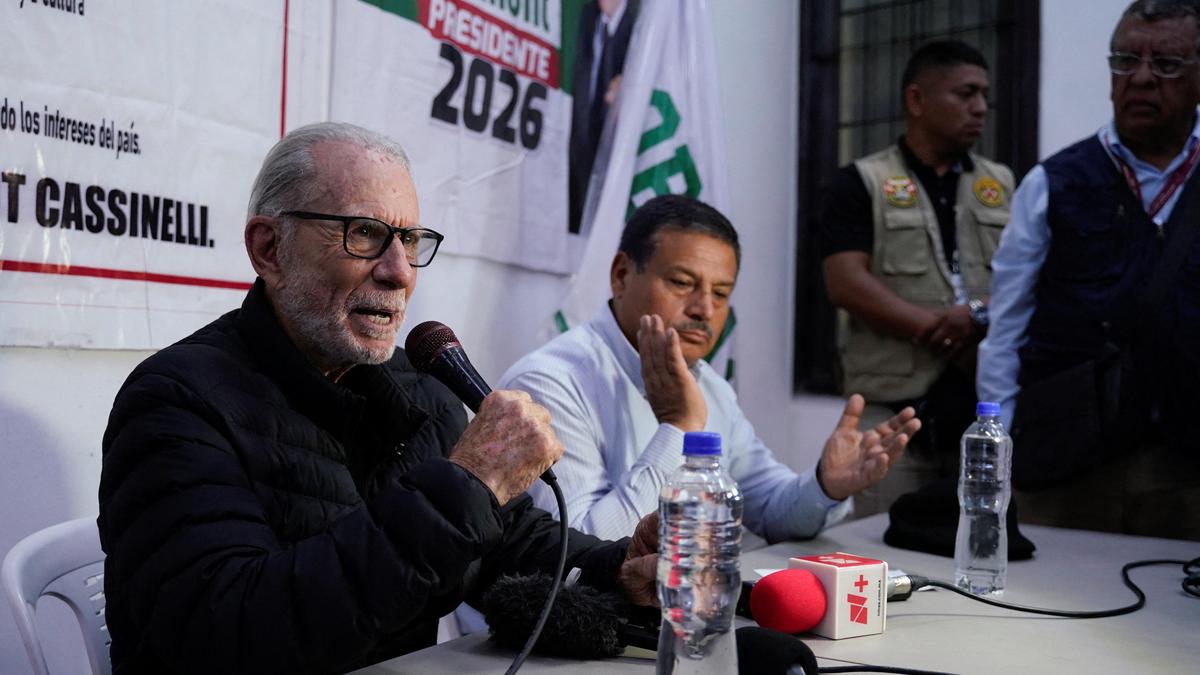
The official word from Lima is that logistical hiccups and "technical setbacks" are the culprits behind the indefinite delay of Peru’s presidential election results. On Sunday evening, the National Office of Electoral Processes (ONPE) took the unprecedented step of granting a one-day voting extension to more than 52,000 citizens in Lima and thousands more in the diaspora, specifically in Florida and New Jersey. This move effectively froze the national count and pushed the realization of a winner—or, more accurately, the confirmation of a runoff—into a legal and political gray area.
But look past the official press releases and you will find a much more volatile reality. This is not just a story about broken printers or late-opening polling stations. It is a story about a state that has forgotten how to function, presiding over an electorate that has largely given up on the democratic process. When you have 35 candidates on a single ballot and a revolving door at the presidential palace that has seated nine leaders in a decade, a "logistical delay" is rarely just about logistics. It is a symptom of institutional collapse.
The Extension That Broke the Count
By Sunday night, as the first exit polls were meant to flash across television screens in Miraflores and San Isidro, the ONPE instead issued a late-night decree. They authorized an extension for voters who were unable to cast ballots during the regular window. While the number of affected voters was eventually revised down from 63,300 to roughly 52,000, the damage to the timeline was done.
In Paterson, New Jersey, and Orlando, Florida—hubs for the Peruvian diaspora—hundreds stood in lines that didn't move for hours. Back in Lima, the mandatory nature of voting created a bottleneck of desperate citizens who weren't necessarily there to support a candidate, but to avoid the $32 fine. For a country where the minimum wage barely covers the basics, that fine is a powerful motivator.
The immediate result of this extension is a vacuum of information. With a field so fragmented that the leading candidates are struggling to break 15% of the vote, every single ballot in Paterson or Lima’s outskirts matters. The margin between second and third place—the difference between making the June runoff and disappearing into political obscurity—could be measured in the hundreds. By allowing more votes to be cast after the initial count had already begun in other regions, the ONPE has inadvertently opened the door to accusations of impropriety and manipulation.
A Ballot the Size of a Menu
The sheer absurdity of the 2026 ballot cannot be overstated. Voters were handed a document that resembled a restaurant menu more than a political instrument. With 35 presidential hopefuls and the first bicameral legislative election in over 30 years, the complexity was a recipe for the very delays we are now seeing.
The candidates are a snapshot of a country in a deep identity crisis:
- The Political Heiress: Keiko Fujimori, making her fourth attempt, leaning heavily on "order" and a 60-day emergency plan to combat the crime wave.
- The Comedian: Carlos Álvarez, whose pragmatic, security-first agenda has resonated with those tired of the traditional political class.
- The Businessman: Rafael López Aliaga, the former Lima mayor who has promised "megaprisons" and intelligence agreements with the U.S. and El Salvador.
When the options are this numerous and the stakes this high, the infrastructure of the ONPE was never going to hold. The agency deployed over 92,000 polling stations across 10,550 locations, but the system buckled under the weight of five simultaneous elections: President, two Vice Presidents, Andean Parliament, 60 Senators, and 130 Deputies.
The Security Paradox
Security was the number one issue for voters heading into Sunday. The country is reeling from a surge in violent crime, extortion, and contract killings. Many candidates pivoted their entire platforms toward aggressive, often draconian, policing measures. Yet, the very state that promises to lock up every criminal in a "megaprison" could not even secure enough poll workers to open stations on time in its own capital.
This irony is not lost on the Peruvian public. In the weeks leading up to the vote, confidence in the National Jury of Elections (JNE) and the ONPE hovered at historic lows. When the state fails at the basic administrative task of collecting paper ballots, its promises of sophisticated, AI-driven crime mapping and "urban terrorism" crackdowns feel like a hollow joke.
The delay also provides a fertile breeding ground for the "fraud" narratives that have plagued Peruvian elections since 2021. In a polarized environment, silence from the counting rooms is rarely interpreted as careful diligence. It is interpreted as a conspiracy. Candidates on the fringe are already beginning to question why certain districts were granted extensions while others were not.
Beyond the Logistics
There is a deeper, more uncomfortable truth behind the Sunday delays. Peru is currently navigating a transition back to a two-chamber legislative system. This was supposed to be the "reset" that brought stability to a country that has averaged a new president every 13 months. Instead, the complexity of the new system has only added to the chaos.
Voters were asked to navigate regional and national constituencies for the new Senate while simultaneously choosing a President from a list of three dozen names. For many, especially in rural areas where the state’s presence is negligible, the process was not an exercise in democracy but a test of endurance.
The one-day extension may ensure that 52,000 more people get to check a box, but it does nothing to address the fundamental disconnect between the Peruvian people and the people who seek to lead them. Whether the results are announced Monday or Tuesday, the outcome is already clear: a June runoff between two candidates who likely lack the mandate of even a fifth of the population.
The Cost of the Wait
The financial markets are already reacting to the uncertainty. The sol has historically been one of the more stable currencies in the region, but that stability is predicated on the idea that the "technocrats" run the country while the "politicians" fight in the street. If the electoral technocracy is seen as incompetent, that firewall vanishes.
International observers from the OAS and other bodies are monitoring the situation, but their presence does little to calm the nerves of a population that has seen presidential candidates arrested, impeached, or exiled with staggering regularity.
The immediate next step is the processing of the remaining ballots and the integration of the "extension" votes. The ONPE has projected that the bulk of the presidential results will be finalized by late Monday. However, the legislative count—which determines the makeup of the powerful new Senate—could take much longer.
Until then, Peru remains in a state of suspended animation. The "one-day extension" is a temporary fix for a permanent problem. The institutional decay that caused the delays on Sunday will not be solved by a few extra hours of voting. It is a systemic failure that the next president, whoever they may be, will inherit on day one.
The real crisis isn't that the results are late. The crisis is that, for many Peruvians, the results no longer seem to matter.