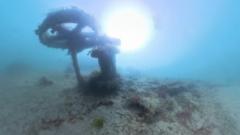
For over a century, the SS Nemesis was a ghost story told in the pubs of Wollongong and Sydney. A 73-meter iron-hulled steamer laden with coal, it vanished into a violent gale in July 1904, taking 32 souls with it. For decades, the families of those lost had nothing but a few washed-up bodies and fragments of a lifeboat to mark the tragedy. Now, modern subsea technology has finally pinned a location to the wreck, resting 160 meters deep off the coast of New South Wales. But the discovery does more than close a cold case. It reveals the brutal reality of early industrial shipping and the immense technical hurdles that keep most of the world's 3 million shipwrecks hidden.
Identifying a wreck of this age is not about a sudden "eureka" moment. It is a grueling process of data overlays, underwater robotics, and forensic naval architecture. While the general public often views shipwreck hunting as a romantic quest for treasure, the reality is a mix of high-stakes logistics and somber historical accounting. The SS Nemesis was finally spotted by Subsea Professional Marine Services during a routine scan for lost cargo containers, proving that even in the era of satellite mapping, we often find our history by accident while looking for the refuse of modern commerce.
The Iron Trap of 1904
The SS Nemesis was not built for comfort. It was a workhorse of the Victorian industrial machine, designed to move bulk cargo through the treacherous "Shipwreck Coast" of Australia. When the ship departed Newcastle for Melbourne on July 9, 1904, it was weighted down with coal. Heavily laden ships behave differently in a storm. They lose buoyancy and struggle to rise with the swell. When the gale hit, the Nemesis was likely overwhelmed by a series of following seas that flooded the engine room, stripping the vessel of its power and leaving it at the mercy of the Tasman Sea.
Witnesses on other ships reported seeing the Nemesis struggling in the distance. Then, the horizon went blank.
The mystery endured because the ship sank in the "dead zone" of the continental shelf. At 160 meters, the site is too deep for recreational divers and too dark for standard aerial surveys. It sits in a high-energy environment where the East Australian Current constantly scours the seabed, burying and unburying steel plates under meters of shifting sand. To find it, researchers had to wait for a convergence of multibeam sonar precision and the sheer luck of a commercial survey vessel passing over the exact coordinates.
Engineering the Reconstruction
Once the wreck was located, the focus shifted to verification. You cannot simply look at a rusted hull and know its name. Saltwater is a slow-motion acid. It eats away at identifying marks, leaving behind a skeletal remains of "concretion"—a hard crust of minerals and marine life that obscures the ship’s lines.
The Heritage New South Wales team used Remotely Operated Vehicles (ROVs) to capture high-definition imagery of the site. They weren't looking for a bell or a nameplate. They were looking for structural DNA. Every ship has a signature. The team compared the wreck’s dimensions, the specific arrangement of its winches, and the layout of its coal bunkers against original 19th-century shipbuilders' blueprints.
The damage to the bow and stern provided the final clue to its demise. The ship was found upright, but with significant impact damage. This suggests it didn't just drift down; it was forced under by the weight of the water on its decks, hitting the bottom with enough velocity to buckle the iron hull. It was a fast, violent end.
The Problem With Deep Water Preservation
Finding the Nemesis is only the first step in a much larger, more expensive problem. Now that the location is known, the site becomes a target. While 160 meters is deep, it is not deep enough to protect a wreck from illegal "scrapping" or souvenir hunters using unmanned grabbers.
The ocean is the world’s largest graveyard, yet we treat it like a limitless pantry or a dumping ground. Australia’s Underwater Cultural Heritage Act 2018 technically protects the site, but enforcement at these depths is nearly impossible. There are no patrols at 160 meters. The only real protection is the high cost of entry. If it costs $50,000 a day to run a survey vessel, the casual looter is kept at bay. But as ROV technology becomes cheaper and more accessible to the private sector, the window for scientific study before a site is disturbed is closing.
Beyond the threat of looting, there is the issue of "black rust." When iron ships sink, they become an artificial reef, but they also become a ticking environmental clock. The Nemesis was carrying coal, which is relatively inert, but many 20th-century wrecks contain heavy fuel oils and unexploded ordnance. Identifying these ships is not just a historical exercise; it is an environmental risk assessment.
Why We Still Can’t Find the Others
The success of the Nemesis search highlights a glaring gap in our global maritime awareness. We have better maps of the surface of Mars than we do of our own seabed. The primary hurdle is physics. Radio waves, which we use for GPS and radar, do not penetrate water. To map the ocean floor, we have to use sound (sonar). Sound is slow, and the ocean is vast.
The Technical Barriers
- Pressure: At 160 meters, the pressure is roughly 17 times that at the surface. Every piece of equipment must be sealed in titanium or oil-filled housings to prevent implosion.
- Visibility: Even with powerful LED arrays, an ROV can only see a few meters in front of its cameras. Mapping a 70-meter ship is like trying to paint a mural while looking through a straw.
- Cost: The fuel, the specialized crew, and the insurance for deep-sea operations make shipwreck hunting a hobby for the ultra-wealthy or a rare line item in a government budget.
Most shipwrecks are found by "mowing the lawn"—sailing a ship back and forth in a grid pattern for weeks on end. It is tedious, expensive, and often produces nothing but images of sand ripples. The Nemesis was found because the shipping industry is currently obsessed with finding lost containers that fall off modern mega-ships. These containers are navigational hazards, and insurance companies pay for the surveys. The ghosts of the 19th century are just the collateral damage of modern logistics.
The Human Element of Forensic Archaeology
For the descendants of the 32 men on the Nemesis, the data is secondary to the closure. When a ship vanishes without a trace, the mourning process is suspended. There is no grave to visit, no certainty of what happened in those final moments.
The images brought back by the ROV showed the ship’s steering gear and personal effects scattered across the silt. These aren't just artifacts; they are evidence of a desperate struggle. By reconstructing the wreck’s final plunge, archaeologists can tell families whether their ancestors died in their sleep in the forecastle or were on deck fighting the pumps until the end. Most of the crew were from the UK, and the search for their living relatives is now a global genealogical project.
This is the true value of the "hunt." It isn't about gold or even about ships. It is about the fact that we refuse to let 32 people remain a footnote in a 120-year-old newspaper.
The Future of the Deep
We are entering a new era of subsea exploration driven by Artificial Intelligence and autonomous underwater vehicles (AUVs). These drones don't need a mother ship or a tether. They can be launched from a beach, programmed to map a specific area, and left to run for days. This will lead to a surge in discoveries like the SS Nemesis.
However, the surge in data brings a surge in responsibility. Governments are currently unprepared for the volume of underwater heritage that is about to be "unlocked." If we find ten ships a month instead of one every ten years, who pays for the conservation? Who manages the gravesites?
The SS Nemesis is a warning. It reminds us that the sea is an efficient eraser of history. If we don't invest in the technology to document these sites now, the "black rust" and the shifting sands will finish what the storm started in 1904. We are currently in a race against time and chemistry to record the stories of the industrial age before they dissolve into the silt of the continental shelf.
The ocean does not give up its secrets easily, and it certainly doesn't give them up for free. Every wreck identified is a victory of human persistence over the crushing indifference of the deep.
The next time a routine cargo survey pings a strange shape on the sonar, it might be the Waratah, or the lost planes of 1942, or another coal-stained steamer from a forgotten trade route. The technology is finally here. The only question is whether we have the will to keep looking once the novelty of the "mystery" wears off.
History is resting 160 meters down, waiting for a light to be turned on.