You’ve probably spent twenty minutes perfecting a three-sentence email, only to realize your sign-off feels like a wet handshake. It’s either "Best," which feels cold, or "Sincerely," which feels like you're writing from the 1800s. Honestly, people are bored of the corporate drone aesthetic. That is exactly why funny signatures for email have become a low-key power move in 2026.
It’s about personality. We’re all buried under a mountain of digital noise, and a tiny spark of humor at the bottom of a message can be the difference between someone liking you or just seeing you as another ticket number. But there is a line. Cross it, and you’re the office clown who doesn’t take anything seriously. Stay too far back, and you’re just a robot. Also making news in related news: The Integration Myth and Why Chinese Students are Smarter to Ignore It.
Let's talk about how to actually pull this off.
The Psychology of the Sign-Off
Why do we care? Research into digital communication, like the studies conducted by the Journal of Computer-Mediated Communication, often highlights that without non-verbal cues—think eye contact or tone of voice—emails are prone to being interpreted more negatively than intended. This is called the "negative neutrality" effect. A joke at the end of your message acts as a digital wink. It softens the blow of a "Please see attached" or a "Per my last email." More insights regarding the matter are explored by Apartment Therapy.
Most people think of their signature as a business card. It’s not. It’s a closing statement. If you've ever seen a signature that says "Sent from my carrier pigeon," you probably chuckled. That person instantly became more human.
Knowing Your Audience is Everything
Look, if you’re emailing a grieving client or a high-stakes legal team, maybe don't use "Sent from my toaster." Context is the king here. Use the "grandma test." If you wouldn't want your grandma to see it while she’s proud of your career, or if it would confuse the hell out of a CEO who has zero time, skip it.
The best funny signatures for email work because they play with expectations. They take the space usually reserved for "Director of Synergistic Operations" and put something real there instead.
Types of Funny Signatures for Email That Actually Work
You don’t have to be a stand-up comedian. In fact, if you try too hard, it’s painful to read. The best ones are brief.
The "Self-Deprecating" Professional This works wonders for freelancers or people in creative roles. It shows you’re competent but don't have an ego the size of a skyscraper.
- "Not an expert, but I play one on Zoom."
- "Typed with one hand while holding a very demanding cat."
- "Professional over-thinker."
The "Sent From My..." Variation We all remember the "Sent from my iPhone" default. It’s the most boring sentence in the English language. Messing with this is a classic move.
- "Sent from my rotary phone."
- "Sent from a galaxy far, far away (or just my couch)."
- "Please excuse any typos; I'm currently being chased by a toddler."
The Existential Dread Vibe Kinda risky, but in the right industry—like tech or late-night production—it’s gold.
- "Sent from the abyss."
- "I'm not ignoring you; I'm just living in a 1990s montage."
- "This email will self-destruct in five minutes (hopefully)."
The Legal and Professional "No-Go" Zone
Let’s be real. There are things you simply cannot do.
Don't use humor to mask a lack of professionalism. If your email is late, a funny signature won't save you; it'll just make you look like a jerk. Also, avoid anything political, religious, or edgy. If it could be misconstrued as an HR violation, it's not a "funny signature," it's evidence.
Real experts in corporate communication, like those at Harvard Business Review, suggest that "authenticity" is the most valuable currency in leadership. But authenticity doesn't mean "no filter." It means being a person. If you're a naturally funny person, let it leak out. If you're not, don't force it. A forced joke is like a bad haircut—everyone notices, and nobody knows where to look.
How to Format for Maximum Impact
Don’t use a giant font. Please.
A funny signature should be subtle. Use the same font size as your name. If you use a bright red Comic Sans font for your joke, you’ve failed. The joke is the "easter egg" of the email. It should be something the reader discovers, not something that screams for attention.
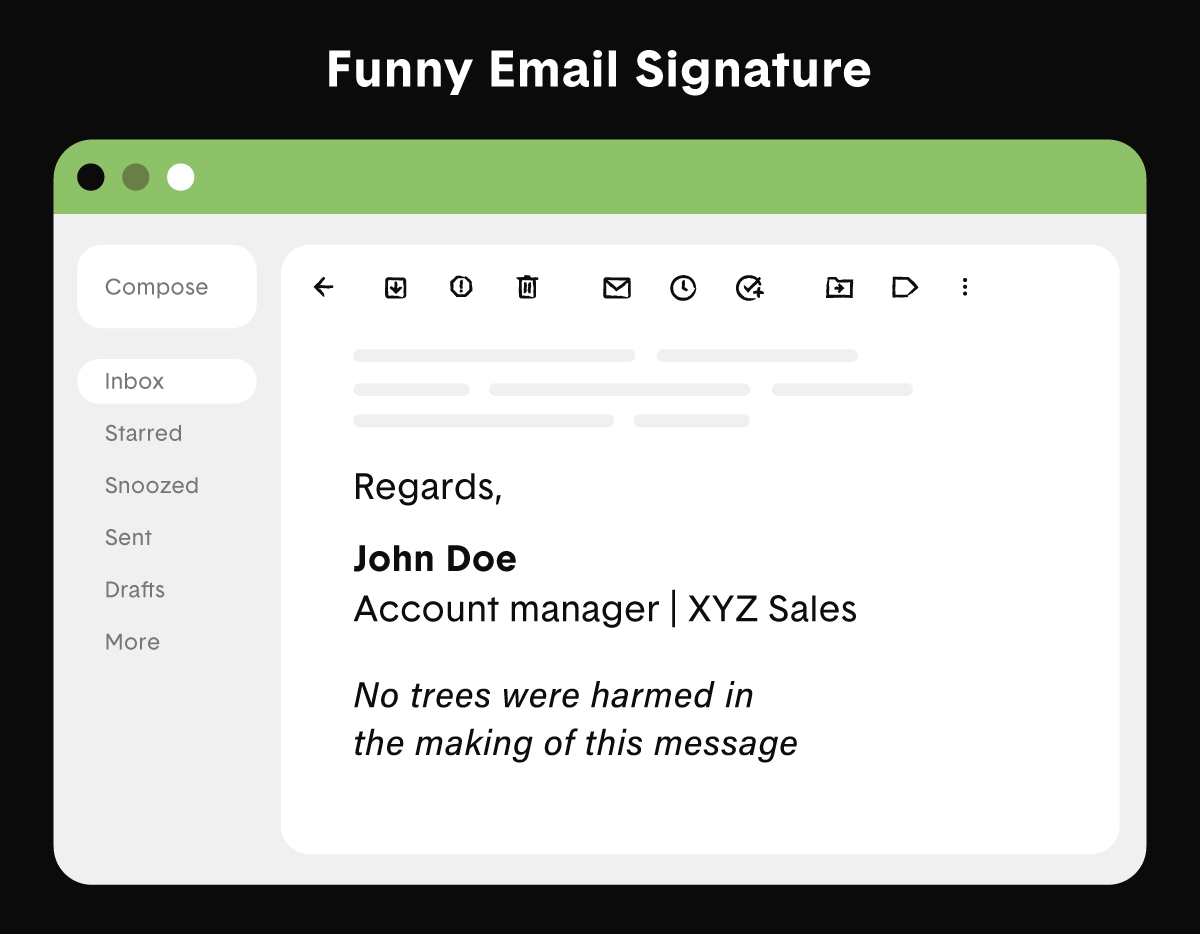
- Name and Title (The boring stuff)
- Contact Info (The necessary stuff)
- The Kicker (The funny part)
By putting it at the very bottom, beneath your phone number, it feels like an afterthought. That’s where the charm lives.
Testing the Waters
If you’re nervous, start with internal emails. Use funny signatures for email with your direct teammates. See if they mention it in the breakroom. If they laugh, keep it. If they ask if you’ve been hacked, maybe dial it back.
The Evolution of the Digital Sign-Off
The way we close emails has changed. In the early 2000s, it was all about those giant, sparkling GIF signatures. Then we went through the "minimalist" phase where everyone just used their initials. Now, in the mid-2020s, we’re seeing a return to personality.
We’re tired of the "hustle culture" language. People are craving connection. A signature that says "Live, Laugh, Leave me alone" might be a bit much for a boss, but for a long-term vendor? It builds a bond. It says, "I know we’re both stuck in this inbox, and I’m with you."
Real-World Example: The "Away Message" Energy
Think about the old AIM away messages. They were a canvas for our moods. You can bring that energy back. If you’re heading out for the weekend, your signature could briefly change to "Currently out looking for my sanity; if found, please return to my desk." It’s a lot more memorable than the standard "I will be out of the office until Monday."
Avoiding the "Cringe" Factor
There is a phenomenon called the "uncanny valley" of humor. It’s when something is almost funny but hits a weird note that makes the reader uncomfortable.
To avoid this, stay away from:
- Quotes from movies everyone has forgotten.
- Inside jokes that only you and your dog understand.
- Sarcasm that could be read as genuine anger.
- "Witty" remarks about how much you hate your job (even if you do).
Keep it light. Keep it brief.
Technical Setup Across Platforms
Different clients handle signatures differently. Outlook loves to mess up formatting. Gmail is usually chill.
If you use images in your signature to convey the joke—like a small "Employee of the Month" badge you gave yourself—make sure you use Alt Text. Many corporate servers block images by default. If your joke is an image that doesn't load, your recipient just sees a broken box with a red "X." That's the opposite of funny.
Stick to plain text for the punchline. It’s safer, it loads faster, and it works on mobile.
Actionable Steps for Your New Signature
Don't overthink this. You can change it tomorrow if it feels weird.
- Audit your current sign-off. Is it "Sincerely"? If so, change it immediately. Even "Cheers" is better.
- Pick one "flavor" of humor. Do you want to be the "tired parent," the "tech-confused millennial," or the "accidental professional"?
- Write three options. Test them out in your "Drafts" folder. Read them back to yourself after an hour.
- Check the "mobile view." Most people read emails on their phones. If your signature is six lines long, it’s going to take up the whole screen. Keep the joke to one line.
- Update your settings. Go into your mail preferences, scroll to the signature block, and add your kicker at the very bottom, separated by a thin gray line or a simple dash.
Humor is a tool. Use it to build a bridge, not to burn one. When you find the right funny signatures for email that fit your specific vibe, you’ll notice something interesting: people will actually start replying to your emails with a little more warmth. And in a world of automated "reminders," that's a massive win.