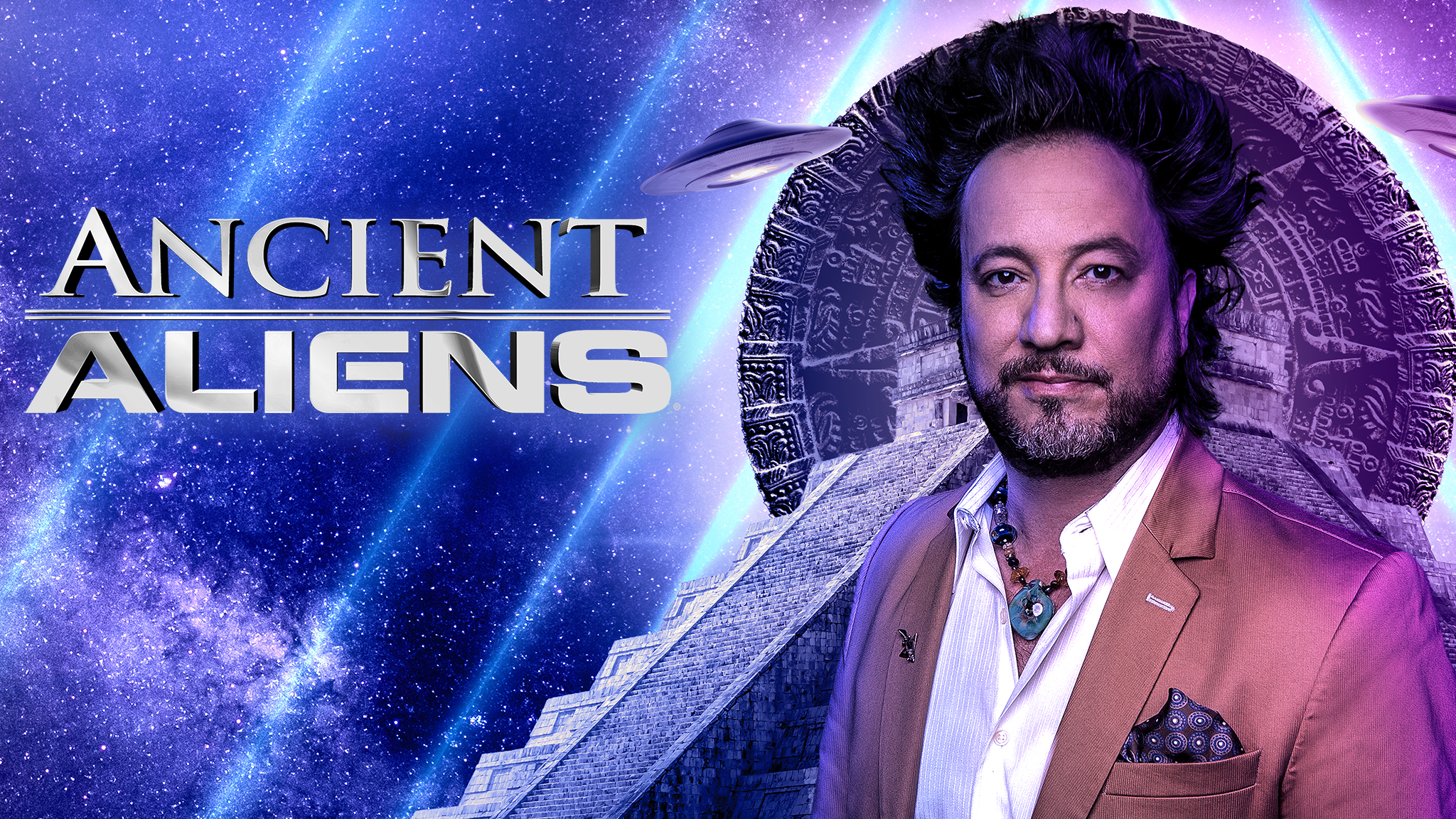
You know the face. Even if you’ve never watched a single minute of the History Channel, you’ve seen the meme. A man with increasingly gravity-defying hair, hands held out as if measuring an invisible giant sub sandwich, and a caption that simply reads: Aliens.
Giorgio Tsoukalos, the man behind the "Ancient Aliens guy" persona, has become a permanent fixture of internet culture. But there’s a lot more to the story than just a funny screenshot and a wild hairstyle. Honestly, his path from a sports information and communications graduate to the world's most recognizable proponent of the ancient astronaut theory is a weird, fascinating trip through the fringes of archaeology and the heights of cable TV stardom.
Who is Giorgio Tsoukalos anyway?
Before he was a meme, Tsoukalos was a guy who really, really liked bodybuilding. Seriously. He worked as a promoter for the IFBB (International Federation of Bodybuilders) and even spent time as a producer for various bodybuilding contests. It’s a far cry from looking for extraterrestrial landing strips in the Nazca Lines, but it explains his comfort in front of a camera and his flair for the dramatic.
He wasn't always the face of the show. Ancient Aliens actually started as a one-off special back in 2009. People forget that. It was supposed to be a documentary—or "docu-series" style exploration—of the ideas popularized by Erich von Däniken. Von Däniken wrote Chariots of the Gods? in 1968, which is basically the "bible" of the ancient astronaut movement. Tsoukalos was a protégé of von Däniken, eventually becoming the director of the Center for Ancient Astronaut Research.
When the pilot aired, the ratings were through the roof. The History Channel realized they had a hit. And at the center of it was Giorgio, with his tan, his enthusiasm, and that hair.
The Mystery of the Hair (Yes, we have to talk about it)
People always ask: what is going on with his hair? In the first season of Ancient Aliens, his hair was actually quite normal. It was a standard, short, dark cut. As the seasons progressed—and the show is currently well past its 18th season—the hair began to migrate upward.
Tsoukalos has joked about it in interviews. He’s mentioned that it’s mostly just a lot of hairspray and the natural evolution of being on a film set for long hours. It became a trademark. It’s a classic branding move, whether it was intentional at first or not. If you see that silhouette, you know exactly who it is and what he’s about to say.
But beneath the hair, there’s a man who is deeply sincere about his beliefs. Whether you agree with him or not, he’s not just playing a character. He genuinely believes that humanity has been visited by extraterrestrial beings in the distant past. He’s spent decades traveling to remote sites like Puma Punku in Bolivia and the pyramids in Egypt, looking for "the evidence."
What the Ancient Astronaut Theory actually claims
Basically, the idea is that our ancestors weren't capable of the architectural or scientific feats they achieved without outside help. Proponents like Tsoukalos argue that:
- Puma Punku’s precision-cut stones are too perfect for primitive tools.
- The Great Pyramid aligns too perfectly with celestial bodies.
- Ancient texts, like the Indian Vimanas or the biblical Book of Ezekiel, are actually eyewitness accounts of spaceships.
Mainstream archaeologists and scientists, like Dr. Ken Feder or the late Carl Sagan, have debunked these claims pretty thoroughly. They point out that humans are incredibly resourceful. We don't need "space brothers" to figure out how to stack rocks or track the stars. When we attribute human achievements to aliens, we’re kind of insulting the intelligence of our ancestors.
Still, Tsoukalos argues that we shouldn't dismiss the possibility. He often uses the phrase, "Ancient astronaut theorists say yes," which has become another catchphrase for the show. It's a clever way of framing a hypothesis as a settled conclusion among a specific group of people.
The Meme that conquered the world
The "Ancient Aliens" meme took off around 2010. It originated on 4chan and Reddit before exploding everywhere. It’s the ultimate "I don't know, therefore..." punchline.
You’ve seen it used for everything. Why is the remote missing? Aliens. Why is my toast burnt? Aliens. It’s a testament to how much the show penetrated the zeitgeist. Tsoukalos has leaned into it gracefully. He doesn't get offended. He’s even appeared in commercials and cameos playing off the meme. That’s probably why he’s stayed relevant for so long—he’s in on the joke.
Is the show actually "History"?
This is where things get sticky. The History Channel has faced a lot of criticism for moving away from actual history and toward "speculative non-fiction." Critics call it "pseudoscience" or "pseudo-archaeology."
The concern is that viewers might mistake the high production value and the "expert" titles for consensus science. In reality, most of the "experts" on the show are authors or researchers within the fringe community, not tenured professors at major universities. But honestly, for most viewers, it’s just fun "what if" entertainment. It’s the modern version of sitting around a campfire telling ghost stories, but with 4K drone shots of Peru.
Giorgio’s legacy and what’s next
Giorgio Tsoukalos has managed to turn a niche interest into a massive personal brand. He’s a regular at conventions like AlienCon, which draws thousands of people who want to hear about "star seeds" and "interdimensional portals."
Despite the skepticism from the scientific community, Tsoukalos has inspired a whole generation to at least look at ancient ruins. Even if they end up disagreeing with his conclusions, they’re paying attention to history. That’s something. He’s also been a producer on the show for years, giving him significant influence over the narrative and direction of the series.
What’s next? More of the same, likely. The show shows no signs of slowing down. As long as there are unexplained mysteries in the world, there will be a place for a guy with wild hair to suggest that maybe, just maybe, someone from the stars dropped by to help.
Actionable Insights for the Curious
If you’re fascinated by the claims made by Tsoukalos and the Ancient Aliens team, here is how you can actually dig deeper without getting lost in the "fringe" weeds:
- Read the source material: Start with Chariots of the Gods? to see where these ideas originated. Then, read a rebuttal like Frauds, Myths, and Mysteries by Kenneth Feder. Seeing both sides is the only way to form a balanced opinion.
- Visit the sites (if you can): If you ever get the chance to visit Teotihuacan or the Giza Plateau, go. Seeing the scale of these places in person makes you realize why people look for extraordinary explanations.
- Check the "how-to": Look up experimental archaeology videos on YouTube. There are researchers who show exactly how ancient people could have moved massive stones using only wood, water, and ropes. It's often more impressive than the alien theory.
- Stay skeptical but open: It’s okay to enjoy the show as entertainment while maintaining a healthy skepticism about the "evidence" presented. Science is about asking questions, and even "out there" questions can lead to interesting discoveries about our past.
The story of Giorgio Tsoukalos isn't just about aliens; it's about how a single person, a specific look, and a very bold idea can capture the imagination of the entire internet. Whether he's right or wrong, he's definitely made the world a bit more interesting to look at.