The fluorescent hum of a hospital at 3:00 AM has a specific frequency. It is the sound of a holding breath. It is the vibration of a space where the veil between "fine" and "gone" is thin enough to translucent. For fifteen years, we watched a young, floppy-haired doctor named John Carter pace those hallways in a fictional Chicago county hospital. We watched him grow up, fail, bleed, and eventually find a weary kind of wisdom.
When ER ended, most of us thought we had said goodbye to that specific brand of visceral, blood-slicked idealism. But Noah Wyle couldn't quite leave the ward.
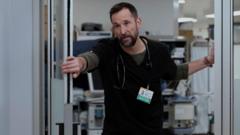
He is back. Not as Carter, but carrying the weight of a man who has seen what happens when the system designed to save us begins to eat itself. His new drama, The Pitt, isn't just another procedural with sterile blue scrubs and rhythmic beeping. It is a plea for something we have dangerously thinned out in the modern world: empathy.
The Weight of the Stethoscope
Think about the last time you sat in a waiting room. Maybe the plastic chairs were bolted to the floor. Maybe the air smelled of industrial lemon and old fear. You weren't a person then; you were a symptom. You were "the gallbladder in bed four" or "the laceration in triage."
This dehumanization is a survival mechanism for doctors. If you feel every jagged edge of every patient’s tragedy, you shatter. But if you feel nothing, you become a mechanic working on a meat machine.
Noah Wyle enters The Pitt as Michael Jolley, a veteran emergency room physician in a modern-day Pittsburgh hospital. The choice of city is deliberate. Pittsburgh is a place of steel and bone, a city that knows how to hurt and how to rebuild. Wyle isn’t playing the wide-eyed student anymore. He is playing the man who has to look into the eyes of a father and explain why a "simple" procedure ended in a quiet room with a sheet pulled high.
The stakes in The Pitt are invisible until they are terminal. We are talking about a healthcare system that has become a labyrinth of insurance codes and "efficiency metrics." When a doctor is told they have exactly twelve minutes to spend with a human being in crisis, the first thing to go is the connection. The second thing to go is the truth.
Why We Still Need the Blood and the Beeps
There is a reason we gravitate toward medical dramas even when the real world feels like a triage unit. We are obsessed with the "Golden Hour." In trauma medicine, that is the period of time following a traumatic injury during which there is the highest likelihood that prompt medical and surgical treatment will prevent death.
But Wyle’s new venture suggests that the Golden Hour isn't just about surgery. It’s about the moment of recognition between two people.
Consider a hypothetical patient—let’s call her Elena. Elena is seventy-two. She arrives at the ER with shortness of breath. In a standard procedural, this is a race to intubate. The music swells. The camera shakes. In The Pitt, the drama lies in the fact that Elena is terrified not of dying, but of the bill. She is terrified that the doctor won't see that she is the primary caregiver for a grandson who is waiting for her at home.
When Jolley—Wyle’s character—stops to actually hear that, the show shifts from a medical thriller to a social document. The "Pitt" of the title is the hospital, yes, but it’s also the depths we fall into when we stop treating medicine as a ministry and start treating it as a marketplace.
The Evolution of the Healer
Noah Wyle’s return to the genre feels like a homecoming for an audience that grew up on the kinetic energy of the 90s. Back then, ER changed the way we saw television. It used "Steadicam" shots to make us feel like we were running alongside the gurneys. It used complex medical jargon that we didn't always understand but deeply trusted.
Today, the world is louder. Information is everywhere, yet trust in institutions is at an all-time low.
Wyle knows this. He didn't just sign on to play a part; he is an executive producer. He has spent years observing how the role of the doctor has shifted from a community pillar to a cog in a corporate wheel. The "empathy" he asks the audience to watch with isn't a soft, fuzzy feeling. It is a grueling, active choice. It is the discipline of looking at someone who is different, difficult, or even self-destructive, and refusing to look away.
The show navigates the gritty reality of a "safety-net" hospital. These are the places that cannot turn you away. They are the front lines of the opioid crisis, the mental health crisis, and the poverty crisis. When you walk through those sliding glass doors, you are bringing the entire weight of your life with you.
Breaking the Fourth Wall of the Soul
The real problem with modern television is that it often treats suffering as a plot point. A character gets sick so another character can have a breakthrough. A death happens to raise the stakes for a season finale.
The Pitt attempts to flip the script. It asks: what if the breakthrough is simply the act of witnessing?
Wyle brings a specific kind of exhaustion to the screen. It’s the exhaustion of a man who knows he can’t fix the world, but feels a moral obligation to try and fix the person right in front of him. This isn't the slick, God-complex medicine of House. It isn't the soap-opera romance of Grey's Anatomy. It is a return to the "blood and guts" of human existence.
Science tells us that empathy is a neurological response—mirror neurons firing in our brains when we see someone else in pain. But medicine tells us that empathy is a limited resource. Compassion fatigue is real. Doctors burn out. They quit. They disappear.
By putting Wyle back in the center of the storm, the show bridges the gap between the nostalgia of the past and the cold reality of the present. We trust him because we saw him become a doctor thirty years ago. We believe his gray hairs because we earned ours alongside him.
The Invisible Stakes of Pittsburgh
Pittsburgh serves as more than a backdrop. It is a character. A city of bridges and tunnels, it represents the struggle to connect. The hospital in the show acts as a microcosm of the American landscape—divided, struggling, yet stubbornly resilient.
There is a scene—a small, quiet one—where a character realizes that the "miracle" they performed didn't actually save the patient's life; it just gave them three more days to say goodbye. In most shows, that’s a failure. In The Pitt, that’s the victory.
We live in an era where we want everything to be optimized. We want the fastest recovery, the most "robust" data, the most "seamless" experience. But medicine is messy. Death is messy. Grief is the messiest of all.
Noah Wyle isn't asking us to watch a show about doctors. He is asking us to watch a show about what it costs to remain human in a system that values numbers over heartbeats. He is asking us to remember that every person behind a curtain in an ER has a story that began long before they checked in and will continue long after they are discharged—if they are lucky.
The lights in the ER never go out. They are always that harsh, unforgiving white. But as Wyle walks back into that light, he carries a lantern of his own. He is searching for that ghost in the hallway—the version of ourselves that still believes we can make a difference, one patient at a time.
The gurney is moving. The monitor is flatlining. But someone is finally listening.
Would you like me to look into the specific air dates and streaming availability for the premiere of The Pitt?