Planning a wedding is basically a full-time job where you don't get paid and everyone has an opinion on the napkins. But when you add the layers of a Catholic liturgy into the mix, things get real, fast. Honestly, staring at a blank document trying to figure out where the "First Reading" goes versus the "Responsorial Psalm" is enough to make anyone want to elope. You want your guests—especially the ones who haven't stepped foot in a church since 1994—to actually know when to sit, stand, or pray. That’s where a solid sample catholic wedding ceremony program becomes your best friend. It isn’t just about being polite; it’s about navigation.
The Mass is a marathon of tradition. If you’re doing a full Nuptial Mass with Communion, you’re looking at about an hour. If you’re doing the Rite of Marriage outside of Mass (no Communion), it’s shorter, maybe 30 to 40 minutes. You’ve got to decide which one fits your vibe and your crowd before you even pick a font for the programs. Discover more on a connected issue: this related article.
Why Your Program Actually Matters
Think of your program as a map for a very specific, very holy road trip. Most people think it’s just a keepsake that ends up in a drawer or, let’s be real, the recycling bin. But in a Catholic setting, it serves a functional purpose. There are cues. There are specific responses like "And with your spirit" that changed about a decade ago and still trip people up.
A good sample catholic wedding ceremony program bridges the gap between the devout grandmother in the front row and your college roommate who thinks a "liturgy" is a type of expensive candle. You aren't just listing names of the bridal party. You’re explaining the flow of a sacrament. Additional reporting by Refinery29 highlights similar perspectives on this issue.
The Standard Flow: Breaking Down the Liturgy
Usually, a Catholic wedding follows a very strict "Ordo Celebrandi Matrimonium." You can't really freelance this. The Church has a structure, and while you have some wiggle room with music and readings, the skeleton is set in stone.
The Entrance Rite
It starts with the Processional. This is the big moment. But liturgically, it’s the "Entrance Rite."
- Processional: Usually instrumental music or a hymn.
- Greeting: The priest welcomes everyone.
- Gloria: This is often sung if you're having a full Mass. It’s a hymn of praise. Some couples skip it for brevity, but technically, for a Nuptial Mass, it’s supposed to be there.
The Liturgy of the Word
This is the "reading" part. You’ll usually pick three readings: one from the Old Testament, one from the New Testament (the Epistles), and one from the Gospels.
- First Reading: Typically from the Old Testament. Think Genesis or the Song of Songs.
- Responsorial Psalm: This is almost always sung. The cantor sings a line, and the congregation repeats it.
- Second Reading: From the New Testament. This is where you usually find the "Love is patient, love is kind" bit from 1 Corinthians.
- Gospel Acclamation: The Alleluia. Everyone stands.
- Gospel: The priest or deacon reads this.
The Rite of Marriage
This is the heart of the whole thing. It happens right after the Homily (the sermon).
- The Address and Statement of Intentions: The priest asks if you're here freely and without reservation.
- Exchange of Vows: The "I do" part.
- Blessing and Exchange of Rings: Simple and iconic.
- The Nuptial Blessing: A special prayer for the couple.
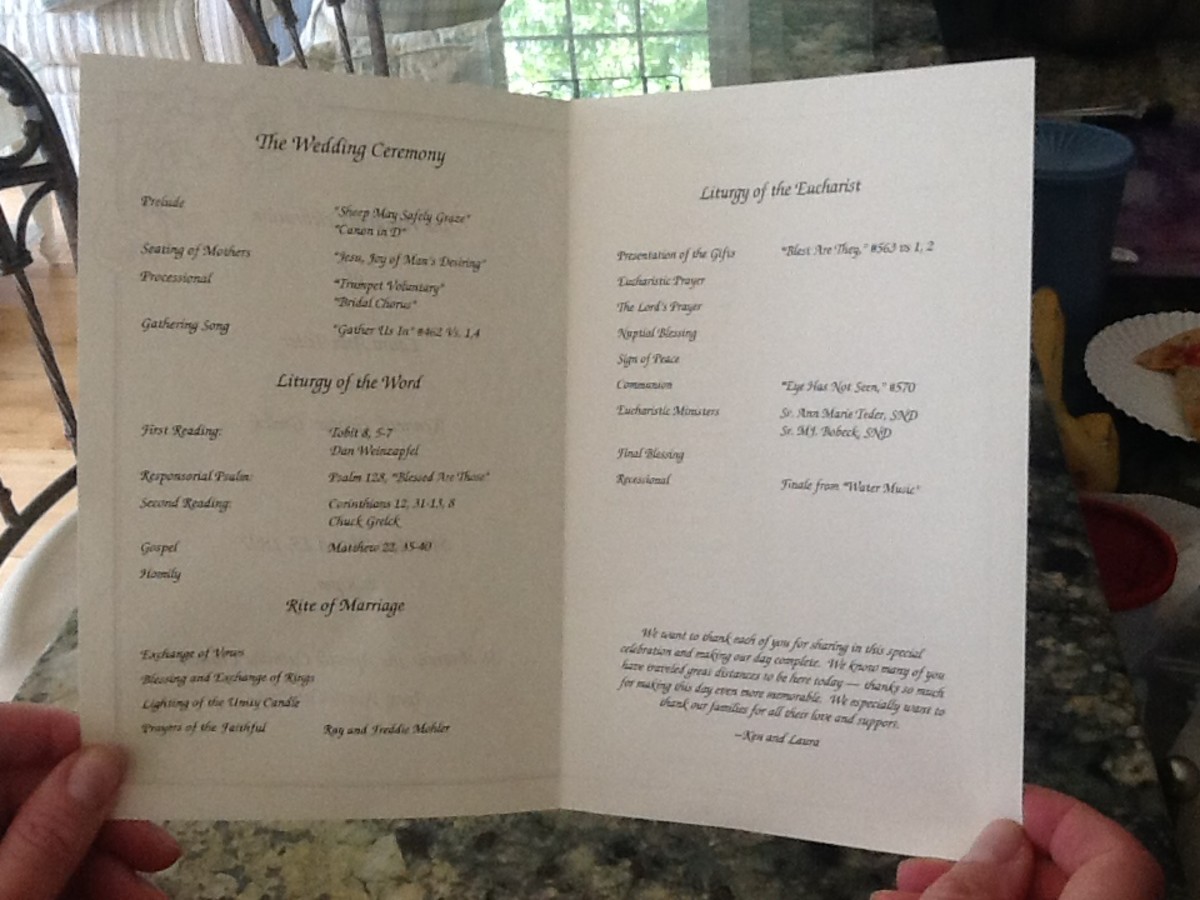
A Sample Catholic Wedding Ceremony Program Structure
If you're sitting down to design this right now, here is exactly how you should lay it out. Keep it clean. Don't crowd the page.
The Front Cover Keep it simple. Names, Date, Church Name, and maybe a small cross or a sprig of greenery.
The Wedding Party List the Celebrant (the priest), the Parents, the Maid of Honor, Best Man, and the rest of the crew. Mention the musicians too. People like to see names.
The Order of Service This is the meat of the sample catholic wedding ceremony program.
The Liturgy of the Word
- First Reading: Genesis 2:18-24 (or your specific choice)
- Responsorial Psalm: "The Lord is kind and merciful"
- Second Reading: 1 John 4:7-12
- Gospel: Matthew 5:13-16
The Rite of Marriage
- Exchange of Vows
- Blessing and Exchange of Rings
- Prayers of the Faithful (This is where you pray for the world, the church, and maybe your deceased relatives).
The Liturgy of the Eucharist (If having a Mass)
- Presentation of the Gifts
- Eucharistic Prayer
- The Lord's Prayer (Our Father)
- Sign of Peace
- Holy Communion (Include a polite note here about who can receive).
Concluding Rite
- Final Blessing
- Recessional
The "Communion Dilemma" and How to Word It
This is the awkward part of every Catholic wedding program. You likely have non-Catholic guests. You don't want them to feel excluded, but you also have to respect the Church’s rules.
Don't ignore it.
The best way to handle this in your sample catholic wedding ceremony program is to include a small, gracious note at the bottom of the "Liturgy of the Eucharist" section. Something like:
"While the reception of Holy Communion in the Catholic Church is a sign of our unity in faith, we welcome those not receiving to remain in their pews in prayer, or to come forward with arms crossed over their chest to receive a blessing."
It’s clear. It’s kind. It prevents that weird "should I get up?" shuffle in the pews.
Music: Where You Can Actually Be Creative
While the prayers are mostly fixed, the music is where you get to put your stamp on things. But a quick heads-up: most Catholic parishes are pretty strict about "secular" music. If you want to walk down the aisle to a Taylor Swift instrumental, you better check with the music director first. Many won't allow it.
They usually want "sacred" music. Think Bach, Pachelbel, or specific hymns like "Joyful, Joyful, We Adore Thee."
In your program, list the titles of the songs and the composers. If you’re having the congregation sing a hymn, print the lyrics. People are shy; they won't sing if they don't have the words right in front of them.
Pro-Tips for a Better Program
I've seen hundreds of these. Some are works of art; some look like they were printed at a gas station ten minutes before the ceremony.
Watch your font size. The lighting in old churches is notoriously terrible. If you use a tiny, 8-point script font to look "elegant," your 70-year-old aunt isn't going to be able to read a single word. Go for at least 10 or 12 points for the main body.
Paper weight matters. Don't use standard printer paper. It wilts. If it’s a hot summer day and the church doesn't have A/C, people are going to use your program as a fan. Use a heavy cardstock so it doesn't turn into a damp noodle by the time you're exchanging rings.
The "In Loving Memory" Section. A Catholic wedding is a great time to acknowledge those who couldn't be there. A small section on the back or at the end of the party list is a nice touch. It keeps the vibe focused on family and legacy.
Dealing with the Logistics of the "Unity Candle"
Funny story: the Unity Candle isn't actually a "Catholic" thing. It’s a popular tradition that crept in from secular or Protestant ceremonies. Some priests love it; others won't let it in the building.
If you're doing it, it usually happens after the exchange of rings. Make sure it's in your sample catholic wedding ceremony program so people know why you’re suddenly walking over to a table with three candles.
Actionable Next Steps for Your Program
You’ve got the basics. Now it’s time to execute.
First, get the official list of readings from your priest or the parish wedding coordinator. They usually give you a book (often called Together for Life) that has all the options. Don't just Google "Catholic readings" because your specific diocese might have preferences.
Second, choose your "Prayers of the Faithful." These are the petitions. You can often write these yourself or customize them. Mentioning specific family members or causes you care about makes the ceremony feel way more personal and less like a "fill-in-the-blanks" event.
Third, send a draft to your priest. Seriously. Do this before you print 200 copies. He might catch a typo in the order of the Mass or tell you that you forgot the "Sign of Peace." It takes five minutes and saves a lot of headache.
Finally, keep it simple. You don't need a 12-page booklet. A folded piece of high-quality cardstock is usually plenty. Focus on the flow, the people involved, and the words of the responses. Everything else is just window dressing. Your guests will thank you for the clarity, and you can focus on actually getting married.