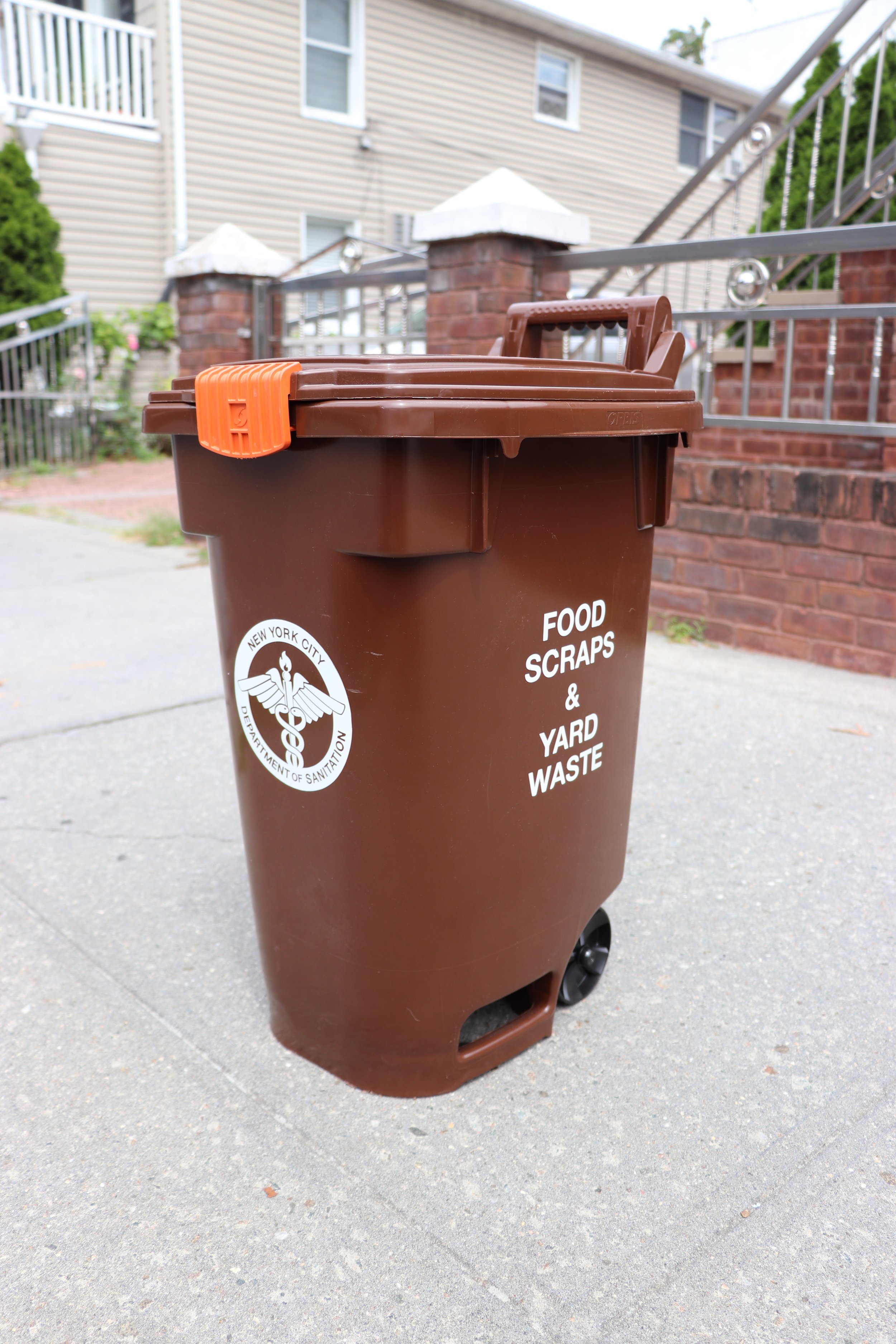
New York City is finally doing it. After years of pilot programs that felt like they were constantly starting and stopping, the Department of Sanitation (DSNY) has gone all-in on curbside composting. It’s mandatory now. If you live in Queens or Brooklyn, you’ve likely seen the brown bins multiplying on the sidewalks like some kind of eco-friendly invasion. Manhattan, the Bronx, and Staten Island are catching up fast. But honestly? Getting your hands on an official nyc sanitation compost bin and actually using it without turning your kitchen into a fruit fly circus is harder than the DSNY website makes it look.
It’s a massive shift for a city that has spent decades just throwing everything into black bags and hoping the rats don't get too fat. Now, we’re being asked to separate the chicken bones from the coffee filters. If you don't? You might get a fine. Eventually. The city is currently in a "warning period" for some boroughs, but the grace period won't last forever.
Why the NYC Sanitation Compost Bin is Suddenly Everywhere
For a long time, composting in New York was a niche hobby. You had to freeze your scraps and trek them to a greenmarket on a Saturday morning. It was a chore. But Commissioner Jessica Tisch and the current administration decided that the only way to tackle the city’s "rat buffet" was to take the food out of the trash bags and put it in locked, heavy-duty containers.
That’s what the nyc sanitation compost bin really is: a weapon against rats.
The bins are designed with a latch that—theoretically—racoons and rats can’t open. They’re made of a thick, reinforced plastic that’s harder to chew through than a standard trash can. When you put your scraps in there, you’re basically cutting off the food supply for the city’s most hated residents. It's not just about the environment; it's about making the sidewalks less gross.
How do you actually get one?
If you’re in a building with under 10 units, the city was supposed to just drop one off. Many people got theirs during the big rollouts in 2023 and 2024. But New York is chaotic. Bins get stolen. They get crushed by snowplows. Or maybe you moved into a new place and the previous tenant took the bin with them for some reason.
You can't just buy these at Home Depot. They are specific DSNY property. To get a replacement or a new one, you have to go to the DSNY website and fill out a form. Sometimes they have "bin giveaways" at local parks, which are great because you can just throw a small kitchen caddy in your bag and walk home. For the big brown bins, you usually have to wait for a delivery window.
The Reality of Food Scrap Logistics
Let's talk about the "ick" factor. People are terrified that a nyc sanitation compost bin is going to turn their building into a stinking mess.
Here is the secret: it only smells if you do it wrong.
If you just toss loose shrimp shells into a plastic bin and let them sit in the July sun for six days, yeah, it’s going to be brutal. But DSNY allows you to use liners. You can use clear plastic bags (they sort them out at the facility) or compostable bags. Most people I know who actually enjoy this process swear by the "freezer method." You keep a small bag in your freezer, toss your scraps in there throughout the week, and only bring it down to the big brown bin on collection night. No smell. No flies. No drama.
What goes in and what stays out?
The rules are actually surprisingly lax compared to backyard composting. Because NYC uses industrial-scale processing—including anaerobic digesters at Newtown Creek—they can handle things your backyard pile can't.
- Meat and bones? Yes.
- Dairy and cheese? Toss it in.
- Greasy pizza boxes? Absolutely.
- Leaf and yard waste? That too.
- Pet waste? NO. Absolutely not. Keep the kitty litter in the regular trash.
- Diapers? Come on, New York. No.
The Infrastructure Behind the Bin
When you see the DSNY truck tip that nyc sanitation compost bin into the hopper, it doesn't just go to a landfill. If it did, this would be a massive waste of taxpayer money. Most of it goes to one of two places.
Some of it heads to the Staten Island Compost Facility, where it's turned into "Big Apple Compost." This stuff is gold for gardeners. You can actually see it being used in city parks and community gardens. The rest goes to the Newtown Creek Wastewater Treatment Plant (those giant silver eggs you see from the Long Island Expressway). There, the food scraps are turned into biogas, which can heat homes or generate electricity.
It’s a circular system. It’s also incredibly complex. The city had to retrofit trucks and hire specialized staff to manage the "Organic Collection" routes. It’s one of the largest municipal composting programs in the world, dwarfing what they do in San Francisco or Seattle just by sheer volume.
Dealing With Your Landlord
This is where things get tricky for renters. In buildings with 10 or more units, the landlord is responsible for setting up a designated area for the nyc sanitation compost bin. They are required by law to provide these bins and to make sure they are set out on the right night.
Some landlords are great. They set up a clean station in the basement or the trash room. Others? Not so much. If your landlord is refusing to provide a bin or isn't setting it out, they are technically in violation of NYC administrative codes. You can report this via 311. However, before you go nuclear, it's usually better to just print out the DSNY flyer and tape it to the mailboxes. Sometimes they just don't know the rules have changed.
The "Smart Bin" Alternative
If you don't have a brown bin at your curb, or if you're worried about it getting stolen, look for the orange "Smart Bins" on street corners. These are high-tech versions of the nyc sanitation compost bin. You download an app (NYC Compost), it connects via Bluetooth, and the lid pops open.
These are honestly a godsend for people in small apartments. They’re emptied frequently, they’re basically rat-proof, and they take the pressure off of having to manage a bin on your own property. They are popping up everywhere, especially near subway stations.
Common Misconceptions That Need to Die
Everyone thinks composting is "gross." But trash is already gross. A black bag full of rotting meat sitting on a sidewalk is a buffet for vermin. A sealed nyc sanitation compost bin is a fortress.
Another myth is that it takes forever. It takes about five seconds to scrape a plate into a different bin. The friction is mostly mental. Once you get into the habit of separating "wet" trash from "dry" trash, your regular garbage doesn't even smell anymore. You end up taking the regular trash out less often because it’s mostly just plastic packaging and paper.
Also, people think the city isn't actually composting it. There's a lot of cynicism in New York. "Oh, they just throw it all in the same landfill." That’s just not true anymore. The DSNY is under intense scrutiny to prove this program works. They are tracking tonnages and reporting them publicly. The scale of the Newtown Creek operation alone proves they are serious about the biogas conversion.
How to Optimize Your Composting Setup
If you’re ready to stop procrastinating and start using your nyc sanitation compost bin, do it right. Get a decent kitchen caddy. You don't want a giant one; a 1.5-gallon bin is usually plenty for a small household.
- Line the bin. Use a BPI-certified compostable bag if you want to be extra eco-friendly, but a regular old plastic bag is fine for the city’s curbside program.
- Keep it cold. If you have room in the freezer, keep the scraps there. This is the ultimate "pro tip" for New York living.
- Add "browns" if it gets wet. If your bin is looking a bit swampy, toss in some shredded newspaper or a cardboard egg carton. It soaks up the moisture and keeps the smell down.
- Lock the lid. Always make sure the handle is pulled forward to lock the lid on the big brown bin. If you leave it loose, you’re just inviting the local wildlife to a party.
Taking Action Today
Don't wait for a fine to arrive in the mail. The city is getting serious about enforcement as we move through 2025 and into 2026.
If you don't have a nyc sanitation compost bin, your first step is to visit the DSNY website and check the schedule for your specific address. Every neighborhood has different pickup days. If you’re in a managed building, talk to your super. Ask where the "brown bin" is kept. If they don't have one, tell them to order one through the city—it’s free for most residential buildings.
Start small. Maybe just start by saving your coffee grounds and eggshells. Once you see how much space that saves in your regular trash, you’ll naturally start adding more. It’s a tiny change that, when multiplied by 8 million people, actually changes the physical chemistry of the city.
No more "leachate" (that gross trash juice) leaking out of black bags onto your shoes. No more rats the size of cats tearing through plastic. It starts with one brown bin. Use it.
Next Steps for New Yorkers
- Check your zone: Go to the DSNY "Find My Collection Day" tool to see when your organics are picked up.
- Request a bin: If your building is missing its nyc sanitation compost bin, submit a request via the DSNY website or call 311.
- Get the App: Download the NYC Compost app to locate the nearest Smart Bin for 24/7 drop-offs.
- Educate Neighbors: Print out a "What to Compost" sign and hang it in your building's trash area to avoid contamination fines.