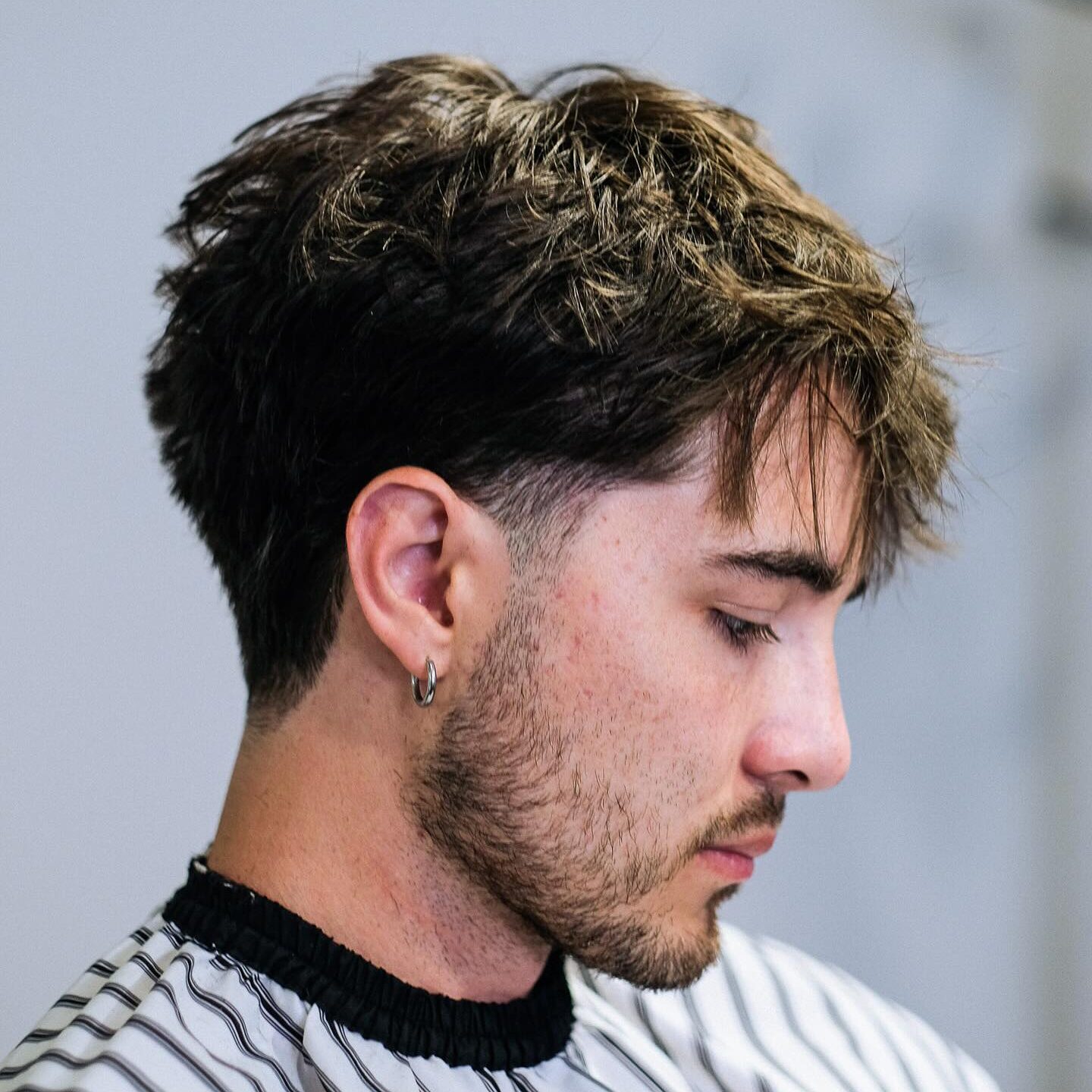
Straight hair is basically a blessing and a curse. You’ve got the shine, but you’ve also got the gravity. Most guys or girls with pin-straight strands know the struggle: you try for a messy look and five minutes later, it’s just lying there, flat, sad, and looking like a bowl cut from 1994. Honestly, that’s why the textured fringe haircut straight hair trend is such a game changer. It breaks up that heavy, curtain-like weight and actually gives your hair some personality.
Most people think you need curls or waves to pull off a fringe. Wrong. If you have straight hair, you just need a stylist who isn't afraid of thinning shears or a straight razor. It's about creating "pointy" ends instead of a blunt line across your forehead. If it’s cut straight across, you’re looking at a 12th-century monk vibe. If it's textured, you're looking like someone who just walked off a set in London or Seoul. Learn more on a connected issue: this related article.
Why the Textured Fringe Haircut for Straight Hair Actually Works
The biggest issue with straight hair is the lack of "interlocking" pieces. Curly hair sticks to itself. Straight hair slides. By getting a textured fringe haircut straight hair specialists focus on removing bulk from the internal layers. This isn’t just about the length at the bottom. It’s about "point cutting"—where the barber snips into the hair vertically—to create different lengths within the same section. This forces the hair to stand up and lean against other strands.
Think about it like this. If you have a stack of flat boards, they lay flat. If you have a pile of jagged sticks, they create volume and gaps. That’s texture. Additional reporting by Cosmopolitan delves into similar views on this issue.
It's also incredibly versatile. You can go for a "French Crop" style where the fringe is short and tight, or a "Korean-style" leaf cut where the fringe hangs down toward the eyes but looks airy rather than heavy. Celebrities like Timothée Chalamet (when he’s not rocking the curls) or various K-Pop idols have mastered this. They use the natural shine of straight hair to make the texture look intentional and high-end.
The Scissors Matter More Than the Pomade
You can buy the most expensive clay in the world, but it won’t fix a bad haircut. If your stylist just uses standard scissors and cuts a straight line, your hair will always look heavy. You need to ask for specific techniques.
- Point Cutting: This is the gold standard. They take a section of hair and snip into it at an angle. It creates a "sawtooth" edge.
- Channel Sliding: This is where the stylist slides open scissors down the hair shaft. It removes weight from the middle of the hair without changing the overall length.
- Razor Cutting: Using a straight razor gives the ends a feathered, "shredded" look that scissors sometimes struggle to replicate.
If you see them reach for the thinning shears, don’t panic, but make sure they aren't using them right at the roots. Overusing thinning shears on the ends of straight hair can make it look frizzy rather than textured. It’s a fine line.
Understanding Your Face Shape
Not everyone can pull off a massive, heavy fringe. If you have a very round face, a thick textured fringe haircut straight hair might make your face look even shorter. In that case, you want the sides tighter—maybe a high fade—and the fringe pushed slightly to one side.
If you have a long or oval face? You’ve won the lottery. A heavy textured fringe helps "shorten" the face and brings all the attention to your eyes. It’s basically a cheat code for better symmetry. Square faces also benefit because the messy texture softens the harsh angles of the jawline.
The Product Trap: What to Actually Use
Stop using gel. Seriously. Gel is the enemy of texture. It clumps straight hair together into wet-looking spikes, which is exactly the opposite of what a textured fringe should be. You want products that are matte or have a "natural" finish.
- Sea Salt Spray: This is your best friend. Spray it on damp hair and blow-dry while scrunching with your hands. It adds "grit." Straight hair is often too smooth, so the salt adds the friction needed for the hair to hold its shape.
- Matte Clay or Paste: Take a tiny amount—think half a pea—and rub it between your palms until it’s invisible. Then, "disturb" your hair. Don't comb it. Mess it up.
- Texture Powder: This stuff is magic. It’s a silica-based powder you shake onto your roots. It provides instant lift and a dry, "day-two" hair feel.
Maintenance is the Catch
The downside? Straight hair grows out very obviously. When a textured fringe starts to lose its shape, it happens fast. You’ll likely need a trim every 3 to 4 weeks to keep the ends looking "shredded" and prevent them from turning into a solid block of hair.
Also, the "morning-of" routine is real. You can’t really just roll out of bed. Straight hair likes to develop "bed head" cowlicks that defy physics. You’ll usually need to wet the front, blow-dry it into position, and then apply your product. It takes maybe five minutes, but it's a commitment.
Common Misconceptions
People think "textured" means "messy." Not always. You can have a very clean, professional-looking textured fringe haircut straight hair that just has a bit of movement. It doesn't have to look like you just got off a motorcycle. It just means the hair isn't a solid curtain.
Another myth is that you need thick hair. Actually, fine, straight hair benefits more from texture because it creates the illusion of density. When you remove weight, the hair becomes lighter and easier to lift.
Real-World Examples and Styles
Take the "Textured Quiff" hybrid. This is where the fringe is long enough to be pushed up but usually worn down and messy. It’s a favorite in modern barbershops because it’s low-risk. If you hate the fringe, you just put some wax in it and push it back.
Then there’s the "Cropped Fringe." Think Cillian Murphy in Peaky Blinders, but with more length on top and more "choppiness." It’s aggressive, masculine, and works perfectly with straight hair because it relies on the hair's natural tendency to lay forward.
If you're looking for something softer, look at the "Two-Block" cut. It’s huge in East Asia. The sides and back are shaved or faded, but the top is left long and draped over. To make this work with texture, the top layers are heavily thinned out so they "float" over the faded sides.
How to Talk to Your Barber
Don't just say "I want a textured fringe." That's too vague. Your barber’s idea of texture might be different from yours.
- Bring a photo. Seriously. Barbers love photos.
- Specify the length: "I want it to hit just above my eyebrows."
- Specify the sides: "Give me a mid-fade" or "Keep it tapered but not skin-tight."
- Ask for "no blunt lines." Use those exact words.
If they start cutting with the shears horizontal to your forehead, speak up. You want them cutting vertically.
Actionable Next Steps for the Perfect Fringe
Start by growing your hair out until it covers your eyes. You need length to create texture. If you cut it too short too soon, you won't have enough "weight" to play with.
Invest in a decent hair dryer with a concentrator nozzle. Texture in straight hair is 70% drying technique and 30% product. Use the "scrunch" method while drying—literally grab clumps of hair in your fist and blow heat on them. This creates artificial bends in the straight hair.
Finally, get a texture powder. Brands like Slick Gorilla or Uppercut Deluxe make versions that are affordable and last forever. A little shake on the roots, a quick tousle with your fingers, and your textured fringe haircut straight hair will actually stay up all day instead of collapsing by lunchtime.
Keep your scalp clean, too. Straight hair shows grease faster than curly hair, and oil will weigh down your fringe, turning your textured masterpiece into a flat mess. Wash with a volumizing shampoo, skip the heavy conditioner on your fringe, and you're good to go.