Confession: I spent years thinking Becky Bloomwood was just a cautionary tale about credit card debt. I was wrong. She’s an icon of optimism, even when her bank manager is literally hunting her down. If you’re just diving into Sophie Kinsella’s world, or maybe you’re a veteran re-reading because life is stressful and you need a laugh, getting the Shopaholic book series order straight is the first step to avoiding a massive narrative headache.
It’s easy to get lost. Between the movie adaptation, the spin-offs, and the fact that the titles sometimes change depending on whether you’re in New York or London, it’s a bit of a maze. But honestly, reading these out of order is like wearing horizontal stripes with a plaid skirt—it just doesn't work. You’ll miss the slow-burn evolution of Becky’s career, her chaotic but endearing relationship with Luke Brandon, and the way her family dynamic shifts from "overbearing" to "genuinely complicated." Don't forget to check out our recent post on this related article.
The Chronological Shopaholic Book Series Order
Let’s get the basics out of the way. You have to start at the beginning. No shortcuts.
The journey begins with The Secret Dreamworld of a Shopaholic (published in 2000). If you’re in the US, you probably know this simply as Confessions of a Shopaholic. This is where we meet Becky, a financial journalist who—ironically—knows nothing about managing money. She’s drowning in Visa bills while trying to convince herself that a Denny and George scarf is a "vital investment." It’s relatable. It’s cringey. It’s perfect. If you want more about the context of this, Glamour provides an excellent summary.
Next up is Shopaholic Takes Manhattan (2001). Some UK editions call this Shopaholic Abroad. Becky follows Luke to New York, and if you think she was dangerous with a British pound, wait until she gets her hands on a Macy’s card. This book is crucial because it bridges the gap between her life as a struggling Londoner and her transition into a global socialite/chaos-magnet.
Then comes Shopaholic & Sister (2004). This one is a bit of a tonal shift. After a massive honeymoon (detailed at the start), Becky comes home to find out she has a long-lost sister, Jess. The catch? Jess is a total minimalist who hates shopping. It’s a brilliant foil for Becky’s personality.
The Middle Years: Marriage and Motherhood
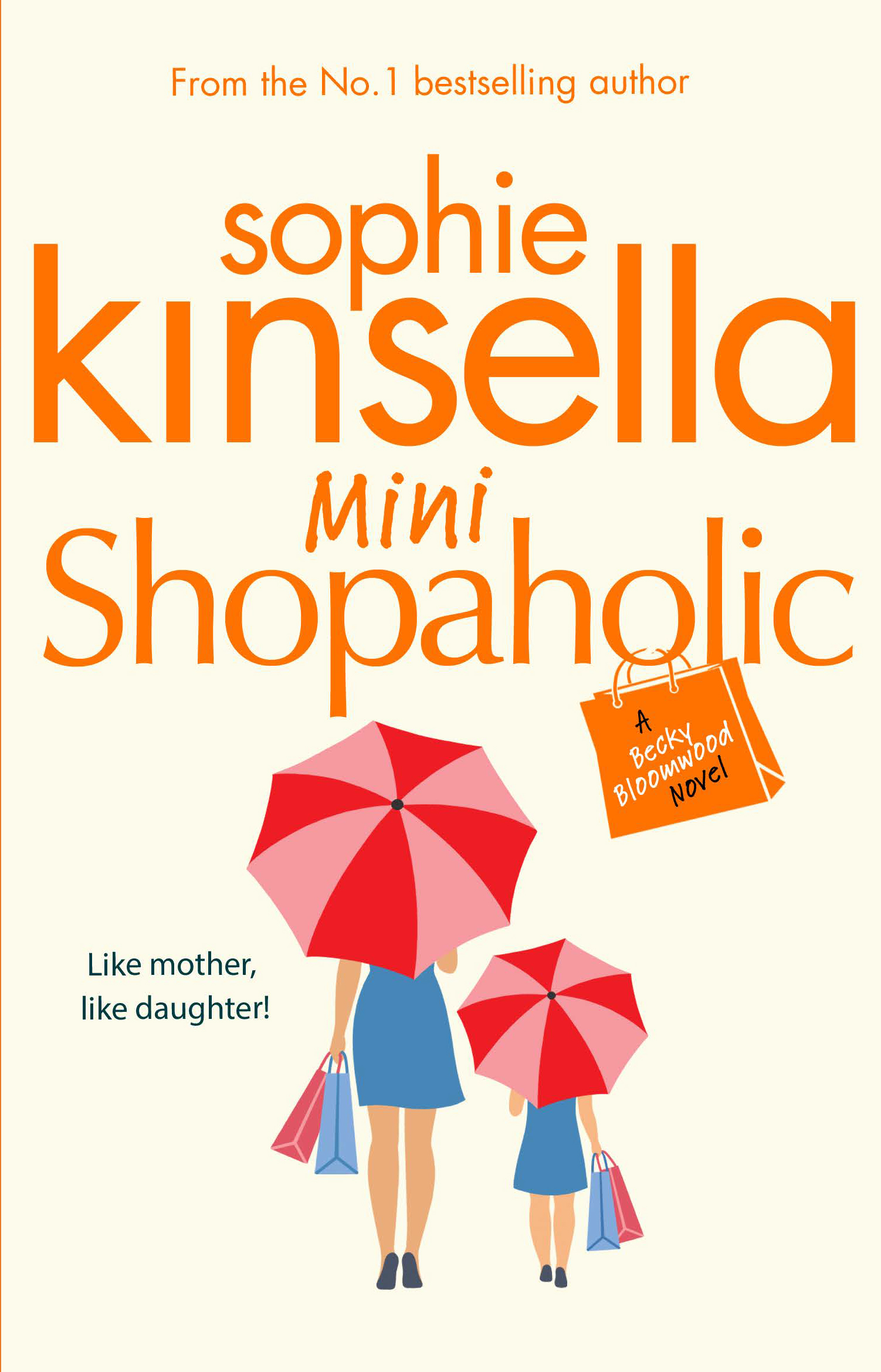
By the time you hit Shopaholic & Baby (2007), the stakes change. Becky is pregnant, and naturally, she thinks the baby needs a designer stroller that costs more than a used car. After this, we get Mini Shopaholic (2010), where we meet her daughter, Minnie. Watching Becky try to parent a toddler who has inherited her "must-have" genes is both hilarious and a little terrifying for anyone with kids.
There was a four-year gap before Shopaholic to the Stars (2014) arrived. This is where Becky moves to LA. It’s probably the most polarizing book in the series because Becky’s obsession with fame gets... intense. But you can't skip it because it leads directly into Shopaholic to the Rescue (2015). These two are basically a two-part story. If you read Stars and stop, you’ll be left on a massive cliffhanger.
The most recent full-length novel is Christmas Shopaholic (2019). It’s surprisingly cozy. It brings Becky back to her roots in a small village, trying to host Christmas for her demanding family. It feels like a "full circle" moment for the character.
Why You Can’t Just Skip Around
I’ve heard people say, "Oh, I’ll just read the Christmas one because it’s December."
Don't do that.
The Shopaholic book series order isn't just about the shops Becky visits; it’s about her character growth. Or lack thereof, sometimes. In the first book, Becky is incredibly lonely. Her shopping is a coping mechanism. By the middle of the series, she’s navigating the complexities of being a step-daughter, a wife, and a professional. If you jump straight to Shopaholic to the Rescue, you won’t understand why she’s wandering through the desert with her father and his mysterious best friend. It sounds absurd because it is, but it makes sense if you’ve followed the breadcrumbs.
Sophie Kinsella—whose real name is Madeleine Wickham—is a master of the "unreliable narrator." Becky truly believes her own excuses. When you read the books in sequence, you start to see the patterns in her logic. You start to anticipate the disaster before it happens. That’s where the joy is.
The "Shopaholic Ties the Knot" Confusion
Wait, I missed one. Shopaholic Ties the Knot (2002).
This is the third book in the sequence. It sits right between Manhattan and Sister. It’s arguably the peak of the series' slapstick comedy. Becky is trying to plan two weddings—one in London and one in New York—on the same day. It’s stressful just reading it.
The reason people get confused is that the movie Confessions of a Shopaholic (starring Isla Fisher) takes elements from the first two books but moves the setting entirely to New York. The movie Luke Brandon is a bit different from the book Luke Brandon. In the books, Luke is a high-powered PR mogul who is often quite stern and work-obsessed. The books give their relationship much more room to breathe and, frankly, more room to fail.
Dealing with the UK vs. US Title Changes
If you’re buying these second-hand or on Kindle, the titles can be a nightmare. Here is a quick reference to make sure you don't buy the same book twice under different names:
- Book 1: The Secret Dreamworld of a Shopaholic (UK) is the same as Confessions of a Shopaholic (US).
- Book 2: Shopaholic Abroad (UK) is the same as Shopaholic Takes Manhattan (US).
- Book 7: Shopaholic to the Stars is the same everywhere, thankfully.
Just check the publication dates if you’re unsure. If it says 2000, it’s the first one. If it says 2019, it’s the Christmas one.
The Financial Reality of Becky Bloomwood
Looking back at the early 2000s through Becky’s eyes is a trip. We’re talking about a time before Apple Pay, before Instagram influencers, and before fast fashion totally took over the world. Becky was doing "haul" content before YouTube even existed.
There’s a lot of debate among fans about whether Becky is actually a "good" person. She lies constantly. She manipulates her friends. She hides bills in the microwave. But Kinsella writes her with such vulnerability that you can't help but root for her. We’ve all had that moment where we bought something we didn't need to feel a little bit better for five minutes. Becky just takes it to an Olympic level.
What Most People Get Wrong About the Series
A common misconception is that these are "just chick-lit."
That’s a reductive way to look at it. The Shopaholic book series order actually tracks the shift in consumer culture over two decades. In the early books, Becky is obsessed with high-end boutiques and the "exclusivity" of brands like Suze’s favorite, Pucci. By the later books, the world has changed. The way Becky shops in Christmas Shopaholic—using online delivery and dealing with the pressures of "perfect" holiday hosting—is a mirror of how our own spending habits have evolved.
Also, people think the series ended years ago. It hasn't. While Kinsella has written many brilliant standalone novels (The Burnout, Love Your Life), Becky Bloomwood is a character she keeps coming back to. There is a depth to the world-building that you only see when you commit to the full list.
Your Shopaholic Reading Strategy
If you're ready to start, don't rush. These books are best enjoyed when you need a mental break.
- Start with Confessions. Even if you’ve seen the movie, the book is richer. The subplot about her neighbors and her job at Successful Saving is much more developed.
- Don't skip Shopaholic & Sister. It introduces characters that become staples in the later novels.
- Read the novellas if you can find them. There are short stories like Shopaholic on Honeymoon (often found as an ebook) that fill in the gaps between Ties the Knot and Sister.
- Pay attention to the letters. At the start of almost every chapter, there are letters from banks, debt collectors, or shops. They are often the funniest part of the book and provide a "real-world" context to Becky’s delusions.
The Shopaholic book series order is a roadmap of a woman trying to find her place in a world that tells her she is what she owns. It’s funny, it’s frustrating, and it’s surprisingly heart-centered. By the time you get to the end, you’ll probably want to go out and buy a green scarf. Just make sure you can actually afford it first.
To get the most out of your reading experience, track down the original UK covers if you're a collector; the illustrations by Britt Spencer are iconic and perfectly capture the whimsical chaos of Becky's life. Once you finish the main series, look into Sophie Kinsella’s standalone work like Can You Keep a Secret? to see how her style handles different tropes.