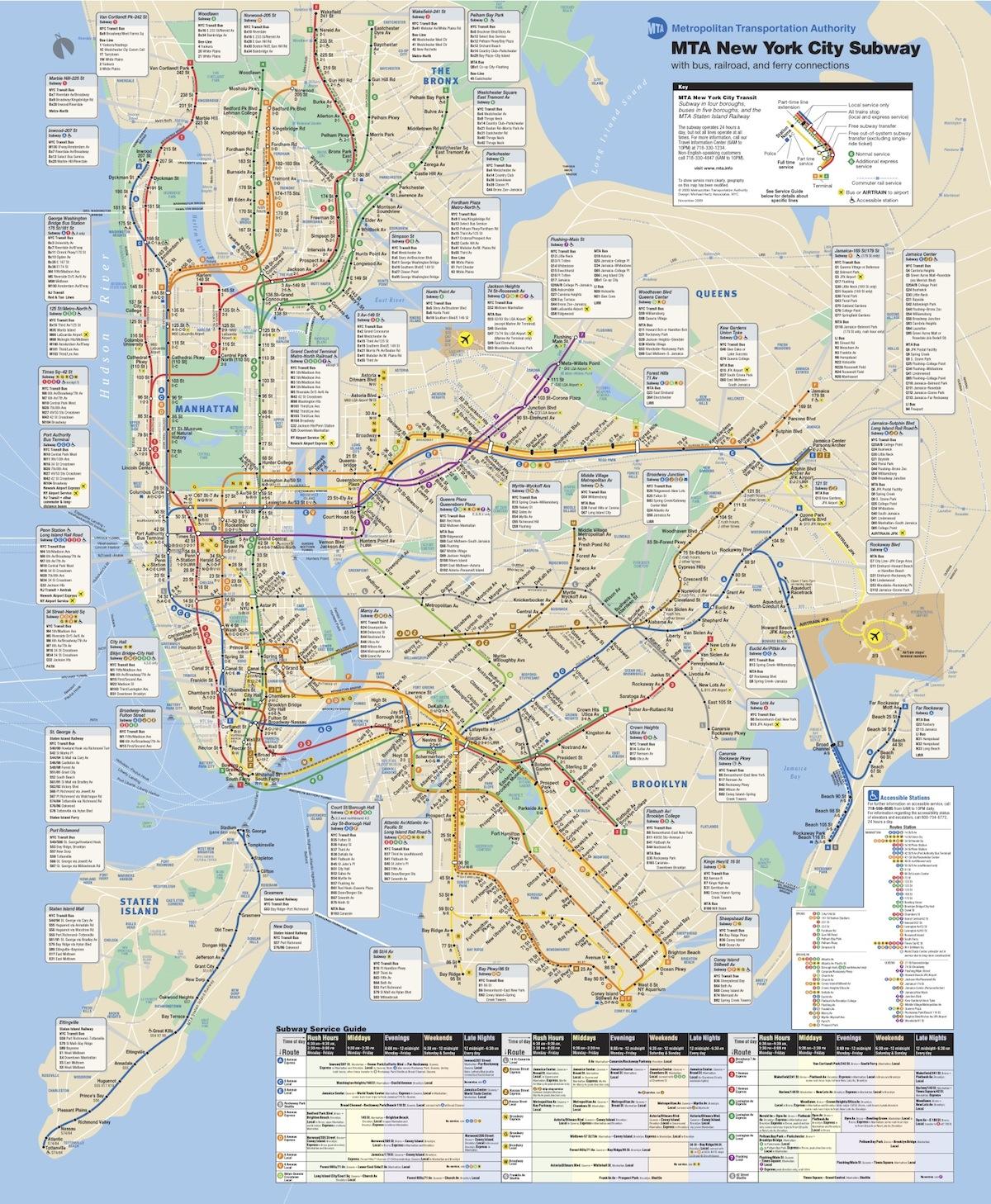
You’re standing on the platform at 59th Street-Columbus Circle. The ground starts to hum. Then, that low, gutteral roar echoes through the tunnel. If you see that blue "A" glowing on the side of the car, you aren't just getting on a train; you're boarding a piece of New York City mythology. Honestly, looking at an mta a train map for the first time is kinda intimidating. It stretches from the top of Manhattan all the way down to the Atlantic Ocean. It’s over 31 miles long. That makes it the longest one-seat ride in the entire New York City Subway system.
People call it the "Freedom Train," a nickname rooted in the Harlem Renaissance and Duke Ellington’s famous jazz standard. But for a commuter trying to get from Inwood to Far Rockaway on a Tuesday morning, it’s mostly just a test of patience. The A train is a beast. It’s an express line that acts like a local at night, a shuttle to the airport during the day, and a lifeline for neighborhoods that other trains simply don't touch.
Decoding the MTA A Train Map: Three Different Endings
If you look closely at the mta a train map, you’ll notice something weird happens once you get deep into Brooklyn. The line splits. This is where most tourists—and plenty of locals—mess up. One branch heads toward Lefferts Boulevard. Another goes to Far Rockaway-Mott Avenue. A third, which only runs during specific times or via a shuttle transfer at Broad Channel, goes to Rockaway Park-Beach 116th Street.
Imagine you’re trying to catch a flight at JFK. You need the Far Rockaway train to get to the Howard Beach-JFK Airport station. If you accidentally hop on the Lefferts Boulevard train, you’re going to end up in Richmond Hill, looking at a map and realizing you're about three miles away from where you need to be. It happens constantly. The conductors usually announce the destination, but with the screeching of the wheels and the general chaos of a crowded car, it’s easy to miss.
The Manhattan Stretch: Express vs. Local
In Manhattan, the A is the king of speed. It skips a ton of stops between 125th Street and 59th Street. We’re talking about a massive jump that saves you probably 10 to 15 minutes compared to taking the C or the B. But here’s the kicker: after about 11:00 PM, the A train turns into a local. It starts hitting every single stop. That quick trip from Midtown to Washington Heights suddenly feels like it’s taking an eternity. It’s a completely different experience depending on the time of day.
Why the A Train Route is So Unique
The mta a train map represents more than just transit; it represents the geographical diversity of New York. You start in Inwood, right near the hilly woods of Inwood Hill Park. You blast through the Upper West Side, fly through the West Village, and dive under the East River into Brooklyn.
Once you hit Brooklyn, the vibe shifts. You’re passing through Bedford-Stuyvesant and East New York. These are neighborhoods with deep histories and very different rhythms than Manhattan. Eventually, the train leaves the underground tunnels entirely. It climbs up onto elevated tracks. You can see the rooftops of houses, backyard gardens, and eventually, the vast marshlands of Jamaica Bay.
The Broad Channel Crossing
This is easily the most beautiful part of any subway ride in the city. Between Howard Beach and Broad Channel, the A train actually travels over the water. You look out the window and you’re surrounded by wetlands and birds. It doesn’t feel like New York City anymore. It feels like you’re on a train across a coastal wilderness. If you’re lucky enough to catch this at sunset, the light reflecting off the water is genuinely incredible.
Common Mistakes People Make with the A Train
Ignoring the "S" Shuttle: During summer weekends, the MTA often runs a shuttle (the S) between Broad Channel and Rockaway Park. People get confused and think the A train will take them all the way to the beach at 116th Street every time. Usually, you have to transfer.
Mixing up the A and the C: They share the same blue color on the map. They share the same tracks in Manhattan. But the C is local. If you’re in a rush to get to Canal Street and you jump on a C because it’s "blue," you’re going to be stopping at every 23rd, 50th, and 81st Street station along the way.
The Fulton Street Maze: Transferring at Fulton Street in Lower Manhattan is like trying to solve a Rubik's Cube. The mta a train map shows it as a single dot, but in reality, it’s a massive complex of interconnected tunnels. Give yourself an extra five minutes just to find the right staircase.
The Reality of Delays and Maintenance
Let’s be real. The MTA is old. Like, over-a-hundred-years-old. Because the A train is so long, a problem in the Bronx (where the D train shares tracks) or a signal failure in Queens can ripple across the entire line. The MTA's "Weekender" updates are your best friend here. They’re constantly doing track work, especially on the South Brooklyn and Queens sections. Sometimes the A train won't even go to Manhattan; it might be rerouted over the F line or just stop at Jay Street-Metrotech.
You’ve got to check the digital screens on the platform. Don’t just trust the printed mta a train map on the wall. Those maps are the "ideal" version of the subway. The reality is often a guy in an orange vest telling you that you have to take a shuttle bus for the next three stops.
Navigating the Rockaways
If your goal is the beach, the A train is your best bet, but it requires a strategy. Most people head for the 67th Street or 90th Street stops for the main boardwalk area. If you want a quieter vibe, you take the A to the shuttle and head out to the 116th Street end.
The Rockaway section of the line is actually an old Long Island Rail Road right-of-way that the city bought back in the 1950s. That’s why it feels so different from the rest of the system. The stations are wider, and the air smells like salt. It’s a weirdly peaceful conclusion to a train ride that starts in the dense urban canyons of Upper Manhattan.
Practical Tips for the Savvy Rider
- Download the MYmta App: It’s better than Google Maps for real-time diversions. It shows you exactly where the "blue" train is currently located.
- The "LIRR" Hack: If the A train is completely messed up in Queens, you can sometimes take the Long Island Rail Road from Far Rockaway or Jamaica and get to Penn Station way faster, though it costs more.
- Stand Near the Middle: In Manhattan, the exits at major stations like 42nd Street are spread out. Standing in the middle of the train usually puts you closest to the stairs at most stops.
- Check the destination sign on the car: Seriously. Look at the side of the train before you step in. It will say "Lefferts Blvd" or "Far Rockaway."
The mta a train map isn't just a piece of paper; it’s a guide to the city’s longest artery. Whether you’re a tourist heading to the One World Trade Center or a local heading home to Ozone Park, understanding the quirks of the A train makes the difference between a smooth ride and a two-hour headache.
Next Steps for Your Trip: Before you head out, pull up the live service status on the MTA website to ensure there isn't a "planned service change" turning your express ride into a local bus. If you're heading to JFK, make sure your train specifically says "Far Rockaway" on the side LED display. Pack a pair of headphones—it's a long ride, but it's the best way to see the true scale of New York City.